


I come from the royal family of Kalabari land. My name, Amachree, is the name of the dynasty that has sat on the Kalabari throne for centuries, since King Amachree. I consolidated the kingdom and gave it the line of succession that endures to this day.
My grandfather, Chief Sekin Amachree, sat at the table in London in 1958 when Nigeria negotiated its independence. My father, Chief Godfrey Kio Jaja Amachree QC, was Nigeria’s first Solicitor-General and the first African Under-Secretary-General of the United Nations.
I do not say this to boast. I say it so the reader understands that when I speak about the Kalabari throne, I am not speaking as a spectator. I am speaking about my family’s house.
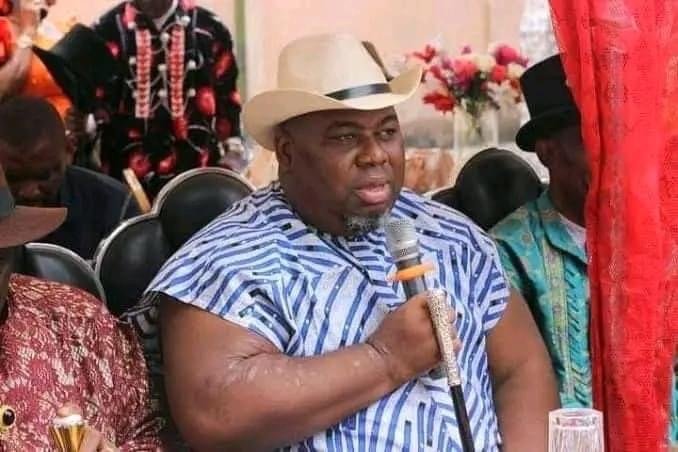
So imagine my confusion, watching from Stockholm, as video after video crosses my screen of Mujahid Asari Dokubo parading himself as a Kalabari king, draped in coral and velvet, receiving homage, installing chiefs, staging regattas.
This is a man the world first met as a militant leader in the creeks of the Niger Delta. A man who, in recent years, has become better known for viral videos in which he taunts the Igbo people with the language of slavery, boasts of his willingness to deal violently with his enemies, and positioned himself as an enforcer for the political fortunes of President Bola Tinubu. How does such a man become a king?
The technical answer is that he did not become the Amanyanabo of Kalabari. The throne of my ancestors, seated in Buguma, remains what it has always been. What Mr. Dokubo received, on the last day of 2024, was a staff of office as Amanyanabo of Elem Kalabari, styled as the ancestral source of the Kalabari people, handed to him not by the custodians of tradition acting in serene consensus, but at Government House in Port Harcourt, by a sitting state governor.
He justified it with a genealogical claim of descent from Amakiri, the founder before the Amachree line. Claims of this kind are easy to make and hard to test, and in Nigeria they are rarely tested at all when the claimant is politically useful.
And that is the real story. Not one man’s coral beads, but the machinery that produced them. Across Nigeria, traditional stools are being minted, revived, upgraded and conferred at a pace that would embarrass a diploma mill. Governors hand out staffs of office the way party chairmen hand out nomination forms. Businessmen with questionable fortunes collect chieftaincy titles in a dozen kingdoms they could not find on a map.
Universities that cannot pay their lecturers sell honorary doctorates to the same men. I have written before about Nigeria’s title culture, this national addiction to prefixes, and the kingship inflation is its most dangerous strain, because a throne is not a certificate. A throne carries the moral authority of a people. When it is handed to a man whose public record is intimidation, ethnic taunting and political thuggery, that authority is not transferred to him. It is drained from the institution.
Consider what a traditional ruler is supposed to be. He is the father of all his people, including the strangers in his midst. The Kalabari kingdom my father raised me to revere was a trading civilization, one that grew wealthy and powerful precisely because it welcomed the world to its waterways.
The Igbo trader in a Kalabari market was under the king’s protection. What, then, are we to make of a self-styled Kalabari monarch who entertains millions online by describing an entire ethnic nation as his slaves? This is not eccentricity. It is a repudiation of the very idea of kingship. A man who preaches hatred cannot be a father of anyone.
Also see: Bera Community Gets Solar-Powered Borehole as NYCN Advocates Grassroots Development
And consider the politics. A traditional ruler is meant to stand above the partisan fray, so that when the community fractures, someone remains whom all sides can trust. Mr. Dokubo, by contrast, announced himself as a warrior for one presidential candidate and promised consequences for those who stood in the way. When the reward for such loyalty arrives in the form of a staff of office from a friendly Government House, every Nigerian can do the arithmetic. The crown becomes a receipt.
I am often asked why I write these columns from so far away, and whether a man in Stockholm has any business commenting on the affairs of the creeks. My answer is that distance is precisely what allows one to see the pattern.
The counterfeit kingship is the same disease as the phantom agencies, the no-bid contracts, the honorary degrees, the ghost workers. It is the substitution of performance for substance, of noise for legitimacy. Nigeria is being governed, at every level, by men who have discovered that in the absence of functioning institutions, the appearance of authority works almost as well as the real thing, and costs far less to acquire.
The Kalabari people deserve better. Nigeria deserves better. Thrones that took six centuries to build should not be counterfeited in an afternoon at Government House. The chiefs, elders and custodians of Kalabari tradition should say plainly what many of them whisper privately, that legitimacy cannot be conferred by a governor’s photograph, and that a kingdom’s honor is not for rent.
The rest of Nigeria should understand that this is not a quaint quarrel over beads and canoes. A country that lets bullies buy its crowns will soon find that it has nothing left that money and menace cannot take. My family has guarded this throne for six hundred years. We did not guard it so that it could become a costume.
Kio Amachree
