


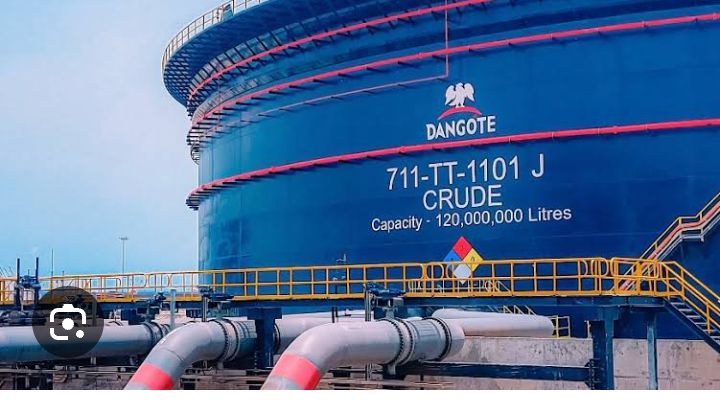
The chairman of the Alliance for Economic Research and Ethics LTD/GTE, Dele Oye, has ascertain that the Dangote Petroleum Refinery has the capacity to save Nigeria N15 trillion per year in foreign exchange from fuel importation costs while earning the country about $11 billion per year from refining activities and exportation of products.
He called on the Nigerian National Petroleum Company Limited (NNPCL) to focus more on supporting domestic refineries rather than putting them into foreign competition during the legal battle between the company and Dangote Refinery.
Speaking in a press release, Oye criticized NNPCL for defending fuel import permits, stating that this attitude does not favor Nigeria’s push towards energy independence.
Nigeria spent about N15.42 trillion on the importation of petrol in 2024, according to Oye, and termed it an indication of weakness in Nigeria’s energy sector that continues to affect its foreign exchange earnings.
According to Oye, with the capacity of 650,000 barrels per day, the Dangote refinery is fully equipped to meet over 90 per cent of Nigeria’s fuel requirement if completely integrated into the national fuel supply network.
Oye also noted that by adopting an approach of depending more on domestic refineries, there would be potential savings of about $11 billion per year, reducing pressure on the naira and improving economic stability.
Furthermore, Oye criticised the statement from NNPC that fuel importation is important to foster competition, and that the policy will only increase Nigeria’s dependency on foreign refining while limiting local industries.
“Giving licence to foreign products while having an available domestic refinery to meet the need is punishing the investors of the refinery and giving rewards to the ones that import,” Oye stated.
Oye asserted that the PIA 2021 and Nigerian Oil and Gas Industry Content Development Act give primacy to domestic refining and domestic value addition and that importation is meant to act as complementary support where domestic capacity is deficient.
He challenged NNPCL on their claims regarding monopoly, reminding that the company is heavily dependent on foreign logistics while cautioning about the dominance of a private refinery.
Oye in an interview aired by Arise News stated that NNPCL’s mandate lies in boosting domestic refining and eliminating obstacles that block the entry of local investors into the oil industry.
This disagreement emerged when NNPCL was opposed to Dangote Refinery’s case in court challenging the issuing of import licenses to other fuel marketers.
In its arguments before the court, NNPCL contended that the import ban could lead to monopolistic tendencies and disruption of supplies.
But according to Oye, this was not true since the reality of the matter is that the Dangote Refinery has disrupted NNPCL’s monopoly in importing fuels.
