


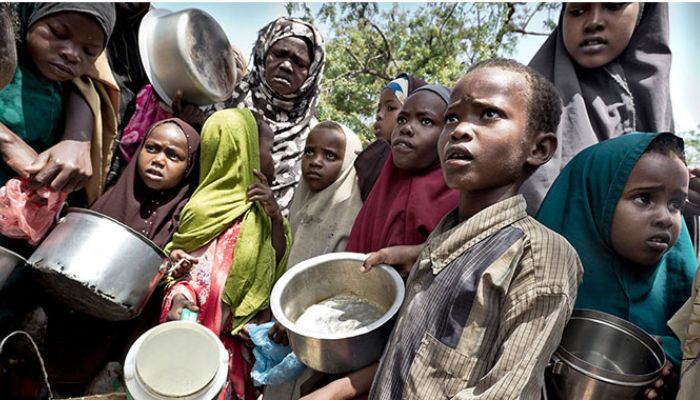
Nigeria has broken a record it should be ashamed of. Nearly 35 million people are projected to face severe food insecurity during this year’s lean season, the highest hunger level ever recorded for this country, and the highest anywhere in Africa. Not the worst in a decade. The worst ever measured. And the country’s response so far has been a shrug dressed up as a strategy.
Let that number sit for a moment. Thirty-five million is more than the population of Ghana. It is close to the population of Canada. It is not a statistic from a warzone thousands of kilometres away; it is Nigerians, in Nigeria, who by June will not reliably know where their next meal is coming from.
The official explanation leans hard on conflict, insurgency and banditry displacing farmers, disrupting planting seasons, emptying granaries in the north. That’s real, and it matters. But conflict alone doesn’t explain a national record. Climate shocks, currency depreciation, fuel-subsidy fallout and a food distribution system with no real redundancy have all stacked on top of the violence. When four or five separate failures compound at once, what you get isn’t bad luck. It’s a system with no shock absorbers, run by a government that keeps discovering this the same way every year, with a press release, not a plan.
Here is the part that should embarrass Nigeria specifically: the safety net was never built to be Nigerian in the first place. The World Food Programme, which has quietly kept famine at bay in the hardest-hit northern communities for years, says it needs over eighty-nine million dollars just to keep operations running through the coming months, and that funding is drying up as donor countries cut humanitarian budgets.
A country does not get to call itself an emerging economy while depending on other nations’ charity to feed its own citizens. Every year this arrangement holds, the government spends less time asking how to grow, store, and move food efficiently within its own borders, and more time hoping somebody else’s budget covers the gap. That is not a food policy. That is a bet, and this year the bet did not pay off.
What would an actual policy look like? Strategic grain reserves that get released before a crisis peaks, not after. Investment in irrigation and storage in the food-producing middle belt so one bad rainy season doesn’t collapse supply nationwide. Security spending redirected toward actually protecting farming communities in the north, since a farmer who cannot safely reach his field produces nothing, no matter how much fertilizer subsidy exists on paper. None of this is too much. Other food-insecure nations have built exactly these systems. Nigeria has mostly built press briefings.
Thirty-five million hungry people is not a talking point for the next election cycle. The question this record should force onto every front page, every legislative floor, and every governor’s desk is simple: if this is the worst hunger crisis ever recorded here, what number would it finally take for hunger to become a governance priority instead of a seasonal news story?
