


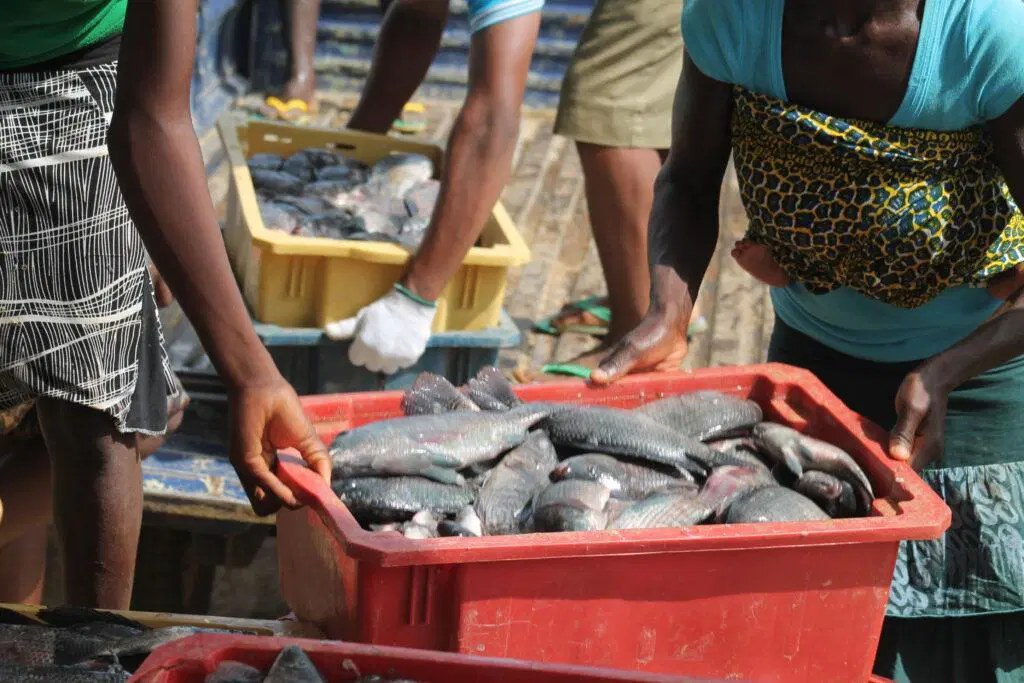
The Federal Government has secured a $200m commitment from the World Bank Group to increase fish production and reduce Nigeria’s dependence on imported fish.
The funding will be made available to state governments as concessional loans. It will support fisheries and aquaculture development, attract investors and help close the country’s fish supply gap.
The Minister of Marine and Blue Economy, Dr Adegboyega Oyetola, announced this in Abuja at a training programme on the Aquaculture Investment Guide. The Federal Ministry of Marine and Blue Economy organised the programme in partnership with the World Bank Group.
The training brought together policymakers and technical officials from across the country. Participants included commissioners from Rivers, Bayelsa, Delta and Cross River States, as well as permanent secretaries and directors of fisheries and aquaculture.
The programme focused on helping state governments develop bankable aquaculture projects. It also covered business models, risk management, environmental protection and public-private partnerships.
Oyetola, who was represented by the Senior Special Assistant to the President on Marine and Blue Economy, Professor Busayo Fakinlede, said states must play a stronger role in boosting local fish production.
Read Also: dangote-cement-turns-football-into-tool-for-host-community-unity
He described fish as an important source of food, nutrition and income for millions of Nigerians. He added that the country must produce more fish locally, reduce imports and work towards becoming a net exporter.
Nigeria needs about 3.6 million tonnes of fish every year but produces only 1.4 million tonnes. This leaves a supply gap of more than 2.2 million tonnes.
The country depends heavily on imported fish to meet this demand. These imports cost Nigeria nearly $1bn in foreign exchange every year.
To address the shortage, the ministry is introducing a state-driven aquaculture development plan. Under the plan, each state will identify key areas for fish production, assess investment opportunities and develop projects that can attract funding.
States will also be expected to set clear production targets and contribute to the national goal of achieving fish sufficiency.
The $200m World Bank support is expected to help states expand fish farms, improve production capacity and attract private investment.
Oyetola commended the World Bank for supporting Nigeria’s marine and blue economy through research, capacity building, cluster development and the Aquaculture Investment Guide.
He also pledged to turn the training into practical results. According to him, he will lead a stakeholders’ meeting after the programme to strengthen cooperation with state governments and other partners.
The minister further highlighted Nigeria’s achievement of shrimp-export certification through compliance with Turtle Excluder Device requirements. He also mentioned the development of the Fish City and Fish Terminal investment portfolio as part of efforts to attract private investors.
Oyetola expressed confidence that increased investment and cooperation would help Nigeria close its fish supply gap, create jobs, improve household incomes, and strengthen food security.
