


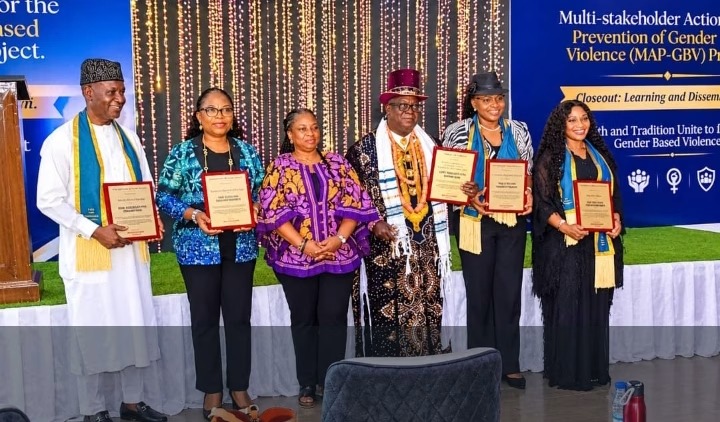
ActionAid Nigeria has reached more than 528,000 people in Rivers, Osun and Anambra States through its Multi-Stakeholder Action for the Prevention of Gender-Based Violence (MAP-GBV) Project, aimed at reducing gender-based violence (GBV) and creating safer communities for women and girls.
The project adviser, Ademola Adeniran, disclosed this at the project’s close-out ceremony in Port Harcourt, explaining that the initiative, supported by the Ford Foundation, strengthened collaboration among government institutions, traditional rulers, religious leaders, civil society organisations and community groups to prevent violence against women and girls.
Adeniran said the project recorded 528,191 beneficiaries, comprising 5,441 direct and 522,750 indirect beneficiaries across the three states.
He added that the intervention covered 74 Local Government Areas and 225 communities, secured 167 GBV prevention pledges from traditional rulers and developed 46 action plans for communities and places of worship.
According to him, six costed work plans of multi-stakeholder committees were implemented, while three state-level committees were operationalised to coordinate gender-based violence prevention efforts.
On community engagement, Adeniran said 120 female cultural influencers were strengthened, while 1,110 women received support to participate in grassroots GBV prevention activities. These interventions, he noted, contributed to the resolution of 2,814 gender-based violence-related issues.
The project also engaged more than 250 traditional and community gatekeepers and over 120 religious leaders to challenge harmful cultural and religious practices that encourage violence against women and girls.
One of the major achievements in Rivers State was the community-led abolition of Female Genital Mutilation (FGM) in Rumudele, Emohua Local Government Area.
Adeniran said the community, led by its Paramount Ruler, Eze Demian Ejiohuo, mobilised more than ₦10 million to support alternative transition rites and livelihood opportunities, leading to the official abolition of the harmful practice.
Read Also: johesu-threatens-fresh-strike-over-fgs-failure-to-implement-conhess-agreement
He also highlighted increased public awareness of GBV prevention, stronger commitments from traditional rulers, and the establishment and passage of community by-laws to address harmful socio-cultural practices.
Among these efforts was the involvement of the Paramount Ruler of Eugenni Kingdom in Rivers State, HRM Moore Ubuo MacLean, in promoting community measures to end harmful practices.
On disability inclusion, Adeniran disclosed that the project recorded 478 women and 423 men with disabilities among its direct beneficiaries, while seven persons with disabilities were specifically empowered and safeguarded through the intervention.
He said the project also partnered with the Joint National Association of Persons with Disabilities (JONAPWD) in Osun State and reached approximately 782 people through disability-rights engagement in Anambra State.
In Rivers State, collaborations with FAECARE and JONAPWD strengthened disability inclusion and advocacy within the GBV prevention programme.
Other achievements included the development of a peer-learning manual for traditional, religious and cultural influencers, as well as the integration of gender-based violence prevention messages into sermons and other faith-based activities.
Adeniran identified initiatives such as the Dinner with the Kings intergenerational dialogue, engagement with female cultural influencers and the Centre of Excellence Award Challenge as strategies that encouraged community ownership and positioned influential local actors as champions of GBV prevention.
He acknowledged that building trust with traditional institutions required sustained engagement, while changes in social attitudes and cultural practices were sometimes difficult to measure immediately.
He said ActionAid addressed these challenges through early engagement with community gatekeepers, continuous communication, flexible implementation timelines and improved documentation of project outcomes.
On sustaining the achievements, Adeniran called for the preservation of indigenous leadership structures, replication of successful interventions at the grassroots, continued operation of community watch teams and integration of GBV prevention into permanent civic and religious institutions.
He also stressed the importance of local financial mobilisation to ensure that communities continue to support efforts to prevent gender-based violence after the project’s closure.
The MAP-GBV Project was implemented by ActionAid Nigeria in Rivers, Anambra and Osun States with support from the Ford Foundation to strengthen coordinated action among government agencies, traditional and religious institutions, civil society organisations and community stakeholders in preventing gender-based violence.
