


Some teachers and schools are breaking the pot to cook the stew. In the name of discipline, they reach for a sledgehammer to kill a fly, punishing small mistakes with public shame, harsh canning, or suspension that does more harm than the offense itself.
A 16-year-old sits at the centre of a case that should trouble every parent who has ever trusted a school with their child.
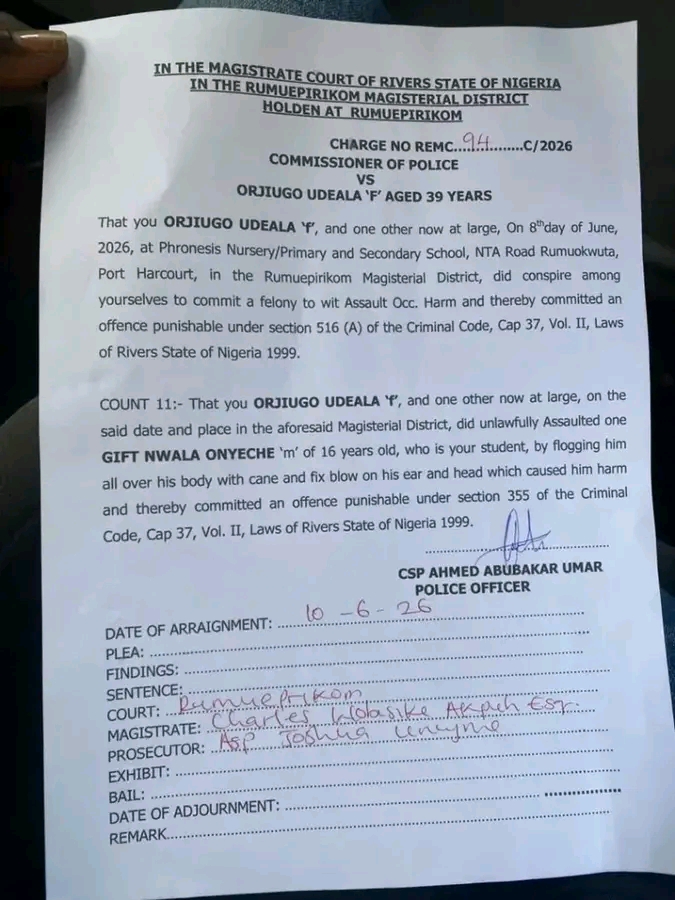
On June 8, 2026, something happened inside Phronesis Nursery, Primary and Secondary School along NTA Road, Rumokwuta. Two days later, the school’s proprietress, Mrs. Orjiugo Udeala, stood before a Magistrate Court in Port Harcourt, charged with conspiracy and assault occasioning harm against one of her own students, a 16-year-old boy named Gift Nwala Onyeche.
The charge sheet says he was flogged with a cane, struck on the ear and head, and left with bodily harm. An accomplice, still at large, is said to have participated.
We do not yet know what Gift did. That detail, conspicuously absent from the charge sheet, sits at the heart of this story like an unanswered question.
Did he speak out of turn? Arrive late? Fail a test? Whatever the provocation, if any, the law is unambiguous: no infraction by a 16-year-old child justifies blows to the head. None. Yet that missing detail matters precisely because it will likely become the centrepiece of the defence.
Also Read: http://NITDA, NISO Explore Partnership For Digital Transformation Of Smart Energy in Nigeria
When the case resumes on August 10, 2026, before Magistrate Charles Wobisike Akpeh, expect the narrative to shift from what was done to Gift to what Gift may have done first. It is a familiar legal maneuver in cases involving authority figures. The victim’s conduct becomes the defendant’s alibi.
Mrs. Udeala has pleaded not guilty and has been granted bail at ₦100,000, a sum modest enough to raise its own questions about how seriously the system weighs violence against minors. An advocacy group, Lawyers Watch for Justice International Initiative, has reportedly monitored the case from the police investigation stage through to arraignment.
Their presence is both reassuring and telling: without civil society watching, cases like this have a way of quietly dissolving. Schools in Rivers State, and across Nigeria, operate under an unspoken compact with parents: we will discipline your children, but we will not harm them.
Corporal punishment occupies a legally and morally contested space in Nigerian education, but there is a line between discipline and assault.
The question now is whether Rivers State’s judiciary will honour that distinction. A bail, a plea of not guilty, and an adjournment are not justice; they are procedures.
Justice will only be served if the court follows the evidence wherever it leads, protects the child at the centre of this case from further intimidation, ensures the second accused does not remain conveniently “at large” through August, and delivers a verdict that sends an unambiguous message to every school proprietor in Obio/Akpor and beyond.
Gift Nwala Onyeche is 16. He went to school. He deserves to know that the institution built to educate him cannot also be permitted to harm him without consequence.
