


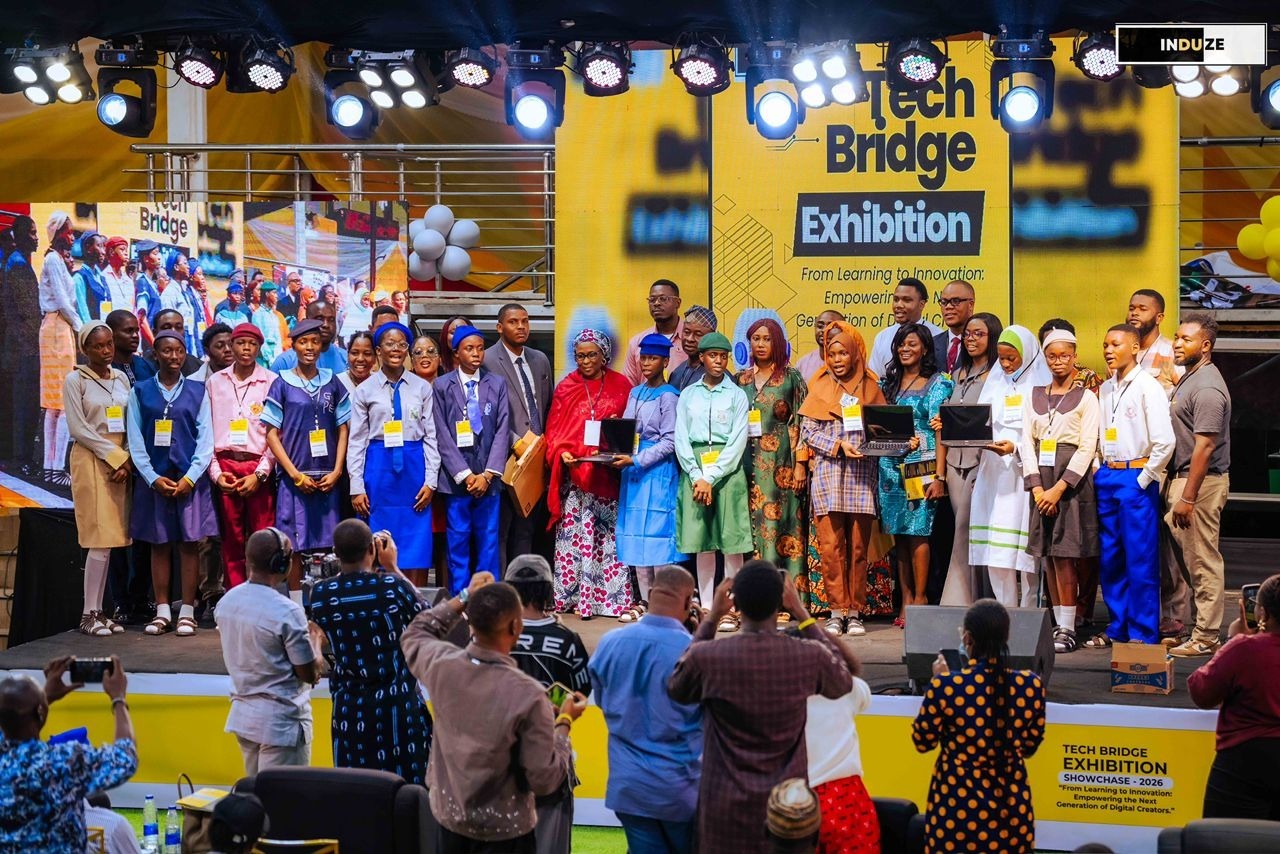
Hundreds of young learners across the Federal Capital Territory have taken a significant step toward becoming future innovators following the successful completion of the Tech Bridge Exhibition, a digital education initiative organised by the Induze Tech Foundation.
The programme, designed to prepare secondary school students for opportunities in the digital economy, brought together participants from more than 42 schools across Abuja’s six Area Councils—AMAC, Bwari, Gwagwalada, Kuje, Abaji, and Kwali.
After months of intensive learning and project development, the initiative culminated in a large-scale exhibition where students presented technology-driven solutions aimed at addressing real-life challenges within their communities.
The Tech Bridge programme was delivered in three stages: digital skills training, capstone project development, and a final exhibition. Through this process, students were exposed to practical learning experiences that encouraged creativity, critical thinking, problem-solving, and innovation.
One of the most remarkable outcomes of the initiative was the presentation of more than 50 student-led projects, demonstrating how young people can leverage technology to develop solutions with real-world impact.
The exhibition attracted widespread participation, with over 3,000 students joining both physically and virtually. Organisers said the strong turnout reflects growing interest in technology education and highlights the increasing demand for practical digital learning opportunities among young Nigerians.
Speaking during the event, representatives of the Foundation noted that the programme was created to address the widening gap between conventional classroom education and the skills required in a rapidly evolving digital economy.
According to them, exposing students to hands-on digital experiences is essential for preparing them for future careers and helping them compete in an increasingly technology-driven world.
A major highlight of the event was the official launch of the Induze Hub (iHub), a new innovation and digital learning centre established by the Foundation at Government Secondary School, Gwarimpa (Lifecamp), Abuja.
The facility is expected to serve as a comprehensive technology and innovation ecosystem for students and educators. It features a Computer-Based Testing (CBT) Centre, a Robotics and STEM Innovation Laboratory, a co-working and professional development space for teachers, and a digital content creation studio.
The Foundation explained that the hub was created to support the implementation of Nigeria’s evolving digital technology curriculum while providing schools with access to modern learning tools and resources.
Beyond serving as a physical structure, the organisation described the Innovation Centre as a platform for expanding access to opportunities, nurturing creativity, and equipping young people with the skills required to succeed in the digital age.
Several government officials, education administrators, and development stakeholders attended the unveiling ceremony.
Among them were Ronnel Gambo Dolla, Deputy Director supervising the Gender Unit at the Federal Ministry of Science, Technology and Innovation, representing the Minister; Hajia Fatima Gambo Bubba, Director and Secretary of the FCT Secondary Education Board; and Abubakar O. Ajayi, Principal of Government Secondary School, Gwarimpa.
Other dignitaries included Dr. Sampson Ebimaro, Director of the International Cooperation Department at the Federal Ministry of Budget and National Planning; Akure B. Jerry of the Federal Ministry of Youth Development; Omotowa Victor Opeyemi and Ojukwu M. Michael from the Federal Ministry of Education Headquarters; and Mrs. Nkwocha Angela from the Federal Ministry of Women Affairs.
With the successful launch of the Innovation Centre, the Foundation is now seeking support from government agencies, private sector organisations, development partners, philanthropists, and educational institutions to expand its reach and deepen its impact.
According to the organisation, collaborative investment in education technology and innovation infrastructure will be crucial in ensuring that Nigerian students are adequately prepared for the demands of the future workforce.
The Foundation stressed that empowering young people with digital knowledge and practical skills is no longer a luxury but a necessity in today’s world.
“Technology education is no longer optional. It is essential. By investing in young people today, we are building the innovators, creators, and problem solvers of tomorrow,” the Foundation stated.
As Nigeria continues its push toward a knowledge driven economy, initiatives such as Tech Bridge are increasingly being viewed as important platforms for nurturing the next generation of technology leaders and innovators.
