


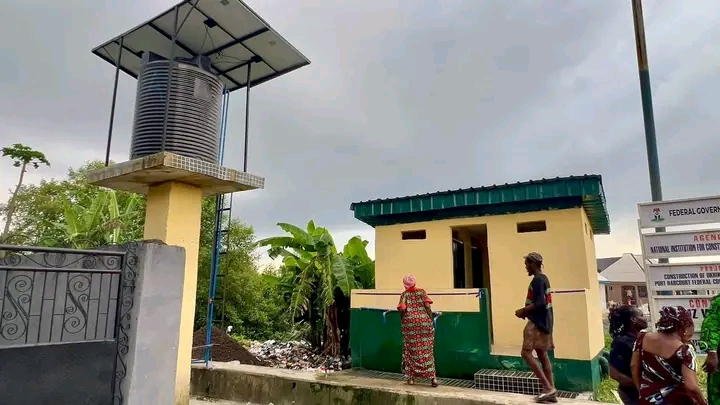
When a federal lawmaker’s headline contribution to his constituency is a public toilet, something has gone extremely wrong with Nigeria’s idea of representative governance. Hon. Manuchim Umezuruike, member representing Port Harcourt Federal Constituency 1 in the House of Representatives, recently commissioned the Okrika Waterfront Toilet Project as his signature offering to a community long abandoned by the state. It is an insult dressed as an intervention.
This is not development. A toilet too small to even qualify as public, a borehole with pipes lying bare and begging for damage, and an environment choking in its own filth, yet a giant signpost stands beside it, declaring it a project. We should not celebrate mediocrity and call it a project.
The Okrika waterfront is not a community that lacks toilets. It is a community that lacks dignity. For years, residents of the waterfront neighbourhoods on the Okrika island and around other waterfronts have lived above and beside their own waste, forced to rely on what they call “waterside toilets”, crude wooden structures perched over the water, discharging directly into the same environment where people fish, wash, and live.
Also Read: http://Bille Residents Demand Immediate Government Action Over Bubbling Gas
The toilets that were renovated over the years were made of concrete blocks. This is not just an odd sanitation routine. It is a public health crisis born of state neglect, compounded by decades of under-investment in one of Rivers State’s most vulnerable waterfront settlements.
To be clear: the absence of a proper underground sewage system, not laziness or cultural preference, drove residents to waterside toilets in the first place. What Okrika needs is not a one-room commissioned toilet block for a photo opportunity. It needs a comprehensive environmental rehabilitation plan: land reclamation, proper sewage infrastructure, housing upgrades, and sustained government presence.
A federal constituency representative has access to the Constituency Development Fund and the legislative influence to make meaningful executive action. To use that access on a waterfront toilet and present it as development is to mistake the symptom for the disease. The Okrika waterfront is an environmental emergency. It deserves a lawmaker who treats it as one.
