


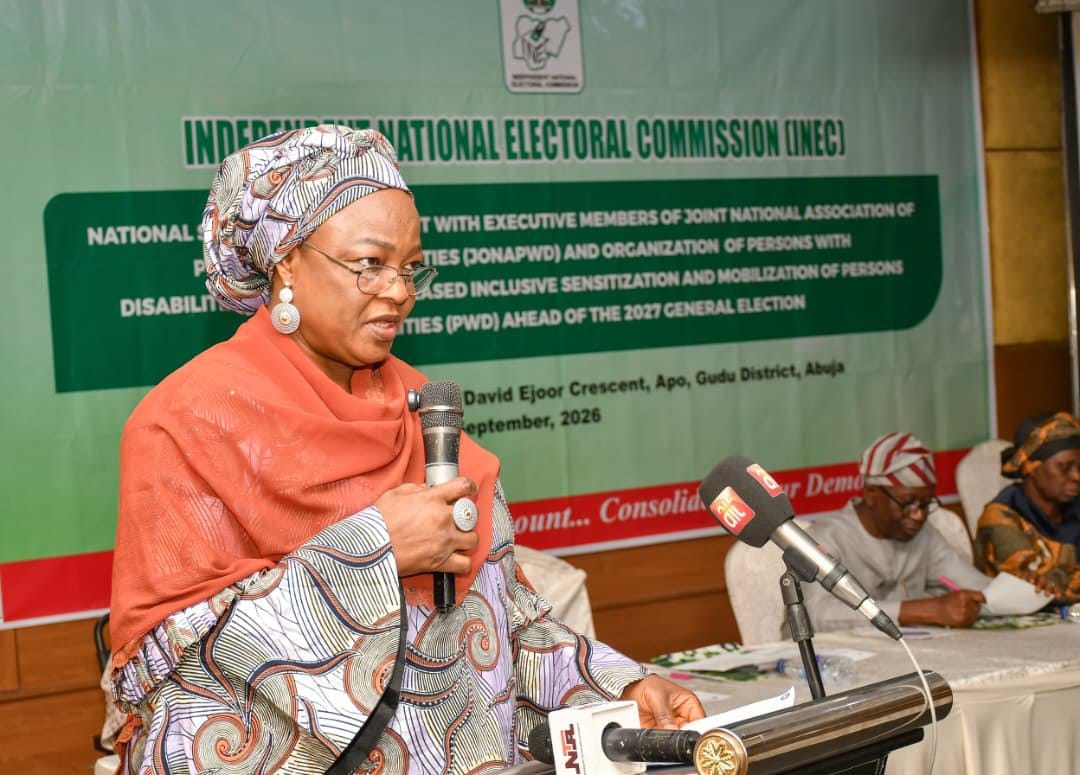
The Independent National Electoral Commission (INEC) has begun consultations with the Joint National Association of Persons with Disabilities (JONAPWD), disability cluster groups and other special-interest organisations to increase the participation of persons with disabilities (PWDs) in the 2027 general elections.
The consultations are centred on voter mobilisation and sensitisation, with the commission seeking to ensure that voters with disabilities receive adequate information and support and can participate fully in the electoral process.
Speaking at the consultative meeting, Acting INEC Chairman Rhoda Gumus, who represented the commission’s Chairman, Joash Amupitan, said the engagement was timely as preparations for the 2027 elections gather pace.
Ms Gumus said INEC’s efforts to promote an inclusive electoral process were backed by existing laws and policies, including Section 54 of the Electoral Act 2026, the Discrimination Against Persons with Disabilities (Prohibition) Act 2018 and the commission’s Access and Participation Framework.
She also stressed the need for INEC and stakeholders to adopt different voter education methods, including accessible materials, community-based networks, broadcast media and digital platforms.
INEC said legacy data collected before the introduction of the Automated Biometric Identification System showed that 137,487 persons with disabilities had registered as voters.
The figure comprises 13,080 visually impaired persons, 9,299 hearing-impaired persons, 30,561 albinos, 19,430 physically challenged persons and 54,941 people belonging to other disability clusters.
Ms Gumus urged JONAPWD and other disability advocacy organisations to take the lead in mobilising their members at the grassroots.
She said the organisations should help ensure that members of the various disability clusters receive timely information on voter registration, Permanent Voter Card (PVC) collection and voting procedures.
According to her, the engagement would also enable INEC and stakeholders to identify challenges within the electoral system and develop joint solutions ahead of the elections.
INEC Director of Gender and Inclusivity, Lakunuya Dorothy Bello, listed some of the measures already adopted by the commission to support voters with disabilities.
They include Braille ballot guides, optical magnifying glasses, the EC30PWD form and the use of sign language during the collation of results.
Ms Bello said INEC would ensure that decisions reached at the national level were implemented across the states through Resident Electoral Commissioners and Electoral Officers.
The officials, she said, would work with relevant stakeholders to address local challenges affecting the participation of persons with disabilities.
The National President of JONAPWD, Abdullahi Usman, thanked INEC for convening the meeting but called for wider consultations that would give individual persons with disabilities an opportunity to present their specific concerns.
Similarly, Ayuba Burki, Executive Secretary of the National Commission for Persons with Disabilities, said persons with disabilities represented a significant section of the population, although determining their exact number remained difficult.
He called for institutional measures to address their needs within the electoral system.
Jake Epelle, founder and Chief Executive Officer of TAF Africa, commended INEC for maintaining priority voting arrangements during recent off-cycle elections.
He, however, called for wider access to polling units and stronger voter education to ensure that persons with disabilities could participate effectively.
Grace Jerry, Executive Director of the Inclusive Friends Association, also provided further recommendations on voter mobilisation.
Summing up the presentation, INEC Deputy Director of Inclusivity, Habiba Jatto, identified stronger collaboration among stakeholders, improvements in the PVC collection process and the removal of barriers to electoral participation as key areas requiring attention ahead of the 2027 elections.
