


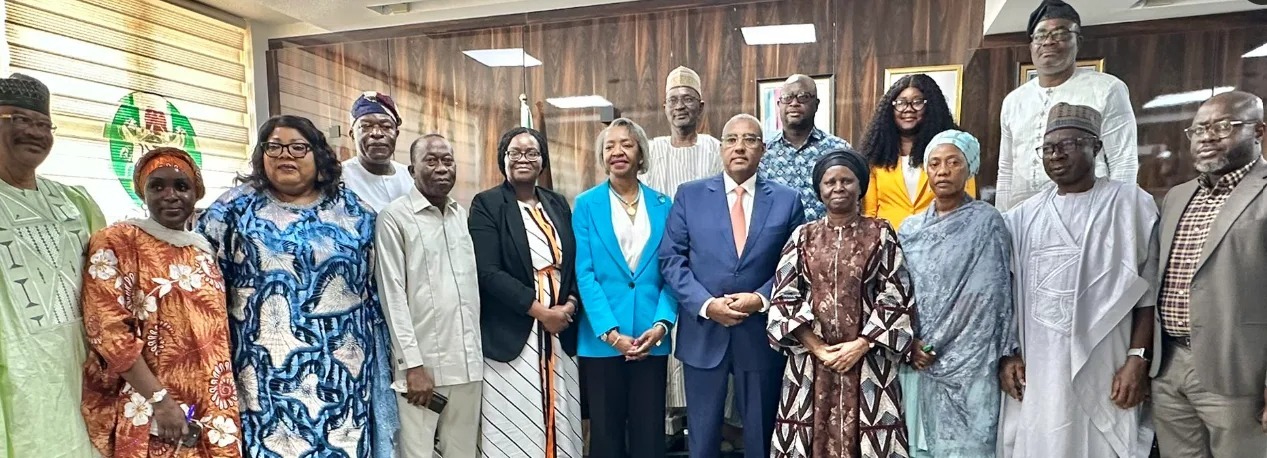
A delegation from the African Union paid a courtesy visit to the Independent National Electoral Commission (INEC) as part of the union’s Pre-Election and Needs Assessment Mission to Nigeria, scheduled to run from September 13 to 19, 2026, ahead of the 2027 general elections.
The delegation, led by former Minister of Foreign Affairs of the Federal Democratic Republic of Ethiopia, Demeke Mekonnen, was received at the commission’s headquarters in Abuja by INEC’s Acting Chairman, Prof Rhoda Gumus.
In a tweet via the commission’s official X handle on Tuesday, Mekonnen explained that the mission was set up to assess Nigeria’s preparedness in key areas including voter registration, electoral technology, logistics, funding, inclusion and transparency.
He said the team would also work to identify potential gaps before, during and after the elections and recommend measures to strengthen the process.
“We want to facilitate support and identify gaps, and for possible remedies and corrections for the successful election process,” Mekonnen said. Speaking on behalf of INEC Chairman Prof Joash Ojo Amupitan, Gumus outlined several milestones the commission has recorded so far.
She said INEC was preparing for the 2027 general elections on an unprecedented scale, with the voter population nearing 100 million, 176,846 polling units nationwide, and a workforce of more than 1.4 million personnel. She added that recent off-cycle elections had allowed the commission to test reforms introduced under the new electoral legal framework.
Gumus also pointed to INEC’s continued use of the Bimodal Voter Accreditation System (BVAS), results transmission through the IReV portal, and inter-agency security coordination as part of efforts to strengthen electoral administration.
Read Also: peter-obi-asks-unn-to-release-academic-records
She disclosed that the commission is working with the National Identity Management Commission (NIMC) through the Continuous Voter Registration Portal to audit, verify, and clean up the voter register.
The INEC official stressed that safeguarding electoral integrity requires cooperation across multiple sectors and cautioned against leaving gaps in the process. She acknowledged that Nigeria’s size and complexity continue to pose technological, logistical and political challenges.
“Electoral integrity is a multi-sectoral endeavour, and international technical support remains vital to bridging operational gaps,” Gumus said.
Among the areas where she said AU technical support would be valuable are digital training for ad-hoc staff, e-learning tools, ICT simulations, election-monitoring systems, disinformation countermeasures, and AI-driven deepfake detection and strategic communication.
She further called for assistance in strengthening inclusion and gender-mainstreaming frameworks for persons with disabilities, internally displaced persons, women and other underrepresented groups.
Gumus assured the delegation of INEC’s full transparency and cooperation as it engages with political parties, civil society organisations, security agencies, media executives and development partners throughout the mission.
She reaffirmed the commission’s commitment to independence, neutrality and professionalism, stating that every administrative decision would be guided by the law and that the outcome of the 2027 general election would reflect the sovereign will of Nigerian voters.
She described the AU mission as “timely and significant to Nigeria’s democratic development,” noting that Nigeria and the African Union share a common commitment to democratic standards, institutional integrity and credible electoral governance across the continent.
