


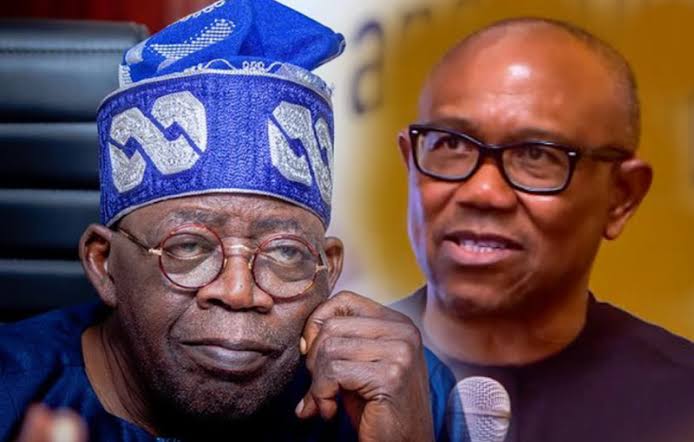
The urge to write this was easy, as I watched Ruben Abati on Arise TV Morning Show, putting forth his views on Peter Obi’s call on President Bola Ahmed Tinubu, to resign from office.
It is possible that so many, who have seen the clip or watched the show, noticed what I did. Whatever, I came away with a compelling desire to share my thoughts.
I posit that, in the theatre of Nigerian punditry, where microphones often masquerade as mirrors of truth, Ruben Abati, highly respected in the commune, stepped forward in this instance, not merely as commentator, but as oracle one who claimed to see not only events, but the marrow of men.
Yet even oracles, history reminds us, are sometimes drunk on the incense of assumption. His proposition hangs in the air like Harmattan dust: that Peter Obi, placed upon the same trembling pedestal as President Tinubu, would not resign; that “his people” would not permit it.
A conclusion dressed as cultural wisdom, but stitched with the loose threads of conjecture. For how does one weigh the conscience of a man never tested in that exact furnace? How does one map the decisions of a hypothetical presidency with the blunt compass of ethnic determinism?
Nigeria is indeed a land where sycophancy kneels easily, where tribe and creed often sit louder than reason at the national table. On this, Abati does not err.
But to drag Obi into that familiar pit without evidence is to flatten difference, to deny the possibility of deviation in a country that survives precisely because of its outliers.
Also see: ‘NDDC Must Act Now’ — Hilda Dokubo Reacts to Viral Pollution Video
There is, undeniably, a point of divergence. Obi’s political pilgrimage especially in 2023 was not carried on the shoulders of old patronage, but on the restless feet of citizens who defied the grammar of Nigerian elections.
Markets whispered his name, youths coded it into hashtags, and polling units became quiet rebellions. This was not the choreography of “his people” dictating terms, but of a man and a movement negotiating a new language of accountability.
Many who have encountered Obi in public life describe a temperament marked by restraint, a certain stubborn minimalism in both rhetoric and governance.
Not sainthood, certainly but neither the predictable elasticity of power that bends to every tribal tug. To suggest, then, that such a figure would be unable to act against pressure is not analysis; it is projection.
And here lies the danger: when punditry abandons evidence for intuition, when it crowns speculation as truth, it ceases to illuminate and begins to obscure.
A man’s character is not a clay pot to be molded by guesswork. It is revealed only in the fire of lived decisions. Until then, to declare what Obi would or would not do is not insight.
It is, simply, a well-worded fallacy. Abati shouldn’t take the Nigerian audience for granted. They can discern. Credibility wanes when deliberate faulty generalizations are mouthed as schooled intelligence.
Udo Silas
