


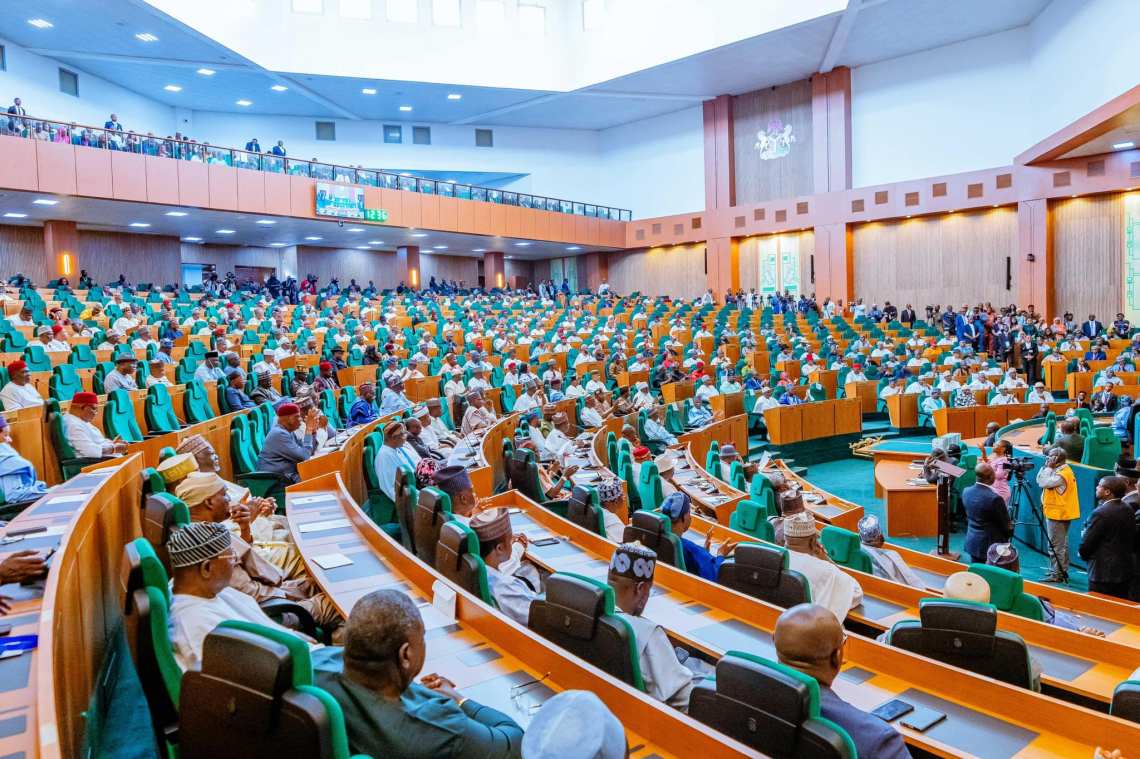
The House of Representatives has passed a crucial bill seeking to alter the 1999 Constitution to allow for the establishment of state police forces.
This marks a major legislative shift in Nigeria’s long-running debate over security decentralisation.
The proposal, designated as HB 617, cleared a major hurdle during Thursday’s plenary session following a decisive manual vote.
The development comes as a direct legislative intervention to restructure the nation’s federal policing architecture in the face of an unrelenting national security crisis characterised by widespread terrorism, banditry, mass kidnappings, and other violent crimes.
The high-stakes legislative session, presided over by the Speaker of the House, Abbas Tajudeen, commenced with more than 290 lawmakers in attendance.
To expedite the security legislation, House Leader Julius Ihonvbere of the All Progressives Congress (APC) from Edo State moved a motion to temporarily suspend the internal rules of the House.
This enabled lawmakers to rescind an earlier decision regarding how reports from the Committee on Constitution Review are presented.
The procedural motion was seconded by the newly appointed Minority Leader, Fred Agbedi of the Peoples Democratic Party (PDP) from Bayelsa State, and was promptly adopted by the floor.
As the House transitioned into the specific voting stage for the security reform, a technical glitch occurred. Tajudeen announced to the chamber that the electronic voting system was non-functional, forcing the house to pivot to a manual voting process.
Rather than reviewing the constitutional alteration clause by clause, the Speaker ruled that the chamber would vote on the bill by its long title.
Following a physical tally of the lawmakers, an overwhelming majority of 289 members voted in favour of the bill, while only four lawmakers voted against it.
Presenting the bill before the vote, the Deputy Speaker of the House and Chairman of the Constitution Review Committee, Benjamin Kalu, framed the legislation as a vital, direct response to Nigeria’s deteriorating security landscape.
Kalu argued that Nigeria’s current highly centralised policing model, which concentrates all command structures at the Force Headquarters in Abuja, has crippled response times during rural and urban emergencies.
By decentralising the police force, states will have the legal authority to set up localised security structures.
The Deputy Speaker emphasised that local state officers, possessing native fluency in regional languages and an intimate knowledge of local geography and community dynamics, would be far more effective at neutralising emerging threats than federally deployed personnel.
He urged his colleagues to view the passage of the bill as a legacy institutional reform that moves national defence beyond stop-gap military interventions.
State Police
The passage of HB 617 follows years of escalating pressure from state governors, regional socio-cultural groups, and civil society organisations who argue that the single federal police force is structurally overwhelmed.
Nigeria is currently battling a multi-faceted security crisis: geometric spikes in highway kidnappings, deadly banditry across the regions, persistent insurgencies, and violent communal clashes across the North-Central and Southern belts.
Historically, proposals for state policing faced stiff political resistance over fears that state governors might weaponise local police forces against political opponents.
However, the sheer scale of the current security breakdowns, where federal troops are now deployed across nearly all 36 states to perform routine civil policing duties, has forced a broad national consensus among lawmakers that the centralised status quo is no longer sustainable.
Tajudeen explained that the House deliberately prioritised the security amendment ahead of all other constitutional proposals due to its extreme urgency.
By pushing the vote through, the House cleared the path for lawmakers to embark on a two-week end-of-legislative-year recess.
Following the successful vote, the House adjourned its sittings until July 7, 2026. This recess is intended to allow lawmakers to return to their constituencies and thoroughly study the remaining constitutional amendment bills scheduled for debate upon resumption.
To become operational law, the state police bill must now navigate a rigid constitutional pipeline.
The bill will be transmitted to the Senate, where it must pass a matching vote. If approved by the upper chamber, it will be forwarded to the 36 State Houses of Assembly, where it must be endorsed by a two-thirds majority.
Upon securing the required state-level approvals, the amendment will be sent to President Bola Tinubu for his final signature into law.
