


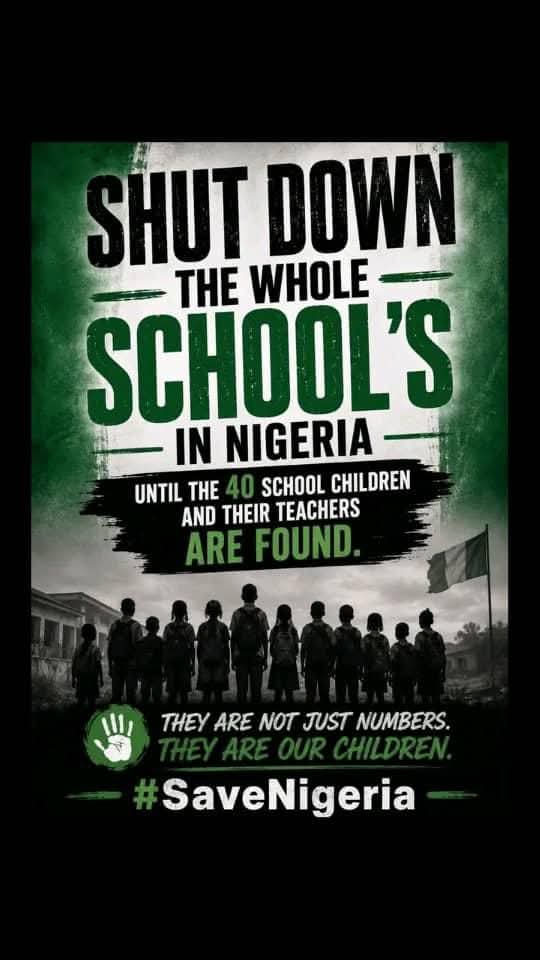
Across social media, a growing chorus of Nigerians are demanding a nationwide shutdown of schools—from nursery to tertiary level—until the safety of abducted children and teachers is fully guaranteed. For many, the argument is simple: no education system can justify continuity when innocent learners are still unaccounted for in forested hideouts, and when the threat of repetition remains very real.
The emotional weight behind this call is understandable. Education, in its most basic form, is meant to be a safe space. The idea that children leave home in the morning and may not return due to violent abduction is a rupture in public trust. For families directly affected, and for citizens watching similar patterns repeat across states, the demand for a shutdown feels less like activism and more like survival instinct.
Yet, on the other side of the debate, school administrators and education stakeholders are confronting a different reality. Many schools, especially at nursery, primary, and secondary levels, are currently in the third term, a critical academic period marked by promotion examinations, graduation transitions, and final assessments that determine progression into new academic stages. A sudden nationwide shutdown at this point would not only disrupt academic calendars but could also create long-term administrative complications, especially in public examination systems and admissions cycles.
There is also the argument of precedent. During the COVID-19 pandemic, schools were shut down nationwide, but that decision came with a coordinated federal response, remote learning alternatives, and a globally acknowledged public health emergency framework. In contrast, the current insecurity crisis, while severe, is geographically uneven and operationally complex. Not all regions are experiencing the same level of threat, and that inconsistency makes a blanket closure policy more difficult to implement without significant disruption to unaffected areas.
Still, the tension between continuity and safety raises a deeper ethical question: should academic progression ever take precedence over the immediate protection of children? If the very students sitting in classrooms today were the ones abducted tomorrow, would the system still defend uninterrupted schooling in the name of academic structure?
Also see: Nigeria’s Fintech Revolution Continues To Attract Global Attention
This is where public sentiment becomes morally compelling. Education is a social contract between the state, schools, parents, and children. When that contract is breached by insecurity, the expectation that learning continues “as normal” can appear detached from lived reality. Parents, many of whom already live with daily anxiety, are justified in questioning whether attendance is worth the risk when safety cannot be guaranteed.
At the same time, there is a legitimate concern that prolonged shutdowns without a structured alternative could further harm children’s futures. Nigeria has experienced how extended school closures can widen learning gaps, increase dropout rates, and expose children to other social risks such as child labour, early marriage, and exploitation. In that sense, keeping schools open is not necessarily an act of neglect—it may, in some cases, be an attempt to preserve stability in an already fragile system. So where does the balance lie?
The responsibility ultimately returns to government, not schools alone. School administrators are not security agencies. They cannot fortify borders, deploy intelligence networks, or guarantee rapid response rescue operations. What they can do is follow directives. If a shutdown is necessary, it must be part of a coordinated national security response, not an isolated reaction driven by fear or public pressure alone.
What Nigeria needs at this moment is not a symbolic shutdown, but a decisive security recalibration around educational institutions. That includes improved intelligence around school routes, armed protection in high-risk zones, rapid emergency response systems, and clear protocols for evacuation or temporary closure in affected areas.
