


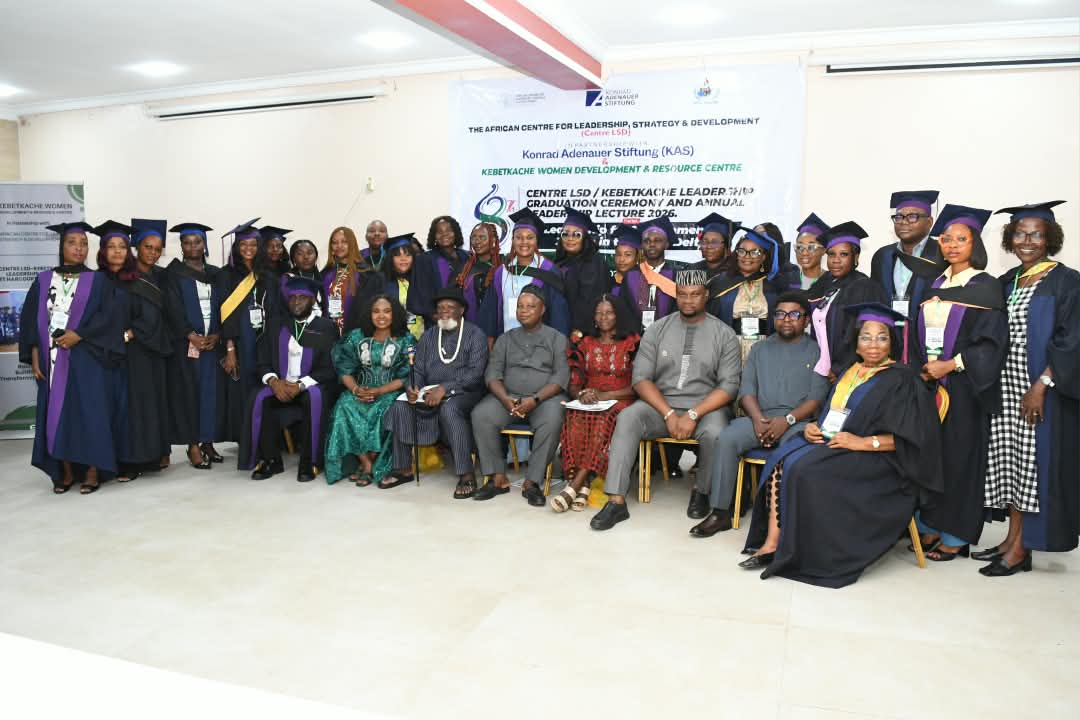
Environmental activist Dr Nnimmo Bassey has urged emerging leaders to prioritise environmental restoration, hold oil companies accountable for pollution and protect communities affected by decades of oil exploration in the Niger Delta.
Bassey, Executive Director of the Health of Mother Earth Foundation (HOMEF), made the call on Saturday while delivering a guest lecture titled “Leadership for Environmental Justice in the Niger Delta” at the eighth graduation ceremony and annual leadership lecture of the Kebetkache/Centre for Leadership, Strategy and Development (Centre LSD) Leadership School for the 2025/2026 session in Port Harcourt.
Represented by Mkpoikana Udoma, Bassey urged the graduands to translate their leadership training into action by challenging injustice, demanding accountability and ensuring that public institutions serve communities rather than private interests.
He said development should be measured not only by infrastructure and economic growth but also by access to clean air, safe water, food and a healthy environment.
“The Niger Delta does not need leaders who merely manage the consequences of injustice. It needs leaders who will work with communities to dismantle the conditions that produce it,” he said.
Bassey challenged political candidates to present concrete plans for tackling oil spills, gas flaring and ecological degradation, urging voters to scrutinise their environmental commitments.
He cited the prolonged fire at the Ororo-1 oil well off Awoye community in Ondo State, gas eruptions in Bille community in Degema Local Government Area of Rivers State, and an uncontrolled crude oil fire at Oil Well 9 in Ofiomina-Ama Alakiri, Okrika LGA, as examples of environmental emergencies requiring urgent attention.
According to him, decades of pollution have damaged rivers, forests, farmlands and mangroves across the Niger Delta, undermining livelihoods without significantly improving living conditions for many residents.
He described extractivism as a system that prioritises profit over people and the environment, calling for greater community participation in decisions concerning land and natural resources.
The environmentalist also warned that Nigeria’s growing interest in critical minerals for the global energy transition could reproduce the ecological damage associated with oil extraction if adequate safeguards were not established.
Citing lead poisoning linked to artisanal gold mining in Zamfara State and fatal mining accidents in Plateau State, he called for stronger oversight of the extractive sector.
He also expressed concern over a reported $700 billion memorandum of agreement between Nigeria and the United States on critical minerals, warning that communities could face displacement and environmental degradation if mining proceeded without adequate protection.
“Changing the energy source without changing this underlying logic will not deliver justice,” he said, stressing that the transition to green technologies must protect community rights, livelihoods and access to natural resources.
Bassey further questioned aspects of the Petroleum Industry Act, particularly provisions concerning oil companies’ roles in appointing members of host community development trust boards and the use of community funds to repair oil infrastructure damaged by third parties.
He said the arrangements raised concerns about community representation, accountability and the management of funds intended for host community development.
Bassey added that environmental leadership should extend beyond public office to include community members who document oil spills, defend water sources and demand investigations into pollution.
He called for greater participation by women and young people in environmental decision-making, noting that women often bear a disproportionate burden of ecological destruction because of their roles in farming, fishing, water collection and family care.
Earlier, the Director of the Kebetkache Leadership School and Executive Director of the Kebetkache Women Development and Resource Centre, Dr Emem Okon, urged the graduands to apply the knowledge acquired during their training to promote environmental justice and community development.
Okon said environmental justice went beyond campaigning against oil spills to include protecting people’s rights to clean air and water, sustainable livelihoods and a healthy environment.
She identified health justice, water justice, ecosystem restoration, truth, healing, solidarity and accountability as essential elements of environmental leadership.
She encouraged the school’s alumni association to strengthen community engagement through leadership circles, environmental clubs and other initiatives that would educate young people about environmental protection and their responsibilities in promoting justice.
Okon also urged the graduands to engage with health assessments, environmental impact assessment reports, remediation processes and just transition initiatives.
She described the leadership school as a platform for nurturing responsible leaders and called on its alumni to translate classroom lessons into practical interventions that would benefit society.
“The Kebetkache Leadership School is a leadership development programme of the Kebetkache Women Development and Resource Centre, implemented in partnership with Centre LSD. It equips emerging leaders with knowledge and practical skills to promote integrity, inclusiveness, accountability and community development,” she said.
Also speaking, the Executive Director of Centre LSD, Monday Osasah, urged the 63 graduands to apply their leadership training in their workplaces, communities, organisations, churches, professional associations and public institutions.
Osasah said the leadership school was established on the conviction that leadership could be developed through training, practical experience and a commitment to societal transformation.
He identified poverty, inequality, corruption, insecurity, unemployment and weak institutions as persistent challenges facing Nigeria and other African countries, stressing the importance of developing leaders capable of addressing them.
“Our objective is not to produce people who occupy positions of authority. It is to produce people of influence, integrity and purpose who can use leadership to transform institutions and society,” he said.
Osasah disclosed that the graduation of the latest set brought the total number of graduates from Centre LSD’s leadership schools to 3,567, according to the organisation’s records.
He said the programme operated centres in Warri, Delta State; Benin City, Edo State; Port Harcourt, Rivers State; Abakaliki, Ebonyi State; Jos, Plateau State; and Kano.
