


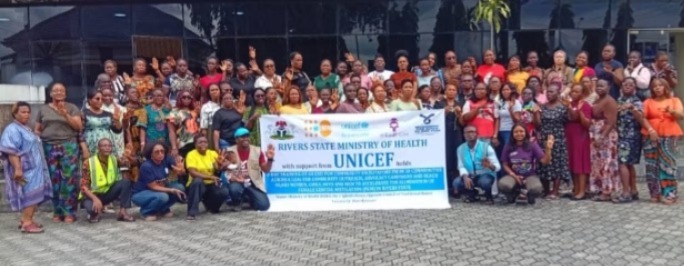
The United Nations Children’s Fund (UNICEF) has launched a renewed drive to eliminate Female Genital Mutilation (FGM) in six local government areas of Rivers State, targeting 90,000 female family members through community-based awareness and training programmes.
The targeted local government areas are Okrika, Ikwerre, Eleme, Ogba/Egbema/Ndoni, Oyigbo and Omuma.
UNICEF Child Protection Specialist at its Enugu Field Office, Victor Atuchukwu, disclosed this during a three-day FGM training programme in Port Harcourt, where 60 community facilitators were trained to lead efforts to end the harmful practice in their communities.
Atuchukwu explained that the facilitators would train 450 Adolescent Gender Champions (AGCs) across 30 communities. Each champion would then mobilise 10 peers, reaching 4,500 young people who would support further awareness and training initiatives aimed at reaching the 90,000 women and girls.
The training was organised by the Rivers State Ministry of Health, with support from the United Nations Population Fund (UNFPA) and the UNICEF–UNFPA Joint Programme on the Elimination of FGM. Participants were drawn from female youth-led and women-led community-based organisations across the six LGAs.
Atuchukwu urged survivors, women and former perpetrators to take ownership of the campaign, stressing that communities must lead efforts to end the practice.
“Lead the movement. No person is coming to end female genital mutilation for you in your community; only you can,” he said.
Read Also: rivers-partners-unicef-to-strengthen-child-protection-social-welfare-services
He noted that UNICEF had begun recording positive changes in attitudes, behaviours and practices in communities where implementation started last year. However, he said changes in FGM prevalence would be assessed through future national surveys, including the Multiple Indicator Cluster Survey and the Nigeria Demographic and Health Survey.
He added that monitoring mechanisms had been established to track progress, including community reports, photographs, WhatsApp groups and joint supervision by the ministries responsible for health, social welfare and rehabilitation, and justice. UNICEF and UNFPA would also conduct physical visits to participating communities.
According to him, limited awareness remains a major obstacle, as some participants were unaware that certain practices, including forms of genital massage, could constitute FGM.
Earlier, the Rivers State Ministry of Health’s Health Promotion Officer, Dr Mary Obisike, urged participants to challenge harmful beliefs, apply the knowledge acquired and educate their communities on the health consequences of FGM.
Participants described the training as interactive and practical, pledging to establish and strengthen adolescent circles and work with parents, traditional rulers and religious leaders to encourage the abandonment of the practice.
The training covered the types and consequences of FGM, adolescent reproductive health, gender concepts, facilitation skills, community dialogue and child protection laws.
UNICEF said the initiative ultimately seeks to protect every child, girl and woman in Rivers State from violence and harmful traditional practices.
