


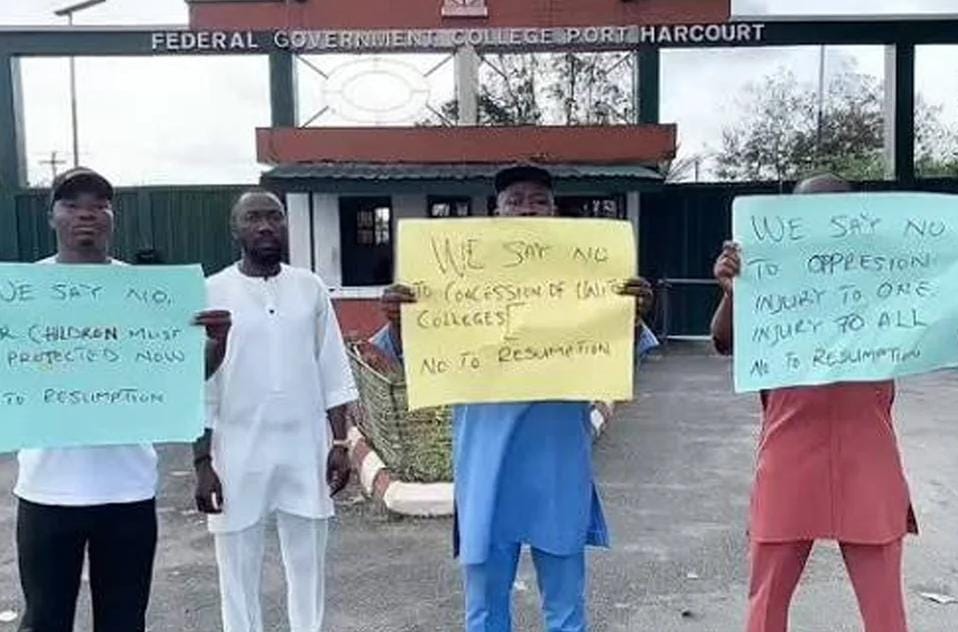
When students of Federal Government College, Rumuokoro arrived for the first day of the 2026/2027 academic session on Monday, they were not greeted with lesson notes or new uniforms. They were turned back at the gate, not because of insecurity or disaster, but because the adults meant to protect their access to education were locked in protest against their own government. In that single image lies the real cost of this policy fight: one that children, who have no say in it, are paying first.
At issue is a Federal Government plan to concede management of unity schools like FGC Rumuokoro to old students’ associations. To be fair, the intention behind such a policy is not inherently sinister. Alumni associations often have both the funds and the motivation to rehabilitate ageing infrastructure that government budgets have long neglected: leaking roofs, broken hostels, outdated laboratories.
If the goal is genuinely to mobilise alumni resources for physical development, that is a legitimate and even commendable objective, and the government deserves credit for seeking solutions beyond its stretched budget.
But good intentions do not eliminate risk, and the risk here falls squarely on current students. As PTA Chairman Matthew Abbah rightly noted, there is a wide gulf between old students supporting a school’s development and old students taking over its management outright.
One is goodwill; the other is a transfer of control. Once an alumni body governs admissions, fees, or policy, not just buildings, the character of a public school can shift quietly but irreversibly, and the working-class families who rely on unity schools precisely because they cannot afford private alternatives may find themselves squeezed out by decisions made in their name but without their input.
This is not an isolated dispute. Nigeria has watched federal responsibility quietly give way to third-party management across sector after sector, always framed as “partnership” or efficiency. Each time, those with the least power to negotiate bear the consequences.
If unity schools can be conceded to alumni bodies today, what stops this from becoming the template for all 104 nationwide? Rumuokoro is a test case, and the country should watch closely how it resolves, including whether the government builds in safeguards that separate infrastructure support from governance control, so that development does not come at the cost of access.
What makes this moment troubling is who holds the consequences now. Not the policymakers in Abuja who drafted the plan, nor the alumni associations poised to gain oversight, but the students of FGC Rumuokoro, sent home on resumption day, their term already disrupted. Parents have vowed to remain at the gate until the decision is reversed, a measure of how seriously they view the stakes.
President Tinubu and Senate President Akpabio should treat this as more than an inconvenient protest. If the goal is truly development, the government can pursue alumni investment without surrendering control. Children should not have to lose school days to make that case.
