


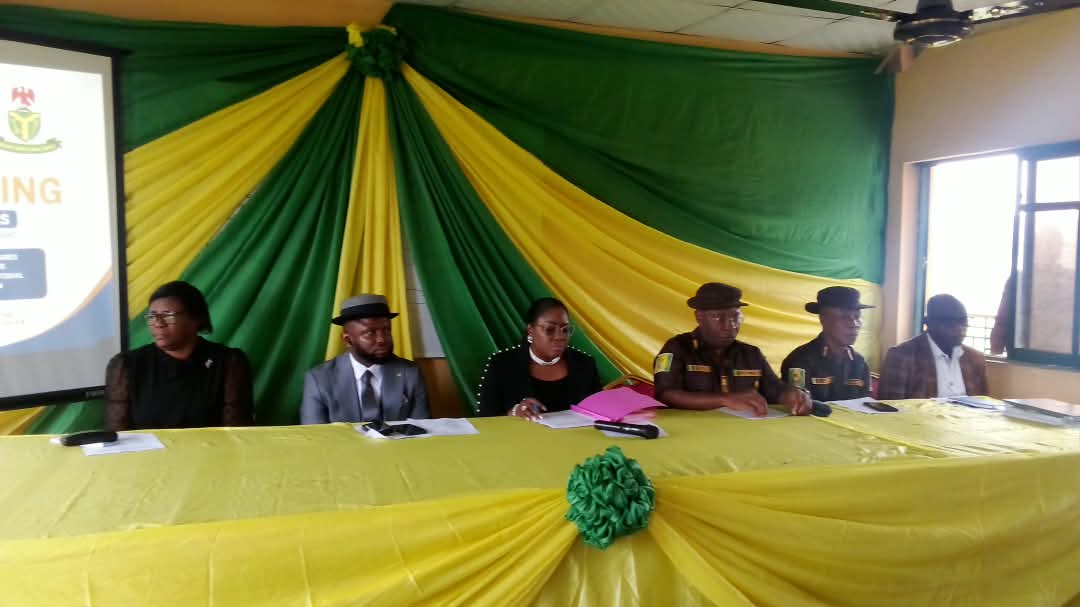
The Chief Judge of Rivers State, Justice Simeon Amadi, has called for stronger collaboration between the judiciary and the Nigerian Correctional Service (NCS) to ensure the effective implementation of non-custodial measures in the state.
Justice Amadi made the call in his keynote address at a one-day training for non-custodial officers of the NCS, organised by the Rivers State Administration of Criminal Justice Monitoring Council (ACJMC) in collaboration with the Nigerian Correctional Service, Rivers State Command.
The training was themed, “Strengthening the Effective Implementation of Non-Custodial Measures Through Enhanced Collaboration Between the Judiciary and the Nigerian Correctional Service: Role of Officers of the Non-Custodial Unit in Advancing Community Safety, Offenders’ Rehabilitation and Victims’ Participation.”
Represented by Justice Chinwe Nsirim-Nwosu, the Chief Judge said non-custodial measures were not intended to excuse criminal conduct, but to provide a structured means of holding offenders accountable while promoting rehabilitation, reintegration and public safety.
He noted that a criminal case did not end with the pronouncement of a sentence, stressing that court sentences must be properly implemented, supervised and completed in a manner that protects the public, respects the law and holds offenders accountable.
Justice Amadi said non-custodial measures should not be mistaken for an absence of punishment, adding that they constitute structured judicial orders requiring discipline, measurable obligations, supervision and consequences for breaches.
According to him, the increasing pressure on correctional facilities makes it necessary to explore suitable alternatives to imprisonment.
He cited figures indicating that Nigeria’s correctional centres had about 80,812 inmates as of February 9, 2026, comprising 51,955 awaiting trial inmates, 24,913 convicted persons and 3,850 persons in other categories.
The Chief Judge also noted that the Port Harcourt Correctional Centre, which was designed to accommodate about 804 inmates, was reportedly housing more than 3,000 inmates.
He said the situation underscored the need for effective policies and practical measures to address overcrowding, particularly where the nature of an offence and the circumstances of an offender made non-custodial sentencing appropriate.
Justice Amadi noted that the Nigerian Correctional Service Act 2019 provides a statutory framework for non-custodial measures, including community service, probation, parole and restorative justice.
He stressed that the success of the measures depended largely on the effectiveness of non-custodial officers in supervising offenders, monitoring compliance with court conditions, keeping proper records and promptly reporting breaches to the appropriate authorities.
He urged the judiciary and the NCS to establish clear communication channels to ensure that court orders were promptly communicated, while compliance and progress reports reached the courts as required.
The Chief Judge also emphasised the importance of protecting victims’ interests in the administration of non-custodial measures, noting that restorative justice mechanisms could provide opportunities to address harm caused by offences and involve victims, offenders and communities in the justice process.
He proposed the adoption of a shared implementation protocol covering referral, receipt of court orders, offender induction, supervision, reporting, breach, variation and completion of non-custodial sentences.
The Controller-General of the Nigerian Correctional Service, Sylvester Nwakuche, represented by Richard Williams, said the training would help strengthen professional competence, improve sentence management and compliance with judicial orders, and deepen institutional collaboration.
He said effective implementation of non-custodial measures required strong institutional cooperation, professional competence, effective communication and a shared commitment to justice, rehabilitation and public safety.
The Executive Secretary of the Rivers State ACJMC, Chief Magistrate Ilanye Brown, in her paper presentation titled: “Administration of Non-custodial Measures under the Rivers State Administration of Criminal Justice Laws (ACJL) 2015 and the Nigerian Correctional Service Act 2019: Challenges and the Way Forward” said the essence of non-custodial service was to repair and rebuild offenders while creating a more empathetic society.
Brown said the training would examine gaps and overlaps in the legal framework governing non-custodial measures and promote greater collaboration among the institutions responsible for implementing them.
She argued that imprisonment does not necessarily lead to remorse or rehabilitation, noting that minor offenders could become hardened after interacting with serious criminals in correctional facilities.
According to her, non-custodial measures represent a paradigm shift from punishment solely through incarceration to an approach that combines accountability with rehabilitation and reintegration.
She stressed that the objective was not merely to reduce overcrowding in correctional centres, but to build a society that recognises the circumstances and shortcomings of offenders while ensuring that they remain accountable for their actions.
Brown further noted that Nigeria’s criminal justice reforms had introduced alternatives to imprisonment, including probation, suspended sentences, community service and parole, through instruments such as the Administration of Criminal Justice Act 2015, the Nigerian Correctional Service Act 2019 and the Rivers State Administration of Criminal Justice Law No. 7 of 2015.
She called for greater attention to the practical implementation of the laws, including the provision of adequate infrastructure and facilities needed to make non-custodial measures effective.
Brown maintained that non-custodial measures should not compromise public safety, but should focus on repairing harm, rehabilitating offenders, protecting communities and facilitating the eventual reintegration of offenders into society.
She said when offenders were properly supervised and given opportunities to address the factors contributing to their criminal behaviour, the justice system would be better positioned to achieve lasting rehabilitation and safer communities.
