


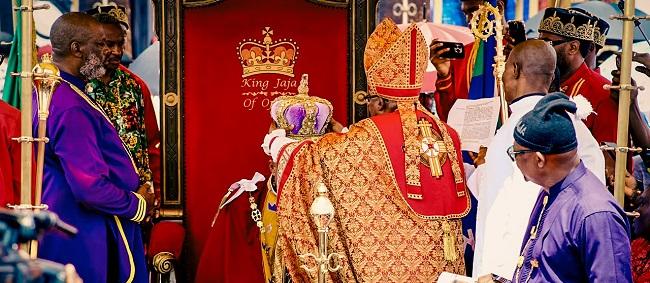
Activist Chetam Nwala described Governor Siminalayi Fubara’s visit to Opobo as “a walk of shame”, stating that it had been intended as a measure to improve his image following his failure to attend the coronation of the town’s new king. Whether that is fair is itself a matter of debate about appearances. A more serious question, however, arises from the governor’s own statements at the staff-of-office ceremony.
King Charles Douglas Mac-Pepple Jaja, Jeki VI, was crowned the sixth Amanyanabo of Opobo on 26th September. On October 2nd, Fubara gave him a certificate of recognition and a staff of office at Government House, where he stated that his government had full responsibility for the entire process, from the burial of the late king to the act of recognition, and that it had deliberately strived to make sure the selection concluded peacefully without leading to new legal action. “We did it,” he was reportedly said.
The fact that peace has been reached over a stool which, it is said, was tied up in court for more than 27 years is by no means trivial. I have found no account of anyone challenging the result, and traditional bodies like the Council of Alapu did take part. Nevertheless, the principle is more important than the outcome. The government only recognises a king after his people have chosen him; it does not choose him, and it should not pretend to have been in charge of his selection.
It is not a technicality that a king who owes his position, or even seems to owe it, to the governor’s office cannot speak openly to that governor. Traditional institutions are valuable simply because they remain outside the realm of party politics. In Delta in 2021, the then-governor Okowa made this point clearly by stating that his government did not interfere with the selection process and that the presentation of the staff had taken place in accordance with the people’s own enthronement.
It is even more significant in Opobo, a kingdom in which the governor is the king’s son and at the same time a member of the nobility; in this case the public cannot distinguish between recognition and patronage when the person who recognises the king also lays claim to having been responsible for his rise.
Governor Fubara’s critics will continue to debate the places he visited. The more pertinent question is as to where the government’s influence should be placed, on the certificate only after the kingmakers have made their statements and not at any time before that.
A staff of office should be one that the people place their trust in, and the government’s signature is all that is needed to confirm it.
