


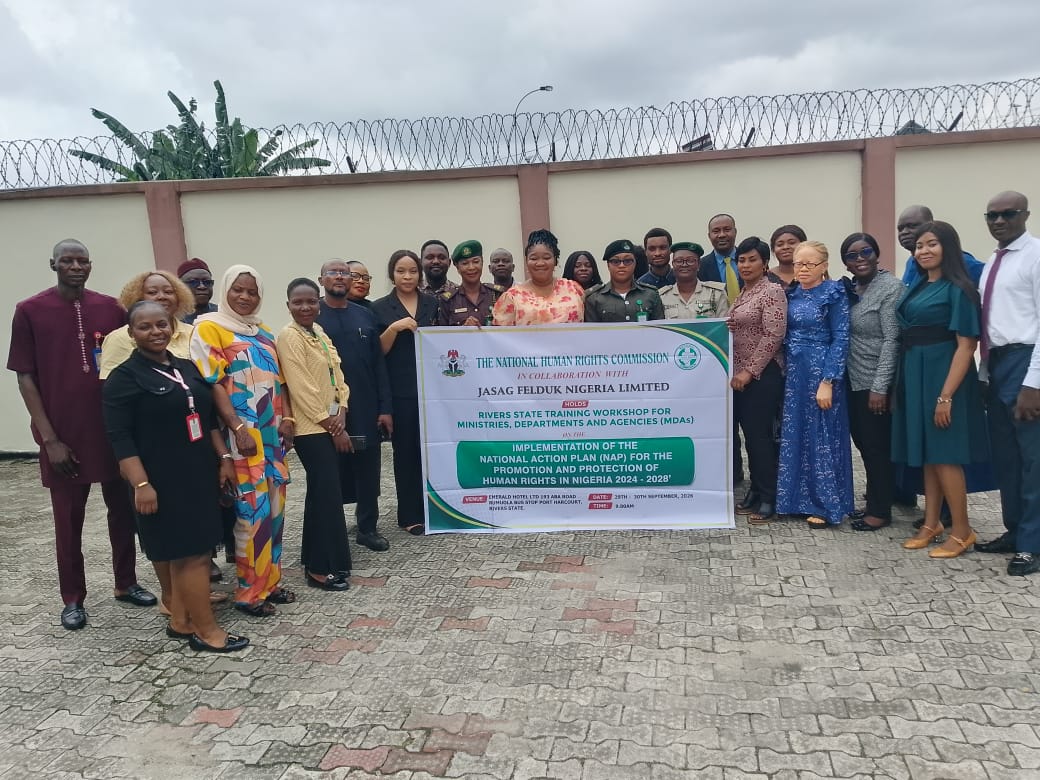
The National Human Rights Commission, NHRC, has issued a blunt challenge to government agencies to stop talking about human rights and start delivering measurable results that ordinary Nigerians can feel.
The NHRC Executive Secretary Dr. Tony Ojukwu, represented by the Rivers State Coordinator, Dr. Chinwe Okoroji, told participants at a two-day training workshop for Desk officers in government ministries, departments and agencies in Port Harcourt that the 2024 – 2028 National Action Plan on Human Rights must move beyond paper commitments.
“The question is no longer whether we support human rights,” Okoroji said. “The question is what each agency is doing to advance their protection. What policies are we implementing? What resources are we committing? What mechanisms have we put in place to prevent violations? How are we protecting the vulnerable? How are we measuring progress? And when violations occur, what remedies exist?”
She stressed that success will be judged by everyday impact, not by documents or workshops. A human rights-based approach, she argued, must shape planning, budgeting, legislation, service delivery and evaluation across government.
According to her, rights to education, healthcare, food, housing, work, security, equality, justice and a clean environment are not abstract ideals but essential pillars of dignity and national development.
Dr. Okoroji urged every agency present to leave the workshop with concrete institutional commitments.
Also Read: Flooding: Rivers Govt Relocates Rumuapara Secondary School
Reporting and monitoring, she said, should be treated as tools for accountability and better performance, not administrative chores. While the NHRC will provide technical guidance, coordination and oversight, implementation rests squarely with the agencies themselves.
“Behind every policy is a person,” she reminded the audience. “Our responsibility is to ensure that the Nigerian child, woman, man, person with disability, older person, displaced person and every marginalized citizen can enjoy their rights without discrimination and with real access to justice.”
In a separate presentation at the training, Dr. Uju Alimole outlined the practical tools needed to make that happen.
She explained Human Rights Impact Assessment as a structured process for identifying and addressing the actual and potential effects of policies, programmes, projects or laws on people’s rights.
Agencies, she said, must look beyond surface-level neutrality and anticipate who might be harmed if rights are not deliberately mainstreamed.
Dr. Alimole, while highlighting rights-responsive budgeting as critical, noted that policy promises mean little without money attached.
She added that spending must be judged not only by the amount allocated but by who benefits and whether it adequately advances economic, social and cultural rights in areas such as health, education and justice.
She added that the National Action Plan will only matter if agencies take ownership, embed human rights into their daily work, and turn commitments into concrete, measurable action that improves lives.
