

AD

Why Nigeria’s Blue Economy Must Start With the People Who Live on the Water

Before Nigeria commits fully to its blue-economy ambitions, we should ask what the term means and who stands to benefit from it.

Globally, “Blue Economy” has come to describe the development of marine and aquatic resources: shipping, fisheries, coastal tourism, offshore energy, biotechnology and other ocean-based activity. Nigeria’s Federal Ministry of Marine and Blue Economy frames its mandate similarly, around the responsible use of marine resources, maritime industries and environmental stewardship. Coastal communities and Integrated Coastal Zone Management also appear among its areas of concern.

But the global conversation has another side. Scholars have warned of “ocean grabbing” or “blue grabbing,” in which marine and coastal resources, spaces and decision-making come increasingly under market-driven control. Some researchers caution that when blue-economy projects are led mainly by commercial interests, they can create tensions over access to common resources and push aside small-scale fishing communities and other coastal users.

That does not make the Blue Economy inherently exploitative, and not every initiative amounts to privatisation. It does raise a fair question: are we developing the water as an economic asset, or developing the people whose lives and livelihoods depend on it?

Starting from place and people

The language of policy shapes its priorities. “Riverine Infrastructural Development” points attention to a specific environment and to what people need to live and work in it: passable roads and waterways, jetties and landing facilities, schools and clinics, clean water, electricity, shoreline protection, communication networks, housing, and emergency response systems.

In the Niger Delta, geography decides how people live, travel, trade, get an education, receive healthcare and take part in the wider Nigerian economy. A policy framework that begins with those realities starts a different conversation from one that begins with marine resources and investment opportunity.
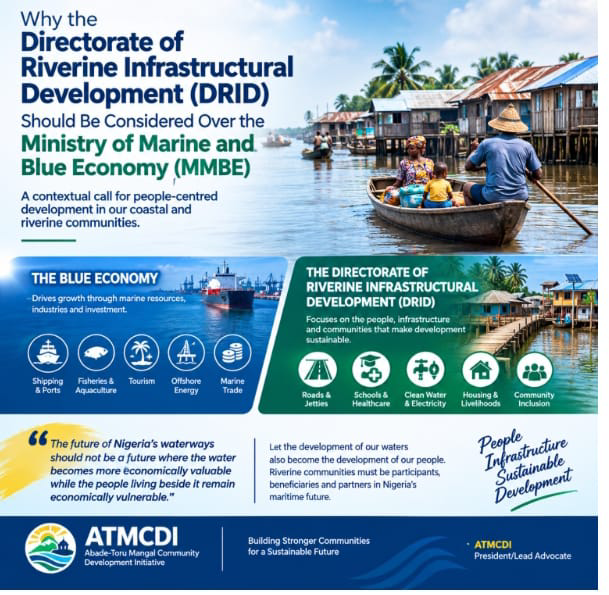
Delta State offers a practical example. Governor Sheriff Oborevwori’s administration has established a Directorate of Riverine Infrastructural Development (DRID), and the governor has publicly said riverine communities are dear to his government. The significance lies less in the name than in the institutional message. Riverine problems get a dedicated body rather than being lost inside broader structures. To a fisherman or trader in a creek community, that says his geography and his access to development matter.

Not an either-or choice

This is not an argument against the maritime economy. Nigeria needs functioning ports, shipping, maritime security, fisheries and aquaculture, coastal tourism and investment in offshore energy. The Federal Ministry of Marine and Blue Economy carries real responsibilities in transport, marine safety and these other areas, and nothing here calls for dismantling them.

The real question is whether infrastructure and human development in riverine communities deserve a dedicated institutional priority of their own. A maritime economy cannot be called sustainable if the communities beside its waterways remain cut off from basic infrastructure and from any meaningful share in the wealth.

A better way to measure success

Nigeria increasingly presents itself as a serious maritime nation, and it measures that by port efficiency, shipping volumes, investment figures and revenue. Those numbers matter, but they are incomplete. A fuller scorecard would ask how accessible riverine communities are and how safe their waterways are. It would look at the state of their schools and health facilities, how well their livelihoods are protected, how much of the value drawn from marine resources stays in the communities that host them, and whether local people have a voice in decisions about their own waters.

The goal should not be to abandon the Blue Economy. It should be to humanise it and localise it, and to make its benefits measurable at community level.

Our position

ATMCDI believes the idea behind DRID deserves serious consideration beyond Delta State. For the Niger Delta, and for Nigeria’s wider coastal and riverine communities, there is a strong case for an institutional framework that puts riverine infrastructure, community inclusion and sustainable human development at the centre of policy. DRID need not replace any function of the federal ministry.

It can serve as a model of focused attention on communities whose challenges are defined by their riverine geography.Nigeria’s waterways should not become more valuable while the people beside them stay economically vulnerable. Riverine and coastal communities should be partners and beneficiaries in the development of these waters, not merely hosts to it. As the country advances its maritime ambitions, no riverine community should be left behind.

By ATMCDI

Oh hi there 👋
It’s nice to meet you.

Sign up to receive awesome content in your inbox.

We don’t spam! Read our privacy policy for more info.

More Top Stories

RSHA Summons Defiant Oil Firm, Vows To Protect Constituents’ Rights
Lebara Nigeria Launches MVNO Service to Boost Creative Economy‎‎
Senator Nwogu of PDP Wins Rivers South-East Senatorial By-Election
Oil Pollution Sparks Crisis for Nigeria’s Sustainability Agenda
Airtel Africa Foundation Awards N50m to 100 Nigerian Students Under Tech Fellowship Programme
Judge Orders INEC To Deregister Five Political Parties Before 2027 Elections
APC Presidential Primary: Tinubu Sweeps All Votes in Rivers
Chinda Wins Ward 4 in Obio/Akpor APC Consensus Primary
U.S Moves to Expand Rural Internet Access in Nigeria, Three West African Nations
Marketers Kick Against Dangote’s Fresh Fuel Import Licence Suit
2027: I Won’t Step Down for any candidate – Amaechi
Obuah Wins APC Ward Senatorial Primary, Pledges Quality Representation
FG Announces Launch of Nigeria’s Digital TV Broadcast
Okrika, Eleme Council Chairmen Intervene as PHRC Host Communities Suspend Protest
Ogor Leaders Pay Congratulatory visit to Omonade
Fubara Reaffirms APC Membership, Dismisses Defection Rumours
Nigeria’s Crude Oil Production Rises to 1.489 Million bpd in April
NNPC Partners With Chinese Firms To Revive Port Harcourt, Warri Refineries
NDC Vows To Work For Party Victory As New Executives Emerge In Delta state
Delta APC stakeholders present as Dafinone declares second term bid
Andoni LG Boss Impose Dusk-To-Dawn Curfew
‎Finidi hails team’s game Control as they Open Two-Point Gap‎
Why Are They Still There?’ Esin Questions NFF Technical Team After World Cup Failures
‎Bronze Isn’t Gold: Eagles’ Ex coach Peseiro Reacts To AFCON Outcome‎‎‎
Shehu Dikko Pushes for Upgrade and Proper Maintenance of Sports Infrastructure
2026 World Cup: Super Eagles Face Harsh Reality After Failed Qualification
‎NFF appoints Akeem Busari as new Flamingos coach
HRM Summons PHED, Asks Reason For Recent Power Outage
Will Nigeria Replace Iran in the 2026 FIFA World Cup?
Osimhen Out of Hospital After Successful Surgery, Eyes Quick Return
Osimhen Backed for Man United Move as Butt Says He Can Elevate Sesko
Drama Erupts as Verydarkman Fires Back at Blessing CEO Over Cancer Claim
Kpai Them All!” — Sarian Martins Unleashes Fury, Links Blessing CEO’s Illness to ‘Spiritual Payback’
Nwaiwu Earns Super Eagles Call-Up as Bassey Withdraws Ahead of Iran, Jordan Friendlies
Super Eagles star Alex Iwobi Leads 7-Man Premier League Player of the Month Shortlist
Delta Queens Edge FC Robo In Five-Goal Thriller to Boost Super Six Push
‎Injury knocks out ‘Super’ Calvin Bassey as Eagles suffer Int’l Friendlies blow‎
Osimhen Set for Race Against Time as Galatasaray Target Quick Return
Super Eagles Open Camp in Turkey Ahead of Iran, Jordan Friendlies
Chukwueze Set for Permanent Fulham Move After Impressive Loan Spell
Rivers United Humiliated as Nasarawa United Run Riot in 4–1 Thriller
‎Chelle can win next AFCON, He deserves a new contract –Ibitoye‎
‎Rivers United blame CAF Champions League for slump‎
Morocco National Team Captain Rejects AFCON Title, Backs Senegal as True Champions
‎Title race heats up as Rivers, Rangers face defining fixtures‎‎
Oborevwori Denies Assaulting Kickboxing Coach in Reimbursement Row
‎NFF faces court notice over congress misconduct‎
FULL CIRCLE AT WEMBLEY: ARSENAL, MAN CITY AND A FINAL LOADED WITH HISTORY
Finidi George Under Pressure as Rivers United’s Title Grip Slips
Osimhen Injury Shifted Momentum as Liverpool Power Through-Slot
Rivers United Stumble Again as Niger Tornadoes Strike Late to Deepen Title Tension
‎Ademola Lookman Cruise into UCL Q’finals, Osimhen Crash out‎
CAF Strips Senegal of AFCON Title, Crowns Morocco Champions After Dramatic Final Controversy
Ikorodu City Dominate Rivers United to Seal Crucial Home Victory
Rivers United Confront Tough Ikorodu City Test as NPFL Title Race Reaches Boiling Point
Obi Mikel Demands NFF Leadership Resignation After Nigeria’s World Cup Failure
Super Eagles Calvin Bassey is a beast” –Bryan Mbeumo‎
Ibinabo Fiberesima Opens Auditions For Web Series In Port Harcourt
Tinubu, NFF Mourns Former Super Eagles Coach Adegboye Onigbinde
Lemina Header Sinks Liverpool as Galatasaray Claim Crucial First Leg Victory
D’Tigress Arrive Lyon Ahead Of 2026 FIBA Women’s World Cup Qualifying
NPFL: Rivers United Trash Bendel Insurance to Remain Top
NITDA Pushes for More Data Centre Investment as Nigeria’s Digital Demand Surges
What The “China Must Go” Crowd Needs to Understand
NCC Seizes Pirated Books Worth Over Two Million Naira in Omoku
Police Nab Suspected Internet Fraudster Over Alleged Ritual Activity in Port Harcourt
Ogoni Compensation: Fabeke Breaks Silence on K-Dere Asset Verification
NIRSAL Appoints Omosimisola Ojumu as Executive Director

Leave a Reply

Your email address will not be published. Required fields are marked *