


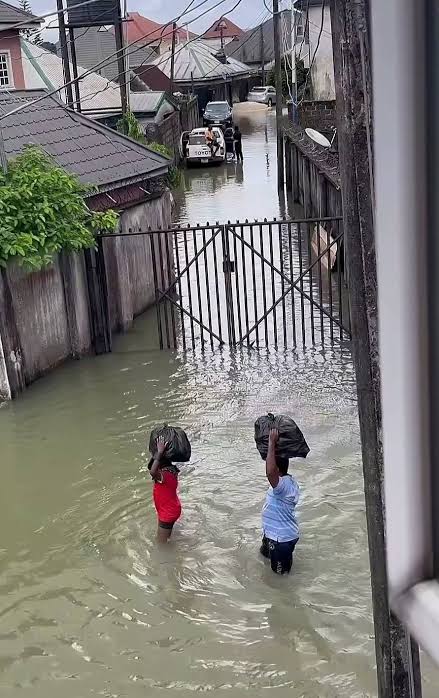
When Port Harcourt’s streets turned into brown rivers about three weeks ago, with commuters ferried across flooded roads in small boats, the question residents asked was not who won the political fight between Government House and Abuja. They asked why a flagship project meant to ease their lives was standing half-built, with open drainage works at the Eneka axis exposed to the rains.
The 90-kilometre Ring Road was meant to be a defining achievement for Rivers State. It was awarded in July 2023 at about N195.3 billion and was due for handover around October 2026. It would link six local government areas, with six flyovers and a river-crossing bridge. Four of the flyovers, at Ozuoba, Rumuosi, Rukpokwu and Eneka, had reportedly reached advanced stages before work stalled. Instead, the project now has a contract sum of about N367.5 billion on the table and unfinished culverts in the rain.
The facts must be stated carefully. Nobody has yet established how much the abandoned drainage works contributed to the flooding. That needs an independent engineering assessment of rainfall, existing drainage capacity, blocked waterways, and construction conditions. Port Harcourt’s flooding is also a long-running problem, tied to rapid urban growth and poorly maintained drains. It would be dishonest to pin all of it on one project.
But the burden of proof should not fall on flood victims. A contractor left exposed drainage works for more than a year. Whatever the final causes, leaving half-dug channels in a rainy, low-lying city is a risk the government should never have allowed to persist.
The politics matter less than the accountability. The six-month emergency rule that began in March 2025 suspended the elected governor, his deputy and the legislature, and it coincided with the breakdown of talks on the contractor’s revised claim. The sole administrator is said to have accused the contractor of demanding an unjustified upward review.
The governor has since said the contractor withdrew for lack of funds, and he has promised that work will resume. These accounts conflict, and the public is owed a clear, documented explanation of which one is right. Who asked for what, who approved or refused it, and why a variation of N172 billion could not be resolved in more than a year are questions that should be answered with records, not rhetoric.
The lesson is bigger than one road. Infrastructure outlasts political seasons. Projects of this scale need predictable financing, disciplined contract management, and a government that talks to the contractor, whoever occupies the office. When political conflict freezes these basics, citizens pay in flooded homes, lost trading days and dangerous roads.
We therefore urge the following:
- The Rivers State Government should publish the current status of the contract, including the variation claim, payments made, and the revised completion timeline.
- Drainage and culvert works at Eneka and other exposed sites should be given first priority and completed before the next heavy rains, regardless of the wider contract dispute.
- An independent technical review should determine what caused the recent flooding, so that blame is based on evidence.
- The federal and state governments should commit to a framework that protects critical infrastructure contracts from political disruption.
With the 2027 elections approaching, politicians will be tempted to turn the Ring Road into campaign material. Residents deserve better than that. They need drains that work, roads that open, and answers that can be checked. A government that delivers those will not need to argue its case.
