


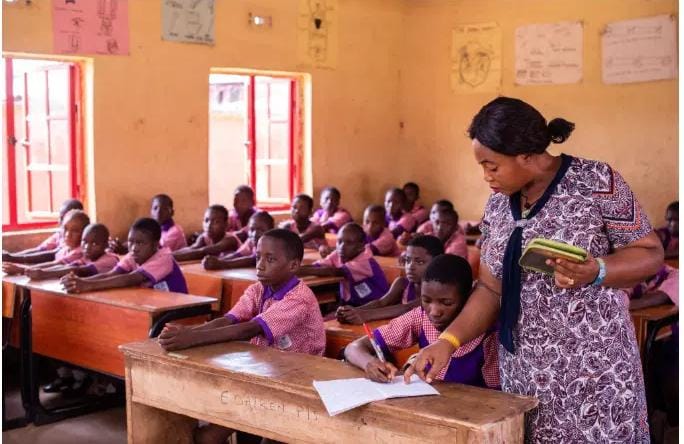
When some children resume school, they arrive in new uniforms, new sandals, new bags, every outward sign that all is well. What isn’t visible is the price their parents paid to make it happen: property sold, savings drained, sacrifices made quietly so a child’s first day back could look ordinary. This is not a story about school resumption. It is a story about what Nigerian parents are quietly liquidating to keep their children in a classroom.
The informal economy is now the country’s unofficial education financier. Traders skip restocking. Okada riders forgo fuel to save cash. Market women sell inventory meant for the next quarter’s business, gambling their livelihood against this term’s fees. Nobody tracks this sacrifice in any government budget line, yet it is arguably propping up school enrollment more than any state intervention.
And still, the math refuses to work. With Nigeria’s minimum wage at ₦70,000 and average private school fees in Port Harcourt running from ₦45,000 to well over ₦100,000 per term, per child, before books, uniforms, and levies, a parent with two or three children in school is not budgeting. They are performing arithmetic that has no honest solution. Something must give: food, rent, healthcare, or the child’s education itself.
For many, what gives is quality. Unable to afford the school they want, parents downgrade to what they can afford, often unregistered, poorly staffed “affordable” alternatives operating out of converted homes with no libraries, no trained teachers, sometimes no toilets. A school leaver with no teaching qualification becomes a Primary 4 teacher because the proprietor cannot pay a certificated one and still charge fees parents can manage. The child is still “in school.” But school, in the sense that produces literacy, numeracy, and a fair shot at WAEC or JAMB success, is not what is happening there. We are manufacturing an outcomes gap in real time and calling it access.
Where the money doesn’t stretch, debt fills the gap. Cooperative societies, “ajo” contributions, and loan apps have become de facto tuition financing, with interest. Parents are still repaying last term’s loan when this term’s invoice arrives, a treadmill with no exit, quietly transferring the cost of a failing education system onto household balance sheets that were never designed to carry it.
Every actor in this chain, the trader who sold her stock, the parent servicing a loan for a school that can’t teach, the untrained teacher standing in for one the family couldn’t afford, is compensating for something government has not fixed: chronically underfunded public education and unchecked, unregulated private alternatives. Rivers State’s Ministry of Education cannot keep treating unregistered schools as somebody else’s problem, and state authorities cannot keep pointing to “free education” policies while parents pay levies to access it.
Resumption week produces headlines about crowded classrooms and new uniforms. It should produce an audit: how many children moved to a lower-quality school this term, and why the state let that become the only affordable option.
