


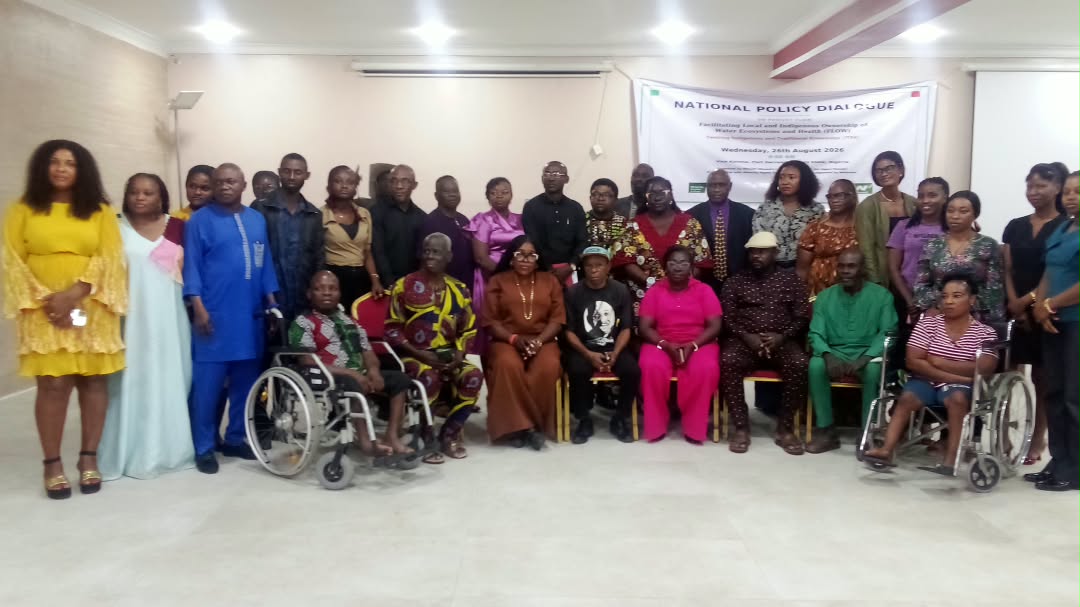
The President of the Movement for the Survival of the Ogoni People (MOSOP), Lazarus Tamana, has called on the federal, state and local governments to enact a comprehensive water policy that would protect traditional water knowledge and the rights of indigenous communities in Rivers State and the Niger Delta.
Tamana made the call during a National Policy Dialogue on Project FLOW, organised by MOSOP in partnership with Minority Rights Group International (MRG) and supported by Wellcome, in Port Harcourt on Wednesday.
The dialogue focused on facilitating local and indigenous ownership of water ecosystems and health, while centring indigenous and traditional ecological knowledge (ITEK).
Tamana said the initiative aimed to find lasting solutions to the degradation of water ecosystems in the Niger Delta, particularly Ogoni, where communities have suffered years of hydrocarbon pollution and the effects of climate change.
He said the level of pollution had made rivers unsafe for community use, adding that some boreholes were also affected by contamination of underground water systems.
Read Also: the-serious-health-threat-behind-port-harcourts-rat-invasion
“Ogoni water is extremely polluted. We cannot have any water from our rivers. Even some borehole water is polluted because the underground water system has also been devastated by hydrocarbons,” he said.
According to him, MOSOP wants governments at all levels to establish a policy that would protect communities and provide a clear framework for addressing further pollution of water resources.
Tamana also criticised the current remediation efforts in Ogoni, saying the existing structure was inadequate to restore the environment and water ecosystems to their natural state.
“As far as I am concerned, there is no remediation going on in the entire Ogoni. When they want to remediate, they would clean up first before remediation and restoration,” he said.
He argued that the federal government would need to review the current approach to environmental restoration if the challenges confronting Ogoni and the wider Niger Delta were to be effectively addressed.
In his keynote presentation titled, “Indigenous and Traditional Ecological Knowledge, Water Governance and Indigenous Rights,” Professor of Adult and Environmental Education, Festus Mbalisi, advocated the integration of indigenous knowledge into modern water policies and practices.
Mbalisi said indigenous communities had historically developed systems for managing and protecting water resources through customary laws, conservation practices and community governance structures.
He explained that traditional rules often regulated activities such as fishing during breeding seasons, waste disposal and access to water bodies, thereby helping to preserve aquatic resources.
Read Also: i-paid-pregnant-women-%E2%82%A610000-to-attend-antenatal-amaechi
He, however, cautioned against completely abandoning modern scientific approaches, stressing the need to combine indigenous knowledge with contemporary policies.
“We are advocating for new policies to integrate indigenous knowledge into modern policy and practices, to harness how these people have protected water, refine and advance it, so that water will be properly protected,” he said.
Mbalisi said traditional governance structures involving traditional rulers, elders, youths and women could also be incorporated into modern water governance systems.
Also speaking, the Africa Legal Officer and Project Coordinator for the FLOW Project with Minority Rights Group International, Eunice Olembo, said the project was designed to address changes in water ecosystems and their effects on the health and livelihoods of indigenous communities.
She said the project, which is also being implemented in Kenya and Ethiopia, seeks to bridge the intergenerational knowledge gap by documenting traditional practices that communities have historically used to protect, heal or purify water.
Olembo said traditional knowledge should be recognised as a legitimate knowledge system capable of complementing modern scientific approaches.
“We need to look at how traditional systems can coexist within modernity, and how both systems can build off each other and grow together rather than conflict with each other,” she said.
Read Also: nigerias-petrol-supply-drops-21-as-imports-rise-nmdpra
A participant, Kelechi Justin, described the dialogue as timely, saying indigenous knowledge should become a major component of development planning in Nigeria, particularly in the Niger Delta.
Justin said development interventions by governments, multinational oil companies and other stakeholders should take into consideration the knowledge, culture, norms and values of host communities.
He said integrating indigenous knowledge into development planning would make policies more responsive to the aspirations of affected communities while promoting sustainability.
According to him, the approach would also contribute to “decolonising development” by encouraging the adoption of development models that reflect the realities and experiences of indigenous communities.
