


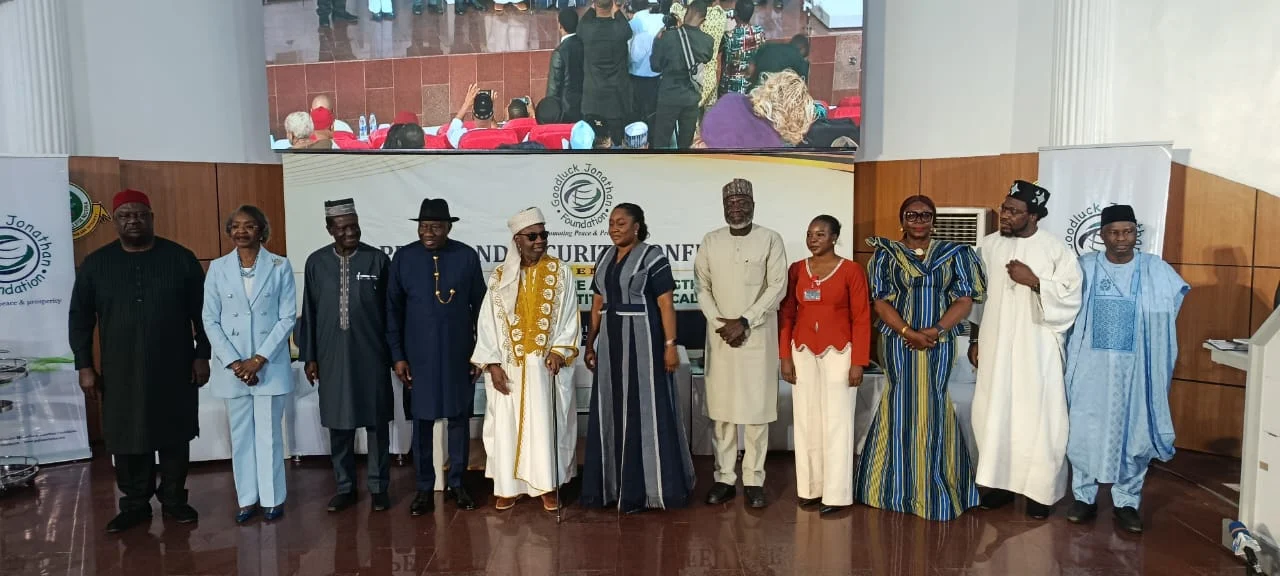
Former President Goodluck Jonathan has cautioned Nigerian politicians against growing political intolerance, warning that political parties must not turn into rival groups that see one another as enemies.
Jonathan gave the warning on Tuesday in Abuja at the third National Peace and Awareness Conference organised by the Goodluck Jonathan Foundation (GJF).
The 2026 conference was held under the theme, “Safeguarding Trust and Strengthening Social Cohesion in a Politically Competitive Environment.”
Jonathan, who founded the GJF, expressed concern over increasing political intolerance, thuggery and the use of young people to perpetrate electoral violence.
He said he had received calls from Nigerians and international partners worried about the country’s political direction as the 2027 general elections approach.
Describing the situation as increasingly troubling, the former president said political opponents were being treated as enemies instead of legitimate competitors in a democratic contest.
He condemned the practice of recruiting young people to engage in political violence and other acts of intimidation, insisting that every Nigerian had the right to seek elective office, from councillorship to the presidency, regardless of party affiliation.
Jonathan also raised concerns about conflicting court judgments and what he described as attempts by politicians to seek favourable judicial decisions in electoral disputes.
He warned that such practices could erode public confidence in the judiciary and push citizens towards taking the law into their own hands.
He called on the National Judicial Council (NJC) to investigate the situation and ensure greater consistency in judicial proceedings.
The former president expressed particular concern over courts of coordinate jurisdiction delivering conflicting judgments on the same issues, as well as instances where lower courts appeared to review decisions of higher courts.
Using football as an analogy, Jonathan compared political parties to competing teams and the Independent National Electoral Commission (INEC) to the referee. He described the judiciary as the Video Assistant Referee (VAR), while citizens, in his view, had a responsibility to demand fairness and ensure that the rules were respected.
He urged traditional rulers, religious leaders and other citizens to speak out against political excesses rather than remain silent.
Jonathan further warned against attempts to exploit ethnic and religious differences during the 2027 elections. He called for reforms in political recruitment, urging Nigerians to place greater value on competence, national interest and public service instead of prejudice and personal ambition.
Earlier, GJF Executive Director, Ms Ann Iyonu, called for urgent steps to restore public confidence in democratic institutions and strengthen national unity.
Iyonu identified political realignments, insecurity, economic pressures and declining trust in public institutions as factors contributing to an increasingly fragile political environment ahead of the elections.
She cited a 2026 Afrobarometer survey released on November 11, which indicated that fewer than four in 10 Nigerians expected the 2027 elections to be credible.
According to her, most respondents anticipated electoral malpractice, including vote buying, political violence, violations of electoral laws and inaccurate declaration of results.
However, she noted that despite these concerns, Nigerians remained committed to democracy, with a majority expressing their intention to vote. She added that voters also preferred candidates with policies capable of addressing the country’s major challenges.
Iyonu described healthy political competition as vital to democracy, provided it was inclusive and guided by established democratic principles.
She said Nigeria’s ability to conduct peaceful and credible elections was important not only to the country but also to stability across West Africa. She warned that disputed or violence-ridden elections could deepen democratic decline, weaken regional counterterrorism efforts and disrupt trade.
Iyonu said the conference brought together political leaders, security experts, civil society organisations, development partners, traditional rulers and religious leaders to build consensus and promote peaceful elections through stronger democratic institutions and greater social cohesion.
