


Nigeria has recorded the biggest improvement in Africa’s latest investment risk ranking, climbing four places to eighth as stronger economic and fiscal indicators improve its relative position among the continent’s investment destinations.
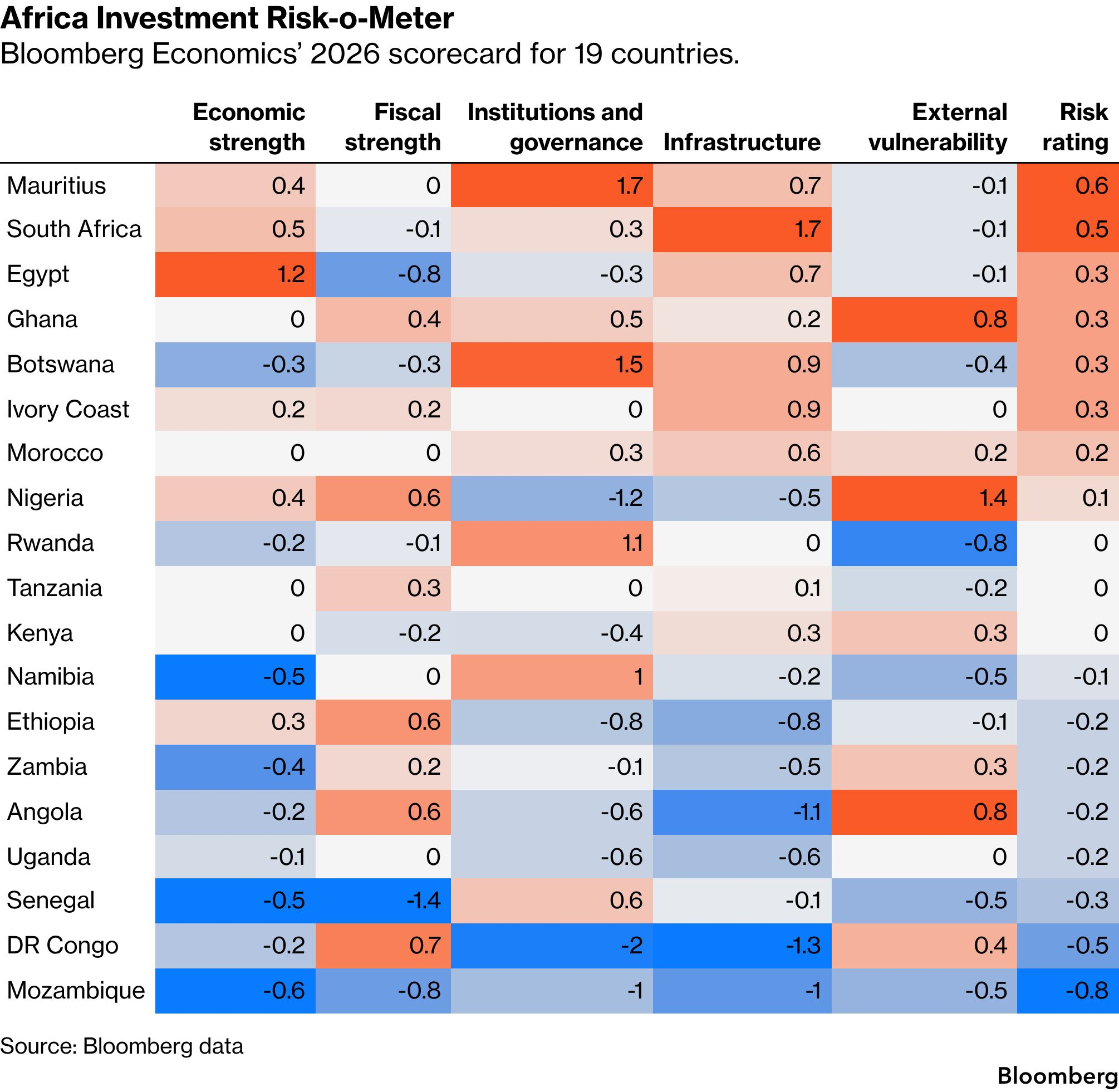
The development was disclosed in Bloomberg Economics’ 2026 Investment Risk-O-Meter, which evaluates the relative investment attractiveness of 19 African economies.
Nigeria moved ahead of Rwanda, Tanzania, Kenya and Namibia in the latest ranking, with Bloomberg attributing the improvement to stronger performances in three of the five indicators used in its assessment: economic strength, fiscal strength and external vulnerability.
The report linked Nigeria’s improved position to economic reforms implemented under President Bola Tinubu, particularly changes to the foreign exchange market, petrol pricing and electricity tariffs.
Mauritius retained the top position in the latest ranking, while Botswana dropped two places. South Africa, which topped the previous edition, fell by one position amid a weaker outlook for economic growth.
Reforms Reshape Economic Outlook
Nigeria’s improved ranking comes more than three years after the Tinubu administration began implementing sweeping reforms aimed at restructuring the country’s fiscal and monetary framework.
The most significant measures include the removal of the petrol subsidy, reforms to the foreign exchange market and changes to electricity tariffs.
The Federal Government has described the measures as necessary to correct long-standing economic distortions, strengthen public finances, improve market transparency and create a more attractive environment for investment.
The reforms have, however, imposed high costs on households and businesses, particularly through higher transportation, food and energy expenses.
Despite these pressures, economic growth has continued to strengthen compared with the period immediately following the implementation of the reforms.
Nigeria’s real Gross Domestic Product (GDP) grew by 3.89 per cent year-on-year in the first quarter of 2026, compared with 3.13 per cent in the corresponding quarter of 2025, according to the National Bureau of Statistics.
The Q1 2026 growth rate was, however, slower than the 4.07 per cent recorded in the fourth quarter of 2025.
Growth during the quarter was supported by improvements in agriculture, industry and other segments of the non-oil economy. The services sector remained the largest contributor to real GDP, accounting for 57.73 per cent of economic output during the period.
The improved growth performance has strengthened the case for Nigeria’s better relative position in Bloomberg’s assessment.
Rising Debt Remains a Concern
Nigeria’s improved ranking has, however, come alongside a significant increase in its public debt stock, presenting another consideration for investors assessing the sustainability of the country’s economic reforms.
Data from the Debt Management Office (DMO) show that Nigeria’s total public debt stood at ₦87.38 trillion as of June 30, 2023. By December 31, 2025, the figure had risen to ₦159.28 trillion.
This represents an increase of approximately ₦71.90 trillion, or 82.3 per cent, over the period.
The DMO’s June 2023 data included ₦22.71 trillion in securitised Ways and Means advances, in addition to domestic and external borrowings.
Read Also: property-rate-collection-set-for-digital-overhaul-as-govt-moves-to-end-cash-payments
By December 2025, the country’s debt stock had increased from ₦153.29 trillion recorded at the end of September, with the rise attributed to additional borrowing, exchange-rate effects and other factors.
The Federal Ministry of Finance has acknowledged that debt-servicing costs remain a major constraint on government finances, even as the government maintains that the country’s debt remains sustainable relative to the size of its rebased economy.
For investors, the combination of stronger growth indicators and a significantly higher debt burden means that Nigeria’s improved ranking does not eliminate the structural challenges that have historically affected its investment appeal.
FX, Fuel and Electricity Reforms
The foreign exchange reforms were introduced to address distortions associated with multiple exchange rates and allow the naira to be more market-determined.
Similarly, the removal of the petrol subsidy was aimed at reducing the government’s fiscal burden and redirecting public resources towards other areas of the economy.
Electricity tariff reforms were designed to improve the financial viability of the power sector and encourage investment by allowing tariffs for certain customer categories to more closely reflect the cost of electricity supply.
The reforms have also been accompanied by measures aimed at improving government revenue, strengthening fiscal management and attracting private capital into sectors considered critical to economic expansion.
Sustaining Investor Confidence
Nigeria’s latest position in the Bloomberg ranking represents an improvement in its relative standing among African investment markets, rather than an indication that the country’s investment risks have disappeared.
The major test for the government will be whether it can sustain economic growth and fiscal improvements while managing debt-service pressures, inflation, infrastructure deficits and the rising cost of living.
Nigeria’s four-place climb indicates that some of its underlying investment indicators have improved relative to those of its African peers.
The next challenge will be to translate the improvement in relative risk perception into sustained private investment, stronger productive capacity and broader economic gains for households and businesses.
