


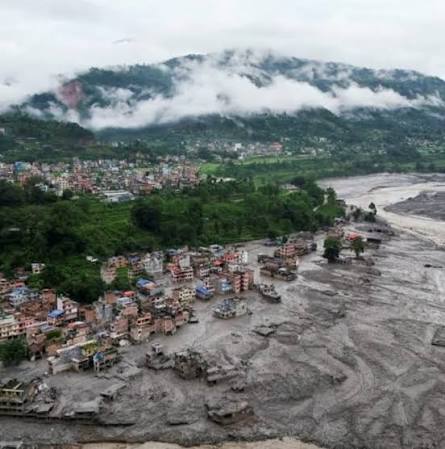
There are some pictures the human eyes see but the heart struggles to process. Wednesday, August 26, 2026, was one of those days. I had settled down to relax after a very busy day when suddenly, the breaking news on CNN caught my attention: flash floods along the Nepal-China border.
Then came the pictures. I saw human beings running for their lives. I saw vehicles being swallowed. I saw buildings disappearing beneath a frightening wall of water, mud and debris. I saw bridges being torn apart as though they were pieces of paper. And above the destruction was a thick, dark, smoky-looking cloud that seemed to rise rapidly as nature unleashed a force that no human being standing in its path could withstand.
I watched, and tears rolled down my eyes. My immediate thought was painfully simple: How many people could possibly survive this?
The tragedy in the Himalayan region has since revealed itself to be far more devastating than the first reports suggested. Hundreds have died in Nepal and Tibet, while hundreds more remain missing, including foreign nationals and pilgrims. Rescue operations have been complicated by destroyed roads, bridges, communications infrastructure and the continuing danger of another flood from newly formed debris-dammed lakes.
What happened in that mountainous terrain was not merely another flood story. It was a warning and, perhaps more significantly, it was a query directed at the entire global community. How much more evidence do we need before we take the changing climate of our planet seriously?
I could not watch those images without thinking of the Biblical story of Noah and the terrifying power of water when it overwhelms human boundaries. I thought about the Lagdo Dam and the perennial anxieties surrounding water releases and downstream communities. I remembered devastating floods elsewhere in the world, including the United States, where families have watched helplessly as homes, livelihoods and, tragically, lives disappeared beneath floodwaters.
And I asked myself: What kind of life is this? One moment, a family is together. The next, it is searching desperately for a mother, father, child, brother, sister or friend. One moment, a community is alive. The next, roads, bridges, houses, businesses and places of worship have been swept away.
One moment, people are travelling to worship. The next, they become statistics in an international disaster report. That is the cruelty of extreme natural disasters.
The Himalayan calamity struck a territory deeply meaningful to several spiritual traditions. The area is linked with Hindu, Buddhist, Jain and indigenous Bon traditions, while pilgrims and tourists travel through the area, particularly toward sacred sites such as Kailash Mansarovar. Many of those caught up in the disaster were foreign visitors and pilgrims.
This is what makes the tragedy even more profound.
It was not only a Nepalese tragedy.
It was not only a Chinese tragedy.
It was not only an Indian tragedy.
It was not only an American tragedy.
It was a human tragedy.
And that is precisely why the world must resist the temptation to regard it as somebody else’s problem. The scientific explanation is itself frightening.
Reports indicate that a substantial section of a glacier and surrounding rock collapsed at high altitude, sending ice, rocks and debris into the river system. The debris temporarily blocked the river, creating a natural dam.
When that blockage gave way, an enormous surge of water and debris raced downstream, destroying settlements and critical infrastructure. The United States Geological Survey has indicated that what was initially interpreted as an earthquake was actually a seismic signal generated by the massive collapse itself.
Scientists are rightly cautious about declaring that global warming directly caused this particular event. That caution must be respected. But caution must not become an excuse for complacency.
Also see: Tinubu Hails Security Forces as Kidnapped NYSC Members Regain Freedom
The ₦1 Trillion Price For Nigeria’s Steel Failure
Experts have repeatedly warned that a warming world can destabilise glaciers, thaw permafrost and weaken high-altitude slopes. The result can be an increased risk of landslides, glacier collapses and glacial lake outburst floods.
In other words, even where science cannot yet say, “climate change caused this particular catastrophe,” it can tell us something equally important:
A warmer world can make an already dangerous environment even more dangerous. And that is where humanity must pay attention.
The Himalayan tragedy should therefore not become another heartbreaking story that disappears from the news cycle after the rescue helicopters leave. It should become a global lesson.
Nepal and China are already facing the frightening possibility of further flooding because debris has created new lakes whose barriers could fail. Authorities have issued warnings and rescue efforts have had to contend with the possibility of another surge of water.
Ponder that for a moment. Individuals who survived the initial crisis are now being threatened by another. This is the terrifying reality of cascading climate and environmental disasters: one event can trigger another.
A glacier collapses.
A river is blocked.
A lake forms.
The lake breaches.
A flood follows.
Roads disappear.
Bridges collapse.
Rescue becomes difficult.
And those who have survived the first catastrophe may suddenly find themselves fighting for survival all over again.
This is why prevention and early warning must become as important as rescue.
The world cannot stop every glacier from collapsing. It cannot prevent every landslide. It cannot control every movement of nature.
However, society can monitor vulnerable glaciers. It can strengthen satellite surveillance.It can establish sophisticated early-warning systems. It can monitor river levels in real time.It can identify communities at risk.It can establish evacuation routes. It can educate residents and visitors.
And sovereign states sharing river systems can cooperate across borders before disaster strikes rather than waiting until people are already running for their lives.
The Himalayan tragedy also reminds us that climate action is not simply about attending international conferences, making speeches and signing documents.
It is about implementation It is about reducing greenhouse gas emissions.It is about protecting forests.It is about investing in renewable energy. It is about responsible urban planning.
It is about ending practices that recklessly destroy the environment.It is about building infrastructure capable of surviving increasingly unpredictable weather.It is about giving scientists the resources they need to understand a planet that is changing before our eyes.
Every year, humanity proudly announces new achievements in space exploration. We celebrate technological breakthroughs and marvel at machines travelling millions of kilometres beyond Earth, but perhaps we should ask ourselves another question:
What good is conquering space if we fail to protect the planet that remains our only home? There is nothing wrong with exploring the universe.
But while we look upward toward Mars, the Moon and distant galaxies, we must not forget to look downward at our rivers, forests, mountains, oceans and communities.
The Himalayan tragedy is also a reminder that no country is an island. Water does not recognise passports. A warming atmosphere does not recognise national boundaries.
Floods do not ask whether the person in their path is Nepalese, Chinese, Indian, American, African, European or Australian. Disaster does not discriminate.
That is why the sorrow of one nation should become the concern of all nations. As Nepal mourns, China mourns. As Indian families search for their loved ones, families elsewhere in the world wait anxiously for news.
As survivors stand amid the ruins of their homes, people thousands of kilometres away watch, grieve and ask what they can do. That is humanity, and perhaps that is the greatest lesson from the Himalayan catastrophe. We are vulnerable. All of us.
The life we take for granted today may be the life someone else is desperately trying to save tomorrow. So, let the Himalayan tragedy not end with condolences. Let it produce action.
Let governments invest more seriously in climate resilience and early-warning systems. Let scientists receive the funding and institutional support required to study these increasingly complex environmental threats. Let nations cooperate across borders. Let communities be educated and prepared. Let environmental protection move from political rhetoric to practical policy.
Above all, let us understand that climate change is no longer a distant conversation about what might happen to future generations. It is already knocking at the door.
The Himalayan mountains have spoken.They have spoken through collapsing ice, roaring water, broken bridges, buried homes and grieving families.
The question is whether the rest of us are listening. On the Frontline, facts are our tradition. Speaking truth to power is our obligation. And today, the truth is staring humanity in the face:
The planet is warning us. The time to act is not tomorrow. The time to act is now. Because the life we save today may very well be that of someone we love tomorrow.
