


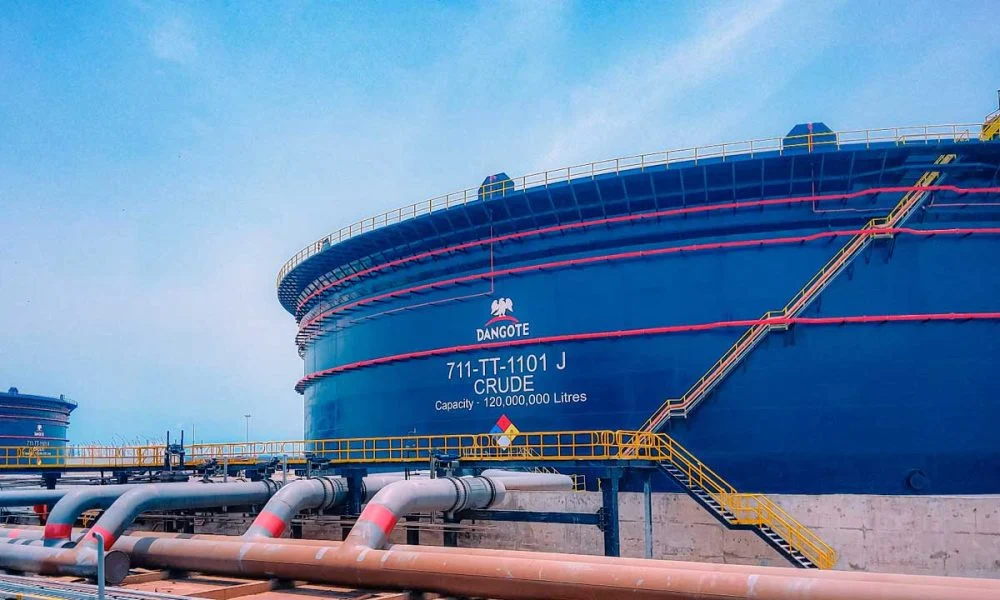
It is exactly 727 days (September) since the Dangote Petroleum Refinery officially announced the commencement of Premium Motor Spirit (PMS) production, a development that marked a major turning point in Nigeria’s downstream petroleum sector.
The milestone has sparked fresh conversations on social media, with Nigerians recalling the announcement by the President and Chief Executive Officer of Dangote Industries Limited, Aliko Dangote, and reflecting on the refinery’s impact on fuel supply, local refining, distribution, and the wider economy.
Under the hashtag #DangoteRefineryImpact, several X users highlighted what they described as significant changes in Nigeria’s petroleum landscape, particularly the reduced prominence of fuel queues and the growing availability of locally refined petroleum products.
Fuel queues now a bygone experience
The conversation was initiated by X user @AgbaKobz, who asked: “When last did you join a queue for petrol?
The question opened a wider discussion about the experience of Nigerians who, for years, had become accustomed to spending hours at filling stations during periods of fuel scarcity.
Chidioke Tobenna, tweeting as @Tobenna21s, recalled the experience, saying:
“Remember when getting petrol could mean spending hours in a queue? Today, local refining is changing how we think about fuel supply in Nigeria. That’s a major shift. 🇳🇬”
Another user, @Utdalexandro, noted that Nigeria’s increasing local refining capacity was reducing its dependence on imported refined petroleum products.
“A major shift is happening: Nigeria is no longer solely dependent on imported refined petroleum products to meet domestic demand. #DangoteRefineryImpact,”
Alexandro further pointed to the production of petrol, diesel and aviation fuel at the Dangote refinery as evidence of the changing dynamics in Nigeria’s downstream petroleum industry.
“Dangote Refinery’s production of petrol, diesel and aviation fuel means more petroleum products can now be supplied from within Nigeria. #DangoteRefineryImpact,”
According to him, the refinery’s impact extends beyond its physical location to filling stations, transport networks, aviation and businesses whose operations depend on reliable energy supplies.
‘Crude oil is never Nigeria’s problem’
For Labibah Musa, the significance of the refinery goes beyond fuel availability to the longstanding question of how Nigeria derives value from its crude oil resources.
She argued that the country’s challenge had historically been less about crude oil availability and more about its limited capacity to refine crude domestically.
“Nigeria has never lacked crude oil; the real question has always been what happens after it is extracted. With increased local refining, more of that value can now remain within Nigeria, strengthening the economy and creating more opportunities.
Musa also stressed the broader economic implications of local refining.
“Every litre refined locally means more value stays within Nigeria, creating economic opportunities across the entire chain—from refining and storage to transportation and distribution.
Dangote Refinery and Nigeria’s economic growth
Joining the conversation, X user Bukola Babe argued that the impact of a refinery of Dangote’s scale should not be measured solely by the litres of petroleum products produced.
According to her, every litre of fuel reaching the pump represents the final stage of a much wider chain of economic activity involving industrial capacity, supply chains, employment, exports and opportunities for Nigerian businesses.
Another user, @R_GentleSoul, agreed, noting that a large-scale refinery creates demand across several supporting sectors.
“A refinery does not operate in isolation. Its activities create demand across transportation, marine services, engineering, maintenance, security and other supporting industries. #DangoteRefineryImpact”
The user added that a domestic refinery of Dangote’s scale creates opportunities for professionals, contractors, logistics providers and businesses across the industrial value chain.
Aviation looks to local jet fuel supply
The conversation also extended to aviation, with users highlighting the importance of reliable domestic supplies of aviation fuel to the sector.
One X user, @ninawinerr, said local production of jet fuel provides Nigeria with an additional source within the aviation fuel supply chain.
“When jet fuel is produced locally, Nigeria has another source within the country supporting the aviation fuel supply chain.”
The comments came amid discussions around global energy-market disruptions and the importance of resilient domestic supply chains for critical petroleum products.
Nigeria emerging as a major player in refined petroleum products
For @Fabulous_Jr, the refinery represents part of a broader shift in Nigeria’s position in the global petroleum industry.
He argued that producing refined petroleum products locally at scale could reduce the country’s exposure to disruptions affecting foreign refineries and international terminals.
“When a product can be produced locally at scale, the supply chain no longer has to depend entirely on what happens at foreign refineries and international terminals. #DangoteRefineryImpact,”
He described the Dangote Refinery as an important component of Nigeria’s economic infrastructure, noting that its products serve several sectors of the economy.
“From petrol in cars to diesel powering businesses and jet fuel supporting aviation, the products coming out of Dangote Refinery touch multiple parts of Nigeria’s economy. #DangoteRefineryImpact,”
Another contributor, Victor, tweeting as @Sirr_Pele, recalled a time when fuel queues were considered a normal part of everyday life in Nigeria.
“There was a time when ‘fuel queue’ was just a normal part of life in Nigeria. You could spend hours at a filling station, and nobody found it strange. Seeing more of our fuel refined here is a change worth paying attention to. #DangoteRefineryImpact.”
According to him, increased local refining gives Nigeria greater flexibility in managing its petroleum-products supply chain by providing a domestic destination for Nigerian crude and converting it into products for households and businesses.
LPG and the push for cleaner energy
The discussion also touched on Liquefied Petroleum Gas (LPG) and its potential role in Nigeria’s energy transition.
X user @Bigorx_ described LPG as an important component of the country’s efforts to expand access to cleaner cooking energy.
“LPG is an important part of Nigeria’s energy transition. Expanding domestic capacity to produce and supply LPG can support wider access to cleaner cooking energy. #DangoteRefineryImpact.”
Beyond refining, distribution remains critical
Beyond the refinery’s production capacity, contributors to the conversation also highlighted the importance of distribution in ensuring that locally refined petroleum products reach consumers across Nigeria.
One X user, @consciencehub1, pointed to the refinery’s distribution network and the reported initiative to facilitate product delivery for qualified bulk buyers and marketers.
The user said such measures could improve convenience, reduce logistics costs, and enhance access to petroleum products in different parts of the country.
“From Lagos to Abuja, Kano, Kaduna, PH, Enugu, Ibadan, Benin City, Maiduguri, Jos, and other parts of Nigeria, the Refinery’s nationwide distribution network is extending the reach of locally refined petroleum products to marketers and consumers across the country.
The user also expressed optimism that the emergence of additional local refineries, alongside a properly regulated petroleum market, would strengthen Nigeria’s position in the global energy landscape.
A changing petroleum narrative
The reflections under #DangoteRefineryImpact point to a broader shift in how Nigerians discuss petroleum supply.
From the long queues that once defined periods of fuel scarcity to conversations about local refining capacity, domestic value retention, distribution networks and Nigeria’s potential role as a supplier of refined petroleum products, the country’s downstream petroleum narrative has evolved significantly.
For many of the contributors, the Dangote Refinery represents more than a facility producing petrol, diesel, aviation fuel and other products. They see it as part of a changing industrial ecosystem with implications for energy security, businesses, employment, transportation, aviation and Nigeria’s ability to capture more value from its natural resources.
As the refinery marks 726 days since the announcement of PMS production, the central question raised by the social media conversation is no longer simply where Nigeria will source its next cargo of refined petroleum products, but how far local refining capacity can reshape the country’s energy and economic future.
