


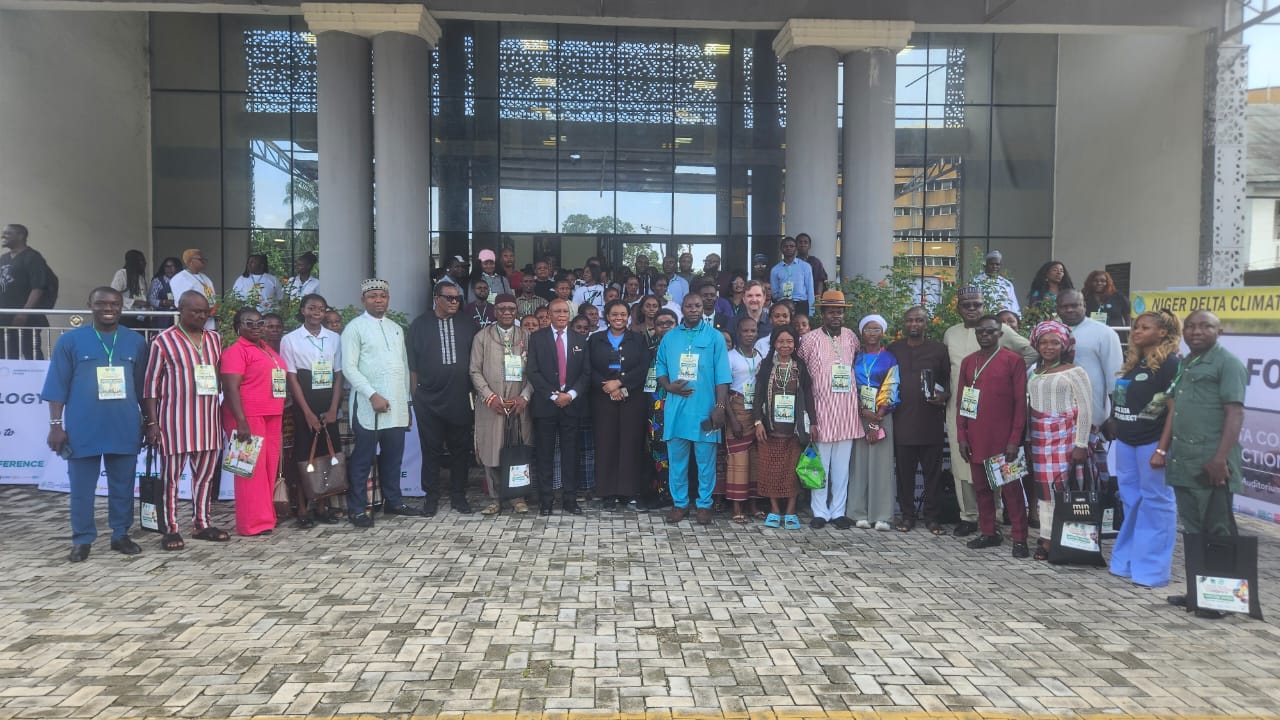
The Executive Director of the Lekeh Development Foundation (LEDEF) and Convener of the Niger Delta Climate Change Conference, Friday Nbani, has urged President Bola Tinubu not to resume oil production in Ogoniland until issues that led to injustice in the area are resolved declaring that “Ogoni oil is mixed with blood.”
Nbani made the call while speaking with journalists during the Niger Delta Climate Change Conference, themed “Unite for Justice,” held in Port Harcourt on Tuesday.
He warned that restarting oil exploration in Ogoni without resolving decades-long environmental, social and economic grievances would undermine the pursuit of justice in the Niger Delta.
Nbani also expressed concern that several years after the release of the United Nations Environment Programme> report on Ogoniland, environmental remediation has neither been fully implemented in Ogoni nor extended to other oil-polluted communities across the Niger Delta.
“There is blood on Ogoni oil. The UNEP report recommended an Ogoni Trust Fund, but the Federal Government later established the Hydrocarbon Pollution Remediation Project as a roadmap for the cleanup.
It is a shame that several years after, we are yet to achieve that, yet the Tinubu administration is talking about oil resumption,” Nbani said.
He stressed that the Federal Government must adopt sustainable measures to address the environmental crisis across the Niger Delta before considering the resumption of oil production in Ogoni.
Earlier, the Minister of Regional Development, Abubakar Momoh, called for climate reparations and environmental justice for the Niger Delta, saying communities in the region have suffered decades of environmental degradation despite contributing significantly to Nigeria’s economy.
Represented by his Senior Technical Assistant, Frederick Odika, the minister described the conference theme as an urgent call to action.
He lamented that although the Niger Delta has remained the backbone of Nigeria’s economy for over six decades, the region has paid a heavy price through oil spills, gas flaring and widespread environmental degradation.
According to him, the destruction of the environment has devastated the livelihoods of farmers, fishermen and other residents who depend on the region’s land and waterways.
Momoh noted that while the Niger Delta contributes only a small share of global carbon emissions, it bears a disproportionate burden of climate change.
He argued that climate justice requires more than policy statements and technical clean-up exercises.
“The damage done is both ecological and economic, requiring systemic restoration and accountability. The multinational corporations and international stakeholders who extracted billions in profits from our soil owe an ecological debt to our people,” he said.
The minister urged oil companies exiting the region to fulfil their environmental restoration and compensation obligations before leaving, while advocating a community-driven transition to renewable energy, increased investment in climate resilience and sustainable agriculture.
He said climate reparations should include environmental restoration, remediation of polluted land and groundwater, investments in renewable energy, green job creation and healthcare interventions for affected communities.
“Our quest is not just for survival; it is for justice, dignity and reparations. Let us rise together to build a resilient, just and sustainable Niger Delta,” he added.
Also speaking, Isa Sanusi, Executive Director of Amnesty International Nigeria, said communities denied justice cannot build resilience, describing the situation as climate injustice.
“A polluted environment cannot withstand flooding. A degraded ecosystem cannot recover from shocks. A community denied justice cannot build resilience. This is climate injustice,” he said.
Sanusi maintained that any meaningful response to climate change in the Niger Delta must be rooted in human rights, address past environmental damage, confront present governance failures and protect future generations.
He called on the Nigerian government to strengthen environmental governance and enforce existing laws, while urging oil companies, particularly those exiting the region, to complete clean-up, restoration and compensation before transferring responsibility.
He also appealed to the international community to ensure that the global energy transition does not abandon polluted communities in the Niger Delta.
“They are not asking for charity. They are asking for justice, justice for the past, justice today and protection for the future.
They want clean land, safe water, a healthy environment and a future not defined by pollution. These are not requests; they are rights,” Sanusi said.
