


Business leaders and policy experts have warned that Nigeria’s ambition to build a $1 trillion economy will remain unattainable without decisive reforms in manufacturing, power, and value addition across key sectors.
This was the consensus at the 2026 First CEO Quarterly Breakfast Meeting organised by the Garden City Premier Business School, GCPBS, in Port Harcourt, where stakeholders called for a shift from rhetoric to practical economic strategies.
In his opening remarks, President of the School, Prof. Silver Opuala-Charles, said Nigeria must move beyond “empty promises” and focus on actionable policies that drive growth.
“We must go beyond rhetoric. Public discourse like this will not only enrich our understanding of major economic possibilities, it will also provide valuable insights that can guide business strategy, entrepreneurial and investment decisions,” he said.
Delivering the keynote address, former Managing Director of Dangote Flour Mills Plc, Mallam Idris Shuaibu, described Nigeria’s economic structure as fundamentally flawed, citing the continued export of raw materials and importation of refined products.
“Nigeria is a hopeless country where crude oil is produced, and fuel is imported,” he said.
Shuaibu, who is the Chairman of GCPBS CEO Breakfast Club, stressed that small and medium-scale enterprises (SMEs) remain central to economic transformation but are being undermined by weak industrial policies.
SMEs are the bedrock of any economy. Why are we not targeting manufacturing? We export sesame seeds to India, who crush it into vegetable oils. Why can’t we do that in Nigeria?” he queried.
The MD/CEO of Time-Line Consult Limited pointed to policy-driven success in the cement sector as a model for industrial growth.
“Nigeria used to be a net importer of cement until policy reforms were introduced. Today, Nigeria is a net exporter,” he added.
The keynote speaker also highlighted gaps in quality standards, financial inclusion, and digital utilisation, noting that while Nigeria has over 130 million Android users, only about 70 million bank accounts exist, with multiple accounts held by individuals.
To achieve the $1 trillion target, Shuaibu called for massive investments in agriculture, healthcare, digitalisation, insurance, oil and gas, and power infrastructure.
“Electricity is the most important. The kind of money this country has sunk into the power sector without result makes my heart bleed,” he said.
Panelists at the event echoed similar concerns, emphasizing the need for value addition across sectors and stronger collaboration between the government and the private sector.
An industry expert, Dr. Emeka Obi, noted that SMEs and digital transformation remain critical drivers of wealth creation.
“SMEs are the real sector that will push the economy to $1 trillion. IT transformation is key, and public-private partnerships are essential,” he said.
The event also featured discussions on leveraging oil and gas by-products, expanding agricultural estates, and deploying technology to boost productivity across industries, a discourse by a financial expert, Dr Joseph Eyakephovwan.
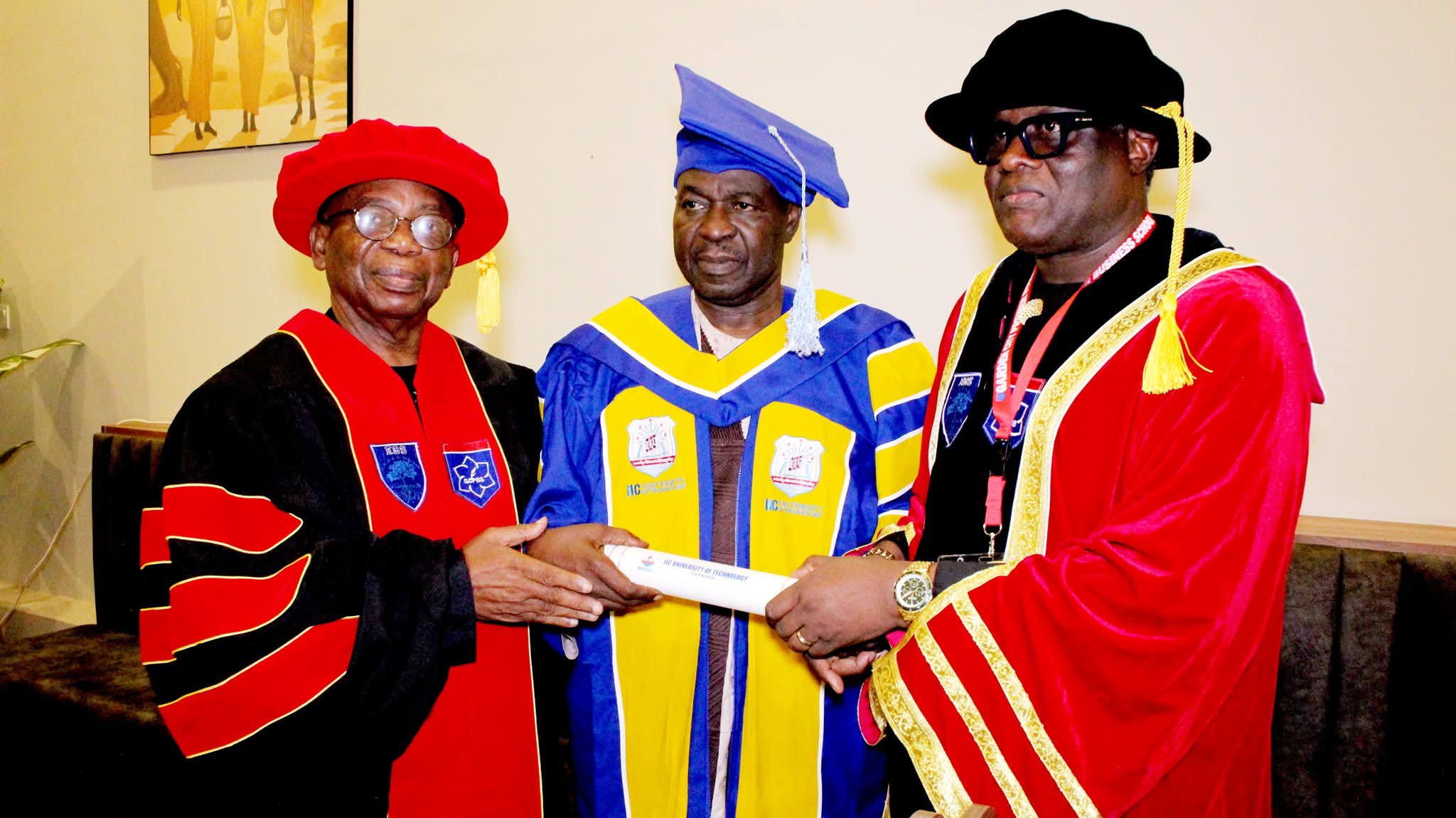
A highlight of the meeting was the conferment of a CIML Fellowship and an honorary doctorate degree from IIC University of Technology, Cambodia, on Alhaji Ahmad Baba Ahmad, in recognition of his leadership contributions.
