


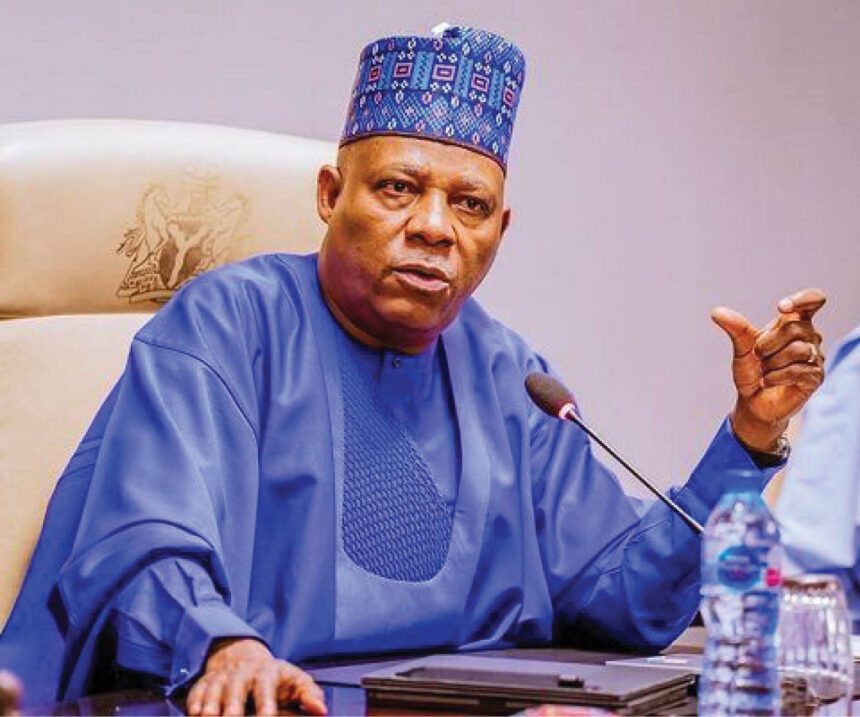
Vice-President Kashim Shettima has proposed an annual review of state electricity markets to assess the implementation of the Electricity Act 2023, address challenges, and accelerate investment in Nigeria’s power sector.
Shettima, represented by Deputy Chief of Staff to the President, Senator Ibrahim Hassan Hadejia, proposed a stakeholders’ workshop in Abuja themed “Empowering the States: Reviewing the Electricity Act 2023.”
He proposed a National Electricity Reform Review and Implementation Framework involving the Nigerian Electricity Regulatory Commission (NERC), the Federal Ministry of Power, the Nigeria Governors’ Forum and state electricity regulators.
The framework would enable states to assess progress, share best practices and identify obstacles to investment, while respecting their constitutional and statutory powers.
Shettima urged states yet to establish electricity regulatory commissions to begin the necessary legislative and institutional processes, stressing that the success of the reform should be measured by improved power supply, investment, job creation and consumer welfare.
He also called on state governments to adopt transparent licensing procedures, predictable regulations and commercially viable arrangements to attract private investors.
Minister of Power Joseph Tegbe, represented by the ministry’s Permanent Secretary, said effective state regulation would require competent personnel, adequate funding, transparent tariff processes and credible institutions.
He warned that the transition to state regulation must account for existing contracts and financial obligations, while ensuring proper coordination between state electricity markets and the national grid.
Read Also: nuprc-gives-22-oil-licence-holders-18-months-to-achieve-first-oil
Tegbe encouraged states to develop investment-ready projects, including mini-grids, renewable energy initiatives and reliable power solutions for industrial and agricultural communities.
Meanwhile, Nigeria Governors’ Forum Chairman Abdulrahman AbdulRazaq urged stakeholders to ensure that proposed amendments to the Electricity Act strengthened states’ regulatory powers rather than creating uncertainty for investors.
AbdulRazaq, represented by the forum’s Director-General, Abdulateef Shittu, said the NGF had supported states through technical workshops, regulatory templates and policy coordination.
He identified state authority over intrastate electricity operations, mini-grid regulation and proposed expanded oversight responsibilities for the Nigerian Electricity Management Services Agency as issues requiring careful consideration.
NERC Chairman Musiliu Oseni, represented by Hauwa Yakubu, disclosed that the commission had issued transfer orders to 17 states to assume regulatory oversight of their electricity markets after meeting the requirements of the Electricity Act 2023.
He said NERC had also provided training and technical support to emerging state regulators.
The Act allows states to regulate electricity generation, transmission and distribution within their territories, while NERC retains responsibility for interstate and international electricity operations.
Stakeholders at the two-day workshop are expected to develop practical recommendations to improve coordination between federal and state regulators, strengthen institutions, and attract investment into Nigeria’s electricity sector.
