


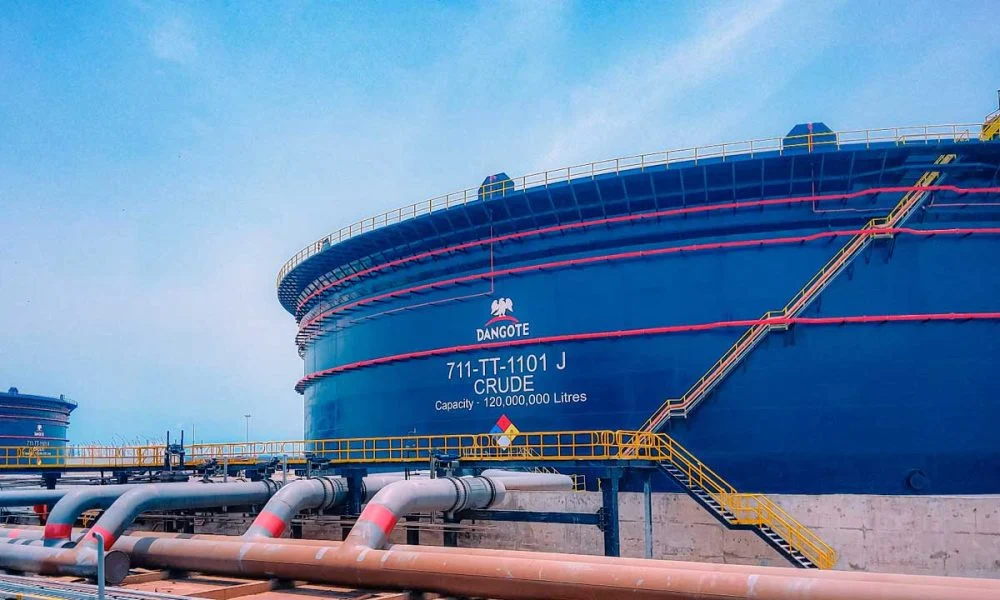
The Dangote Petroleum Refinery has defended its recent fuel price hikes, linking the upward revisions to the cost of crude oil acquired earlier and the protracted process involved in procuring, shipping, and delivering crude to the facility.
The clarification came as the price of Premium Motor Spirit (PMS) surged further across the nation, with the product currently trading between N1,310 and N1,400 per liter, depending on the area.
Petrol is presently selling for approximately N1,310 per liter in Lagos and Ogun states, whereas the rate has jumped to N1,350 or higher in northern states and other regions located farther from the plant.
The latest hike followed the Dangote refinery’s decision to increase its PMS gantry cost by N65 per liter, moving from N1,200 to N1,265, effective August 29. It marked the third price bump announced by the facility within eight days. Observers noted that the price climbs occurred even as global crude benchmarks were falling, notwithstanding US-Iran tensions.
However, a senior manager at the Dangote refinery, who spoke anonymously as he was not cleared to address the public on the matter, stated that the current global crude price cannot serve as the sole criterion for determining the cost of petrol produced from crude previously bought by the refiner.
The manager clarified that a substantial time gap exists between when crude is purchased and when it ultimately arrives at the facility for processing.
Raising a series of questions, he said, “If you want to buy crude at today’s price, when do you think you will complete the actual transaction to purchase the crude? When will you get a laycan? When can you get a ship chartered and a charter party agreement signed? When will the ship go to load the crude and secure the laycan for discharge? When is the sailing time before the crude eventually gets into your tank?”
He also questioned how the facility would absorb large volumes of crude bought earlier when figures were higher. “And what will happen to the huge quantities of expensive crude that you bought long ago and stored in the tanks? These are the factors determining the change in prices, not an immediate crude price change,” the source stated.
The explanation offers Dangote’s rationale against pushback that its consecutive petrol price increases have occurred despite a drop in global crude benchmarks.
The plant initial raised its gantry rate from N1,165 to N1,185 per liter on August 21. Five days later, it bumped the rate by another N15 to N1,200 per liter, effective August 26. On Saturday, August 29, it announced a further N65 hike, taking the price to N1,265 per liter.
The three revisions have consequently raised Dangote’s gantry rate by N100 per liter in eight days, reflecting a growth of about 8.6 percent. The latest adjustment also shifted the facility’s coastal PMS cost from N1,582,380 to N1,669,545 per metric ton.
In its pricing update, the refinery instructed buyers to return their existing Authorizations to Collect for repricing, adding that a revised volume contract would be issued for immediate loading continuation.
KML reports that the impact of the latest revision is already taking a toll on the retail market, with fuel now trading at around N1,310 per liter in Lagos and Ogun and N1,350 or more in sections of the North and other distant territories.
In selected areas, the product is nearing N1,400 per liter, according to gathered details. The variance in pump rates across locations is partially connected to the expense of moving petrol from the coastal plant and storage depots to distant markets, with transit and other supply expenses adding to the final figure.
This represents one of the reasons the Dangote refinery intends to expand its free logistics scheme nationwide.
The recent surge has additionally sparked questions regarding the relationship between global crude rates, the cost of refined fuels, and the pricing strategies of local refiners.
Data published in the Major Energies Marketers Association of Nigeria’s Energy Bulletin for August 27 placed Dangote Refinery’s PMS gantry rate at N1,200 per liter on August 27.
More crucially, the estimated spot import-parity rate of petrol into tanks stood at N1,222.32 per liter, while the NPSC-NOJ spot figure was N1,221.32 per liter. This meant that, as of August 27, Dangote’s N1,200 gantry rate was N22.32 below the spot import-parity projection of N1,222.32 per liter.
However, two days later, the plant raised its gantry cost to N1,265 per liter, placing the new figure N42.68 above the August 27 spot import-parity calculation. It remains unconfirmed whether the import parity is still at the August 27 level.
The crude market remains unpredictable amid geopolitical friction involving Iran and the United States, alongside uncertainty surrounding oil flow through the Strait of Hormuz.
According to Oilprice.com, Brent crude settled at $88 per barrel, while WTI closed at $83 on Friday, representing a 5 percent decline. But the Dangote executive contends that such daily shifts do not automatically align with the cost of crude already purchased by a refiner.
Crude acquisition, according to him, entails negotiating and finalizing the deal, securing a loading window, chartering a vessel, loading cargo, sailing to Nigeria, and securing a berth before the crude can be transferred into storage containers.
Consequently, crude undergoing processing at any given time may have been bought when international benchmarks were drastically different from current figures.
Also see: 2027: Wike Welcomes Fubara in Port Harcourt as Rivers Peace Moves Advance
The official also highlighted the plant’s existing stock, maintaining that substantial volumes of crude bought at higher rates remain in storage. The refiner’s position is that lowering the price of petrol instantly whenever international crude drops could mean selling products manufactured from high-cost stock at a price tied to cheaper replacement crude.
This issue is especially critical for Dangote as the plant does not depend exclusively on Nigerian crude. Reuters reported on August 26 that between 30 and 40 percent of the plant’s crude feedstock was being imported.
The recent hikes have nonetheless heightened anxiety among petroleum distributors, who have cautioned that the instability is complicating operational planning.
The National Publicity Secretary of the Independent Petroleum Marketers Association of Nigeria, Chinedu Ukadike, noted that marketers were managing multiple elements capable of driving up fuel costs.
“We are facing the challenges of the volatility in the market. There are policies of the government, policies of the international market, and exchange rates. These are inherent dispositions to the increase in pump prices. We are not refiners to be able to determine the price of petroleum products.”
He nevertheless recognized that Dangote had previously lowered its fuel price in response to global market movements. “But, I also believe that Dangote has been consistent in terms of reducing its price in line with the international market rate. With this situation now, we cannot, at this particular point in time, structure our business. It’s going to be too difficult for us to structure our business,” he stated.
Ukadike further cautioned that persistent conflict between Iran and the United States could worsen pricing instability. “The more the Iran and United States crisis continues to persist, the more we’ll be having these irregularities in price,” he added.
The IPMAN representative said the price swings were already manifesting in the cost of fuel nationwide. “Also, bear in mind that the price of crude oil is determined by the international market. So, for all the independent marketers, we will continue to strive. Prices have been fluctuating, and we are still loading. The price of petrol will continue to be volatile as long as the price of crude is not stable and other factors relating to the financial situation,” Ukadike noted.
Ukadike added that distributors and consumers were ultimately bearing the brunt of the cost adjustments. This comes at a juncture when the presidential candidate of the African Democratic Congress, former Vice President Atiku Abubakar, stated he would reintroduce fuel subsidies to ease economic hardship and the cost of living.
