


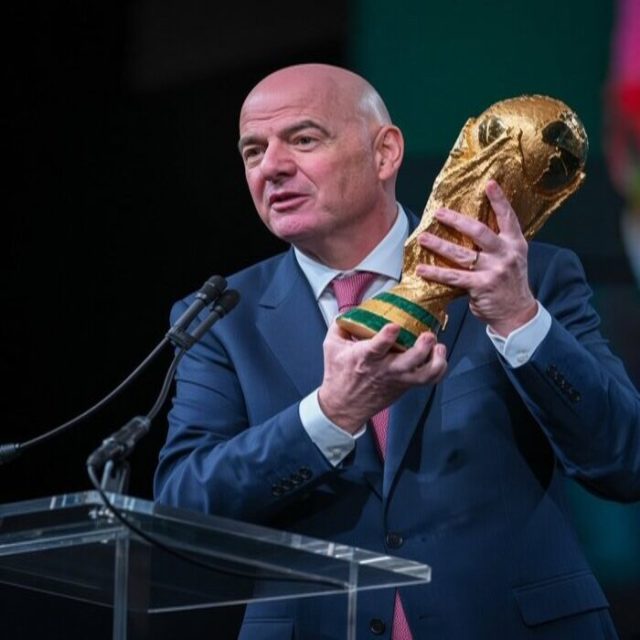
FIFA President Gianni Infantino has said Nigeria is not currently equipped to host the senior FIFA World Cup, but expressed confidence that the country could achieve the ambition in the future with significant investment in infrastructure.
Infantino made the remarks during an interview with ARISE News in Abuja on Monday, November 23, when asked whether Nigeria could host football’s biggest tournament.
“Today, no. But tomorrow, why not?” he responded, pointing to Nigeria’s resources, football passion and potential for development.
The FIFA president identified stadiums, hotels, airports and transportation networks as essential requirements for hosting the competition, stressing that substantial investment and international standards would be necessary.
“The key to hosting a World Cup is obviously the infrastructure, the stadiums, the hotels, the airports, transportation. And this is where the investment is really necessary,” he said.
Infantino also referenced facilities he visited during his stay in Nigeria, including the national training centre project in Abuja and the renovated Warri City Stadium in Delta State.
He described the Warri facility as impressive, although relatively small, and said the projects showed that Nigeria had the potential to make progress towards hosting major international competitions.
Rather than immediately targeting the senior World Cup, Infantino suggested that Nigeria could begin by hosting youth competitions before gradually building the experience and infrastructure required for larger tournaments.
Nigeria has previously hosted two major FIFA youth competitions: the 1999 FIFA World Youth Championship and the 2009 FIFA U-17 World Cup.
However, staging the senior men’s World Cup would require a much broader level of preparation, including modern sporting facilities, accommodation, efficient transport systems and adequate airport infrastructure.
Although Infantino’s comments offer encouragement to Nigeria’s long-term hosting ambition, his assessment makes clear that the country is not ready to stage the tournament at present.
The challenge for Nigeria is to translate its football passion and available resources into sustained infrastructure development capable of meeting FIFA’s requirements.
