


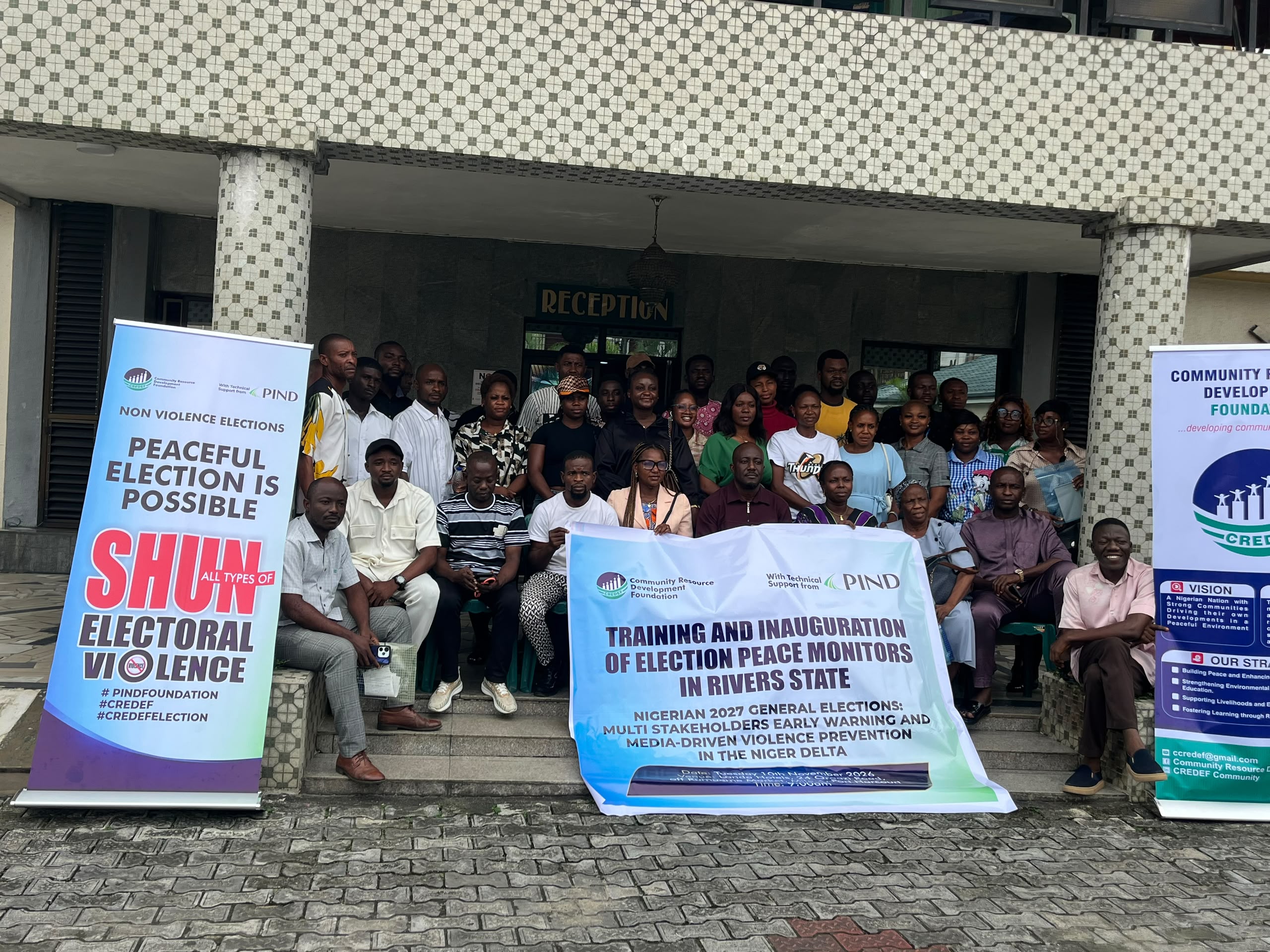
Civil Society Organisations have called for increased collaboration among relevant security agencies and timely information sharing to prevent electoral violence in Rivers State during the 2027 general elections.
Speaking at a roundtable for Peace Monitors on Tuesday, November 10, 2026, in Port Harcourt, the Executive Director of Community Resource Development Foundation, Dr Franklin Owaribo, stressed the need for proactive measures to gather real-time information and transmit it promptly to authorities for intervention.
According to him, CREDEF is a consortium member of a four-organisation initiative led by the PIND Foundation aimed at ensuring electoral peace in the Niger Delta, particularly in Rivers, Akwa Ibom and Delta states.
In Rivers State, CREDEF is leading the effort.
“The essence of bringing this together is actually to train peace monitors, people who will ensure that they get real-time information before, during, and after the 2027 elections,” Owaribo said. “We need information to be able to act proactively, and this information is going to be dependent upon people who are getting real-time data from the field.”
He explained that 40 monitors, five persons from each of eight identified hotspot local government areas, were trained based on research showing these areas had recorded the highest levels of electoral violence in the past.
Read Also: rivers-govt-inaugurates-committee-for-statewide-tree-planting-initiative
The LGAs are Port Harcourt City, Obio/Akpor, Khana, Ikwerre, Emohua, Okrika, Ogba/Egbema/Ndoni and Oyigbo.
“These 40 people have become our ambassadors in the field to get information that can be cascaded to relevant authorities that will respond effectively to the violence,” Owaribo added.

Participants expressed confidence that the knowledge gained would enable them to contribute actively to peace before, during and after the elections.
They noted that strengthening early warning mechanisms remains key to promoting violence-free polls across the Niger Delta.
Gift Meluubari, Project Coordinator for Voices for Change and a peace monitor from Obio/Akpor Local Government Area, highlighted peace-building and conflict resolution as major takeaways.
“It made me understand that conflict can be intra; it can be personal, it can also be extended to others around,” she said. “One key thing I would take to my local government today is that we should find a better way to resolve conflict. We should not just look at the surface, but we should look deep, and we should make restitutions.”
She charged stakeholders to promote peace, noting that “nobody benefits from violence” and that vote-buying should not be used to create conflict.
Another participant, Kemka Emenike, said the training equipped monitors with skills in peacemaking, election monitoring, data collection and analysis, as well as personal security while reporting.
“The major part that distinguishes us is knowledge. I have the knowledge. I’ve been trained, and they are not trained,” he said.
“I’ve been trained on how to secure myself while reporting effectively and what my information, given as data, can do for the peace of the nation and society at large.”
Emenike expressed hope that the 2027 elections would produce leadership capable of managing the state’s resources for the benefit of the people, particularly the youth facing unemployment.
The monitors pledged to deploy the skills acquired to support peaceful elections in their respective communities.
