


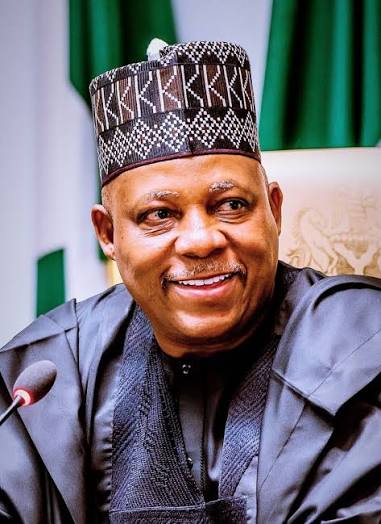
The stage was set. The world was watching. And Kashim Shettima, Nigeria’s Vice President, stood before the 81st United Nations General Assembly with the opportunity to speak truth to power. Instead, he chose silence. He chose evasion. He chose to strip Nigeria bare before the very nations that have exploited, colonized, and continue to dominate the African continent and its diaspora. He danced naked, not with pride, but with the shame of a conquered servant desperate to please his masters.
This is not hyperbole. This is the sobering reality of a government that has traded its moral authority for the illusion of protection.
One year ago, on this same global stage, Shettima spoke with a clarity that now feels like a distant memory. In September 2025, he declared that Palestinians are “not collateral damage” but human beings entitled to dignity and freedom. He endorsed a two-state solution. He condemned violence against civilians. He positioned Nigeria as a nation with a conscience, a nation that understood oppression because it had endured it. The words were not perfect, but they were present. They mattered.
This year, those words vanished. Palestine, Gaza, the two-state solution, all erased from Nigeria’s national statement. The silence was deafening. And it was deliberate.
The Muslim Public Affairs Centre was quick to note the betrayal. The phrase Nigeria had spoken “without stuttering and without doubt” just twelve months earlier had been surgically removed from the nation’s diplomatic vocabulary. Why? What changed? The answer is as ugly as it is obvious.
Nigeria is not silent on Palestine because it suddenly believes Israel’s cause is just. Nigeria is silent because it is terrified of Washington. The Tinubu government is fighting for its life in American courts, battling to prevent the release of documents that could destroy the president’s political future. Every diplomatic calculation, every omitted sentence, every swallowed condemnation is calibrated to avoid antagonizing the one power that holds the keys to those records.
This is the danger we have warned about. A government whose president is desperately trying to hide his records in a foreign court loses the independence of action. It cannot speak truth to power because it is itself in the grip of a power far greater than its own. When a nation’s foreign policy is dictated by the fear of what a foreign prosecutor might reveal, that nation is no longer sovereign. It is conquered.
The courting of Israel is not the cause of Nigeria’s silence. It is a symptom of the same disease. The Minister of State for Foreign Affairs, Bianca Odumegwu-Ojukwu, met with Israeli Ambassador Michael Freeman earlier this year to discuss defence cooperation, border security, and intelligence sharing. Israel pledged sixty fully equipped ambulances. A bilateral defence agreement is in the works. These deals are real. But they are not the reason Shettima stood mute. They are part of the same desperate scramble for cover, the same instinct to cling to any ally who might whisper a good word in Washington’s ear.
The betrayal does not end with Palestine. Shettima’s speech this year contained a catalogue of omissions that should trouble every African, every Nigerian, every person of conscience who believes that the continent’s voice matters.
Sudan, a nation bleeding, its people slaughtered, its women raped, its children starved, received only a passing mention, buried in a list of security concerns. No moral outrage. No naming of perpetrators. No demand for accountability. The same restraint applied to the Sahel, to the Democratic Republic of Congo, to the countless conflicts ravaging the continent. Shettima spoke of “propaganda shielding aggressors from justice” without identifying a single aggressor. It was a masterclass in saying nothing while appearing to say something.
The “UN80 Initiative,” endorsed by President Tinubu just one year ago, was abandoned. The social register, the fuel subsidy removal’s human cost, the suffering of ordinary Nigerians, all absent. What remained was a sterile recitation of macroeconomic indicators, a performance designed to reassure international investors rather than to serve the Nigerian people.
But the deepest wound, the one that cuts across the entire Global South, is the Palestinian omission. Africa has a history. A history of chains. A history of ships. A history of lands stolen and peoples dispersed. The African diaspora, scattered across the Americas and Europe, knows what it means to be rendered invisible, to have their suffering ignored, to be told that their pain is “complicated” and their demands “unrealistic.”
When Nigeria, the most populous Black nation on earth, a nation that has contributed troops to peacekeeping missions from Liberia to Darfur, a nation that has historically been a voice for the oppressed, stands silent on Palestine, it is not just a diplomatic choice. It is a betrayal of the very spirit that made Africa the moral conscience of the world during the anti-apartheid struggle. And it is a betrayal committed not for principle, but for the personal survival of one man and his family.
Marcus Aurelius, the Stoic emperor, wrote that “the happiness of your life depends upon the quality of your thoughts.” If that is true, then the quality of Shettima’s thoughts at UNGA 81 reveals a government whose happiness depends not on virtue but on survival. And not its own survival, but the survival of its leader’s legal shield.
Epictetus taught that “no man is free who is not master of himself.” Nigeria, under this government, is not master of itself. It is a hostage.
The ancient philosophers understood this intimately. Plato, in his Republic, warned that in a democracy, the insatiable pursuit of individual desires, wealth, power, and reputation eventually leads to the erosion of social cohesion and the rise of tyranny. The citizens become “so sensitive that the least vestige of restraint is resented as intolerable.” The struggle between the rich and the poor degenerates into class warfare, and out of that chaos, a strongman emerges. But that strongman is never truly free. He is enslaved by the very forces that elevated him.
So it is with Nigeria. The government has traded its soul for a seat at Washington’s table. It has traded Africa’s heritage of liberation for a moment of diplomatic convenience. It has traded the blood of Palestinians and the tears of Sudan for the blessing of a superpower that views the continent not as a partner but as a pawn.
Shettima stood at the podium of the United Nations and chose to dance naked. He stripped Nigeria of its dignity, its principles, and its voice. He stood before the world not as a representative of a great nation but as the servant of a frightened president who will do anything, say nothing, abandon anyone, betray everyone, to protect himself from a foreign court.
The question now is not whether this government has betrayed Nigeria, Africa, and the diaspora. That is settled. The question is what Nigerians will do about it. Because a nation that allows itself to be represented by a naked dancer at the world’s most important stage is a nation that has forgotten how to stand.
And a nation that has forgotten how to stand cannot walk toward freedom.
Mohammed Bello Doka
