


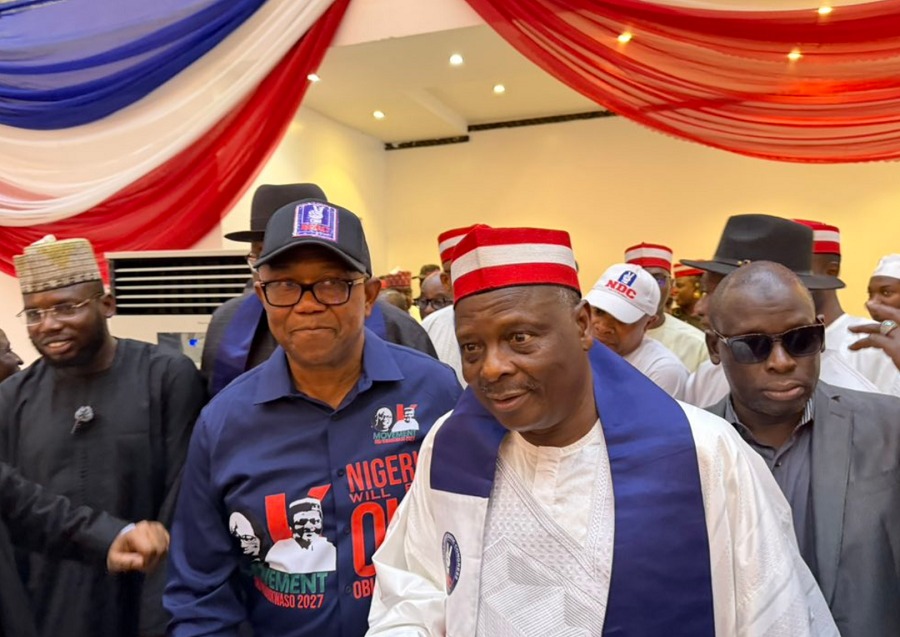
A fresh disagreement is brewing within the opposition Nigeria Democratic Congress (NDC) after the Obidient-Kwankwaso (OK) Movement rejected the party leadership’s attempt to disown a 59-member presidential campaign council the group had inaugurated.
The dispute has exposed a potentially significant fault line between the party and one of the grassroots movements backing its presidential ticket for the 2027 general election.
The OK Movement, which supports NDC presidential candidate Peter Obi and his running mate, Rabiu Kwankwaso, insists its organisational activities do not require the personal approval of the party’s national chairman or any other individual within the NDC.
Its position followed a warning from NDC national chairman, Cleopas Moses, that the party had no connection with the campaign council the group unveiled last Thursday.
At the centre of the disagreement is the 59-member council, which named John Ughulu as national director-general and Saadatu Sani as national secretary.
In a statement on Saturday, Moses dissociated the NDC from the council and urged the public to disregard it, arguing that the party’s candidates were subject to its authority and discipline, and that only party leadership could constitute and announce a presidential campaign council.
The OK Movement responded swiftly. Sani accused Moses of making “unguided assertions” and urged him to familiarise himself with the party’s constitution.
While acknowledging the constitutional supremacy of political parties within their own spheres, she maintained that the movement remains an independent organisation with its own leadership and internal processes.
“The OK Movement does not require the personal validation or approval of any individual before exercising its legitimate organisational functions in accordance with established processes,” she said.
The disagreement extends beyond the fate of one campaign council, touching on how much autonomy grassroots movements should have when they claim substantial membership and structures outside a party’s formal hierarchy.
Read Also: net-win-nawoj-seek-peaceful-political-dialogue-ahead-of-2027-elections
Sani said the OK Movement, which claims a nationwide network of roughly 2.5 million registered members and coordinators, would continue campaigning for Obi, Kwankwaso and other NDC candidates in constituencies where it has resolved to support them.
She said the movement was built from the grassroots, is not dependent on sponsorship from any individual or office holder, and is not seeking political appointments as a condition for its support.
Sani described the OK Movement as more than an election-season support group, saying it has its own philosophy, structure and long-term political vision. “We speak for Nigerians who are demanding a better political system, economic opportunity, accountability and a government that places citizens at the centre,” she said.
The NDC emerged as the vehicle for the Obi-Kwankwaso ticket following negotiations among opposition politicians and groups seeking to challenge the ruling All Progressives Congress (APC), bringing together figures and support groups with differing histories, structures and interests.
The latest dispute offers an early sign of the organisational challenges the coalition may face as the 2027 election approaches, and suggests the relationship between the NDC’s formal structures and the grassroots movements backing its candidates may need clearer boundaries.
Sani also addressed allegations concerning Ughulu’s alleged involvement in the Lagos State primaries, saying the matter required clarification and defending the movement’s decision to stand by its members when their integrity is questioned, while stressing that it would not engage in personal attacks.
The movement called on Moses to withdraw what it considers defamatory statements and apologise to both the OK Movement and Ughulu.
“The OK Movement will not compromise its standards. The OK Movement will not surrender its independence.
The OK Movement will not be intimidated,” Sani said, adding that the movement’s principles, organisational independence, accountability and its long-term objectives for Nigeria remain non-negotiable.
With the 2027 election still months away, the dispute presents an early test of how the NDC will manage the competing structures and expectations within its broader support base.
