


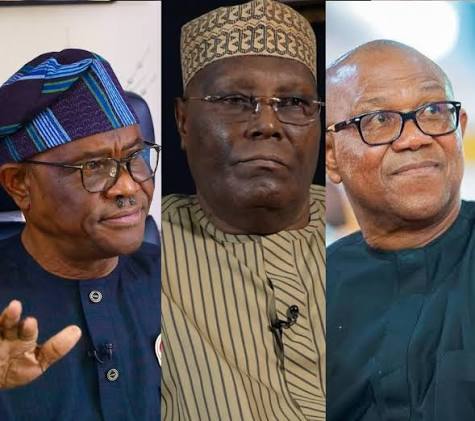
Nigeria has entered another election season, and, as expected, the political temperature is rising. Names are dominating conversations, alliances are shifting, old political wounds are being reopened and new friendships are being forged. President Bola Ahmed Tinubu is seeking another term, while former Vice President Atiku Abubakar and former Anambra State Governor Peter Obi are among those positioning themselves for the contest. FCT Minister Nyesom Wike, meanwhile, remains one of the most vocal actors in the unfolding political drama.
But somewhere in all of this noise is the Nigerian whose greatest political concern is not who defeats whom in 2027, but how to survive until then.
The 2027 election should be about the future of Nigeria, yet much of the political conversation is already becoming a contest of personalities and political arithmetic. Who controls which region? Who has the stronger structure? Who will defect? Who will form an alliance? Who will support Tinubu? Can Atiku and Obi work together? Where does Wike stand?
These are legitimate political questions, but they cannot be the only questions Nigerians ask.
The more important question is: what will any of these politicians do differently to make life better for the average Nigerian?
The coming election should therefore force candidates to answer difficult questions.
How will they create millions of productive jobs rather than temporary political appointments?
How will they make Nigerian businesses competitive?
How will they reduce the cost of food and transportation without creating another unsustainable subsidy regime?
How will they secure farms and communities so that farmers can return to their fields without fear?
How will they fix the power sector?
How will they improve public schools and hospitals?
How will they reduce corruption and waste in government?
How will they ensure that economic growth is reflected in household incomes?
These are the issues that should dominate campaign debates.
The electorate must also resist the temptation to see every political disagreement as a battle between heroes and villains. Nigerian politics is rarely that simple. Politicians who were opponents yesterday can become allies tomorrow, while today’s allies can become tomorrow’s rivals. The people, however, remain, and their problems remain.
That is why Nigerians should look beyond the political theatre of 2027 and demand something more substantial. Candidates should be asked what they intend to do about the economy, security, education, healthcare, electricity, employment and the cost of living. They should be required to explain not only what they will do, but how they will fund it and how Nigerians will measure their performance.
Ultimately, democracy is not about giving politicians power for its own sake. It is about using political power to improve people’s lives.
Tinubu, Wike, Obi and Atiku may dominate the headlines today, but none of them should become bigger than the country they seek to lead or influence.
The real protagonist of the 2027 election should be the Nigerian citizen.
The market woman, The farmer, The teacher, The civil servant, The entrepreneur, The unemployed graduate, The student, The pensioner, The young Nigerian struggling to build a future, their welfare must not become an afterthought in the race for power.
Nigeria has had enough elections built around personalities. What the country desperately needs now is an election built around performance, competence, ideas and accountability.
In 2027, Nigerians should not merely ask, Who can win?
They should ask the more important question: Who can govern—and who has a credible plan to make our lives better?
That is the debate Nigeria needs.
