


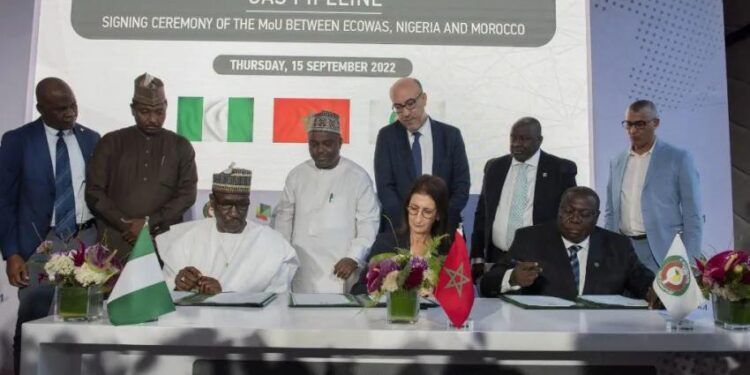
Nigeria and Morocco are on the verge of making strides towards the $25 billion Nigerian-Moroccan Gas Pipeline Project, where both countries have already prepared to seal an important inter-governmental agreement in 2026.
The agreement is anticipated to give legal recognition to all the political and regulatory decisions for the long-awaited project across continents.
The planned African Atlantic Gas Pipeline, which stretches for up to 6,900 kilometres from Nigeria via various countries of Western Africa to Morocco, with further shipment to Europe, will involve 13 countries, supported by the Economic Community of West African States (ECOWAS).
The agreement, according to the officials, will improve coordination between participating countries and help form a joint supervisory agency for the project.
Designed to be developed in phases, the pipeline will allow early delivery of economic benefits rather than waiting for a single final investment decision. At full capacity, it is expected to transport up to 30 billion cubic metres of gas annually, supporting domestic use in Morocco and exports to Europe.
A joint venture between the Nigerian National Petroleum Company Limited (NNPC) and Morocco’s ONHYM will drive execution, financing, and construction of the project.
Although investor interest remains strong, funding is yet to be finalised, with plans to combine equity and debt financing.
The pipeline is expected to boost electricity generation, support industrial growth, and deepen regional integration. If completed, it could enhance energy security and position West Africa as a major player in the global gas market.
