


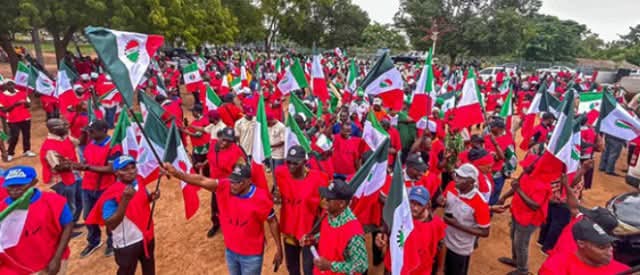
Nigerian labour unions and government workers are demanding an immediate review of the national minimum wage, arguing that the current ₦70,000 rate is no longer sustainable due to rampant inflation.
This call comes as several states have already increased their minimum wage above the federal benchmark. In July 2024, President Bola Tinubu signed a new National Minimum Wage Bill into law, raising the wage from ₦30,000 to ₦70,000.
However, workers and union leaders say the economic reality has quickly eroded the value of this increase. The workers who spoke with the News Agency of Nigeria, NAN, said the rising costs for food, transportation, housing, and other necessities have made it difficult for them to meet their basic needs.
Benson Upah, Acting General Secretary of the NLC, stated that the current wage is “not sustainable under the present economic situation” and that workers are under “immense pressure.”
He confirmed that the union has engaged the Federal Government, FG, on the matter and hopes for a swift resolution through dialogue, but warned that industrial action remains an option if negotiations fail.
Several state governments have taken proactive measures to address the economic hardship faced by their workers, setting a precedent that federal workers and unions want the national government to follow.
Imo State raised its minimum wage to ₦104,000 in August 2025 while Lagos State increased its wage to ₦85,000 in October 2024, with a plan to raise it to ₦100,000 in 2025.
Also, Rivers State approved a ₦85,000 minimum wage in October 2024. Bayelsa, Niger, Enugu, and Akwa Ibom states set their minimum wages at ₦80,000, while Ogun and Delta states implemented a ₦77,000 wage.
Similarly, Benue and Osun states have their wages at ₦75,000, while Ondo State sets its wage at ₦73,000. Shehu Mohammed, President of the Association of Senior Civil Servants of Nigeria (ASCSN), called the states’ actions a “wake-up call” for the federal government.
He noted that their initial demand during negotiations was a “living wage” of ₦250,000, arguing that ₦70,000 can barely cover a worker’s transport to the office, let alone sustain a family.
Also see: SERAP Sues RMAFC Over Proposed Salary Increase for Politicians
Federal workers also voiced their concerns. A civil servant, Kemi George, described the situation as frustrating, stating that after paying for transport and food, “nothing is left” for rent and school fees.
Another worker, Obi Chimaobi, emphasised that the current wage is unbearable and “you are already in debt before the month even ends.”
Workers believe that a wage increase is not just about appeasing unions but is also about restoring dignity and boosting the economy.
Jeremiah Okon suggested that if states with less revenue can make these adjustments, the federal government should follow suit, proposing a minimum wage of at least ₦150,000. He added that higher wages would stimulate the economy by increasing consumer spending.
