


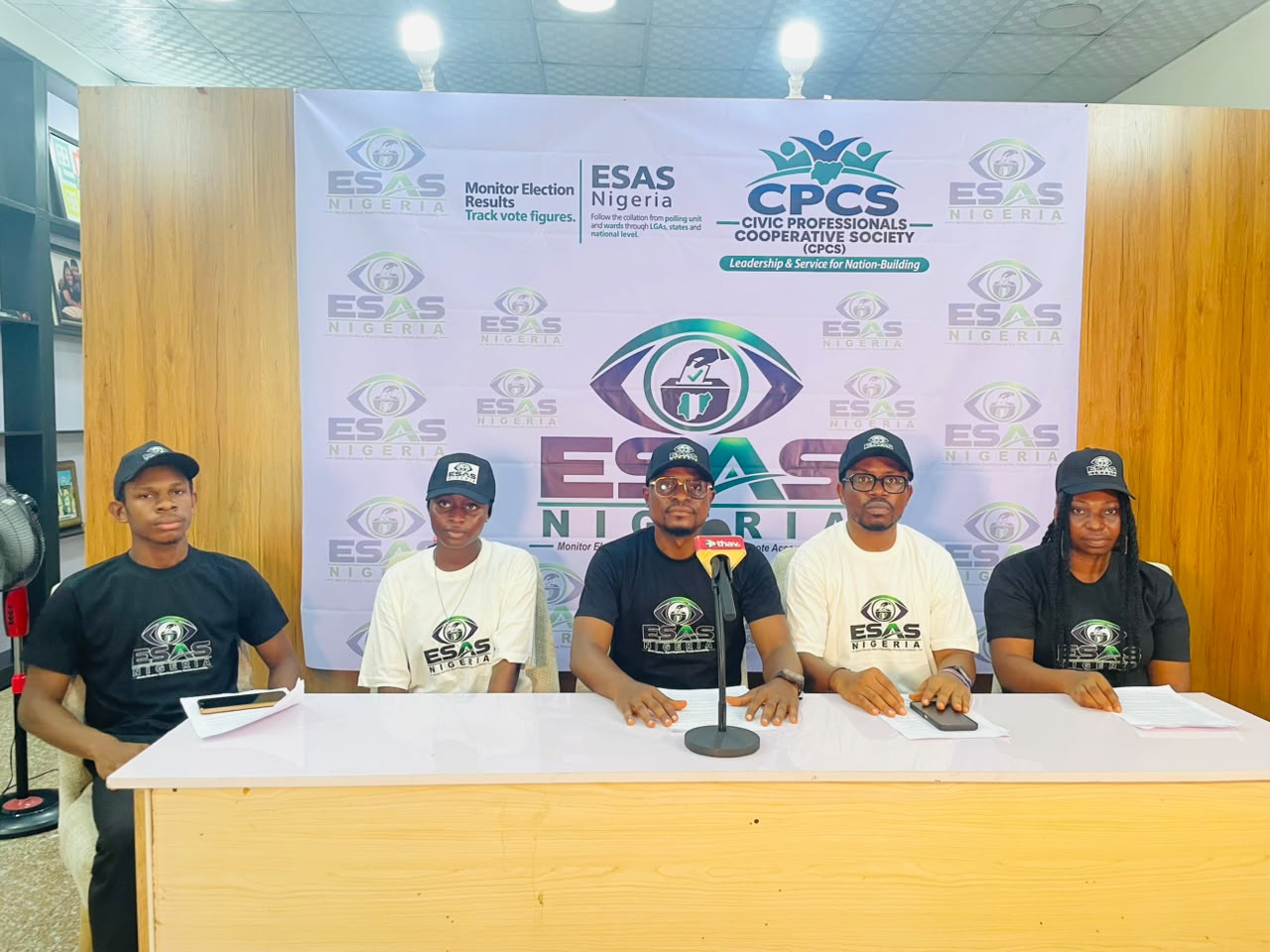
The Election Surveillance and Accountability System (ESAS) Nigeria says it has developed a technology that will detect discrepancies in election results uploaded to the Independent National Electoral Commission’s (INEC) Result Viewing Portal (IReV) ahead of the 2027 general elections.
The organisation said the technology would enable Nigerians to monitor election results in real time, verify figures uploaded from polling units and identify irregularities before the final announcement of results.
General Secretary of ESAS Nigeria, Bob Oyet, disclosed this while briefing journalists in Port Harcourt on Thursday, November 26, 2026.
Oyet explained that the technology would subject every Form EC8A uploaded to the IReV portal to public scrutiny and automatically check the results against INEC’s electoral guidelines.
He said the system would analyse uploaded result sheets, validate the figures, tabulate votes and identify discrepancies, thereby reducing the burden of manually monitoring results from polling unit to polling unit.
According to him, the technology would also preserve evidence of uploaded results, including cases where an earlier result is deleted and replaced with another document.
“Our system is an evidential system. If a result is uploaded to the IReV portal and subsequently deleted and another one uploaded to replace it, we will have a copy of the original result,” he said.
Oyet stressed that ESAS would not sanction INEC but would provide evidence that citizens, political parties and other organisations could use to challenge electoral irregularities through appropriate channels.
He maintained that the objective was to expose discrepancies early enough to enable stakeholders to raise objections before results progressed to higher levels of collation and announcement.
The ESAS General Secretary also called on INEC to open its electoral processes to independent scrutiny, particularly the voters’ register and IReV portal, to rebuild public confidence in the commission.
He expressed concern over the declining confidence in Nigeria’s electoral system since the 2023 general elections, citing controversies surrounding the voters’ register and questions about the transparency of electoral processes.
Oyet said ESAS was a non-partisan, citizen-driven initiative established to promote transparency, accountability and public confidence in Nigeria’s electoral process.
He urged INEC to provide comprehensive guidelines for its November 28 mock election exercise, including clear information on eligibility, observers’ responsibilities and the procedures for accessing relevant electoral information.
He also called on the commission to permit independent audits of the voters’ register and IReV system while ensuring that legitimate votes are protected.
Speaking, ESAS Nigeria’s Contact and Mobilisation Officer, Engr. Kelvin Mavimus, said the organisation would deploy different broadcast channels, including collaborations with online platforms, television and radio stations, to ensure that Nigerians could monitor the electoral process as it unfolds.
Mavimus maintained that INEC’s constitutional responsibility was to conduct elections and announce results, not to determine their outcomes.
He said the ESAS technology would also provide an automated collation platform capable of processing results uploaded from polling units.
According to him, the system would read information contained in Form EC8A, validate the figures against established electoral criteria, aggregate the votes and facilitate collation on the ESAS platform.
He explained that the technology would address challenges associated with the manual collation of results, particularly at the ward level, where stakeholders have called for the publication of Form EC8B, the ward collation result sheet, on the IReV portal.
Mavimus said the system was designed to give Nigerians access to real-time electoral information without requiring the deployment of human observers to every polling unit.
