


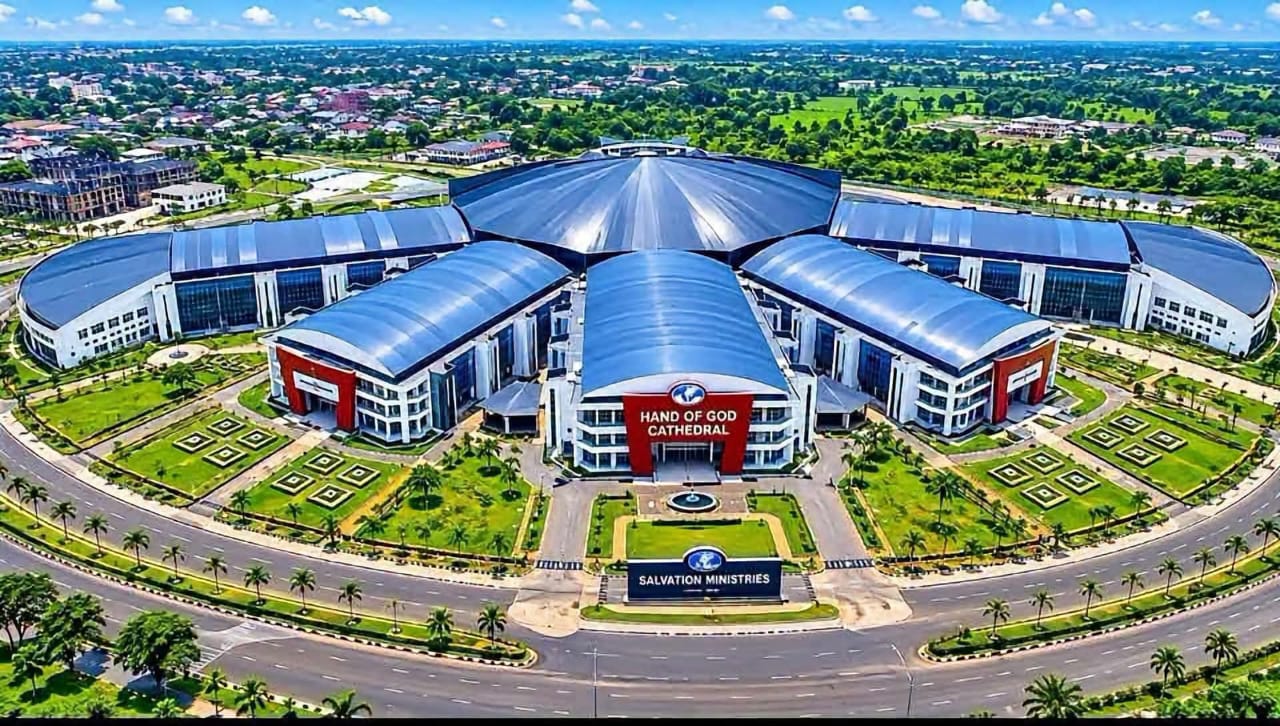
Ten days after its official dedication, the Hand of God Cathedral in Port Harcourt continues to attract attention, with its remarkable size, architectural design and religious significance keeping it in conversations beyond the church community.
The massive auditorium, which belongs to Salvation Ministries founded by Pastor David Ibiyeomie, was officially dedicated on Friday, November 6, 2026, at Igwuruta along Port Harcourt Airport Road. The ceremony was led by Bishop David Oyedepo, founder of Living Faith Church Worldwide, and attracted several prominent Christian leaders and worshippers.
With a reported seating capacity of 120,000, the cathedral has become one of the most talked-about religious developments in Rivers State. Its scale has also placed Port Harcourt in conversations about some of the world’s largest Christian worship centres.
Beyond its capacity, the building’s design has contributed to the attention it continues to receive. The structure features five wings arranged to resemble an open hand, with a central auditorium forming the palm. Covering approximately 56,130 square metres, the eight-floor complex represents years of construction and investment by the ministry.
Regular Sunday services commenced at the new cathedral on November 8, two days after its dedication, marking the beginning of a new phase for the ministry.
However, the attention surrounding the building goes beyond its religious purpose. While many have celebrated it as a major achievement for Port Harcourt and the Christian community, its size and scale have also generated wider conversations about the place of massive religious structures in a society facing several economic and developmental challenges.
The cathedral’s impressive scale has also raised questions about the cost of such a massive religious project, particularly at a time when many Nigerians are struggling with economic hardship.
Some have questioned whether the enormous resources invested in the construction could have been channelled towards supporting vulnerable families, improving access to education or providing other forms of social assistance. From this perspective, the project has reopened conversations about the social responsibilities of religious institutions, especially in a country where many people continue to battle poverty.
On the other hand, supporters argue that the cathedral provides the space needed to accommodate a growing congregation, allowing more people to worship together without the limitations of capacity. They also see it as a long-term investment in the ministry’s growth and religious activities. Ultimately, the debate reflects two different perspectives on the role of large religious projects: whether their value should be measured primarily by their spiritual purpose or also by the immediate social needs they could help address.
The Hand of God Cathedral has undoubtedly added another landmark to Rivers State. But beyond its impressive structure and reported capacity, its lasting significance will also depend on the role it plays in the lives of worshippers and the wider community.
