


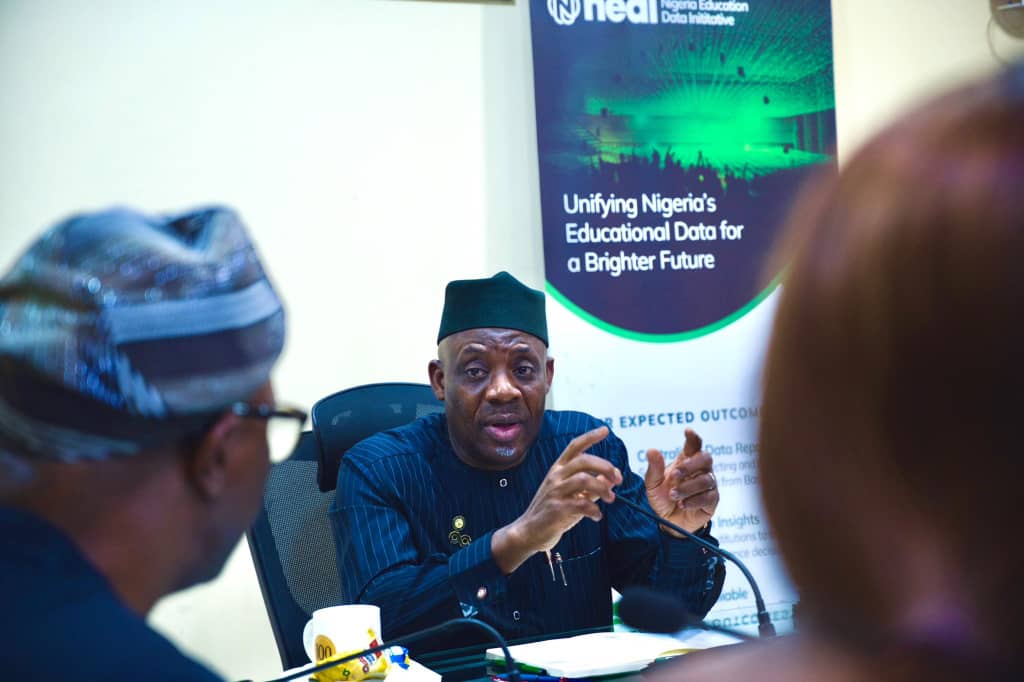
The Federal Government and the National Bureau of Statistics (NBS) are set to strengthen data collection on Nigeria’s education sector through a new digital education data platform aimed at improving planning and policy decisions, including accurate tracking of out-of-school children.
In a statement issued by the Minister of Education, Dr. Tunji Alausa, the initiative followed a meeting between the ministry and Prince Adeyemi Adeniran, Statistician-General of the Federation and Chief Executive Officer of the NBS, where both parties discussed expanding the use of education data for national development.
The statement explained that the collaboration builds on existing education data infrastructure developed by the Federal Ministry of Education, including the Nigeria Education Data Infrastructure (NEDI) and the Digital National Education Management Information System (D-NEMIS).
It noted that the D-NEMIS platform has digitised the Annual School Census, which was previously conducted manually across the country.
The platform collects school-level data across states and local government areas, including the number of public and private schools at primary and secondary levels, number of teachers, classrooms, laboratories, and Water, Sanitation and Hygiene (WASH) facilities.
According to the statement, the digitised system is designed to support evidence-based decision-making and improve the quality of education planning nationwide.
As part of the collaboration, the NBS will work with the Ministry of Education to conduct a nationwide household survey to generate accurate data on out-of-school children across all 36 states and the Federal Capital Territory.
It added that the survey will explore improved data mapping methods, including approaches previously tested in Kaduna State to verify out-of-school figures.
The statement also disclosed that the NBS has deployed eight statisticians to work directly with the NEDI team to support data aggregation, analysis, and policy planning.
It said the partnership reflects a broader shift toward evidence-based governance aimed at improving education outcomes and strengthening national planning through reliable data.
