


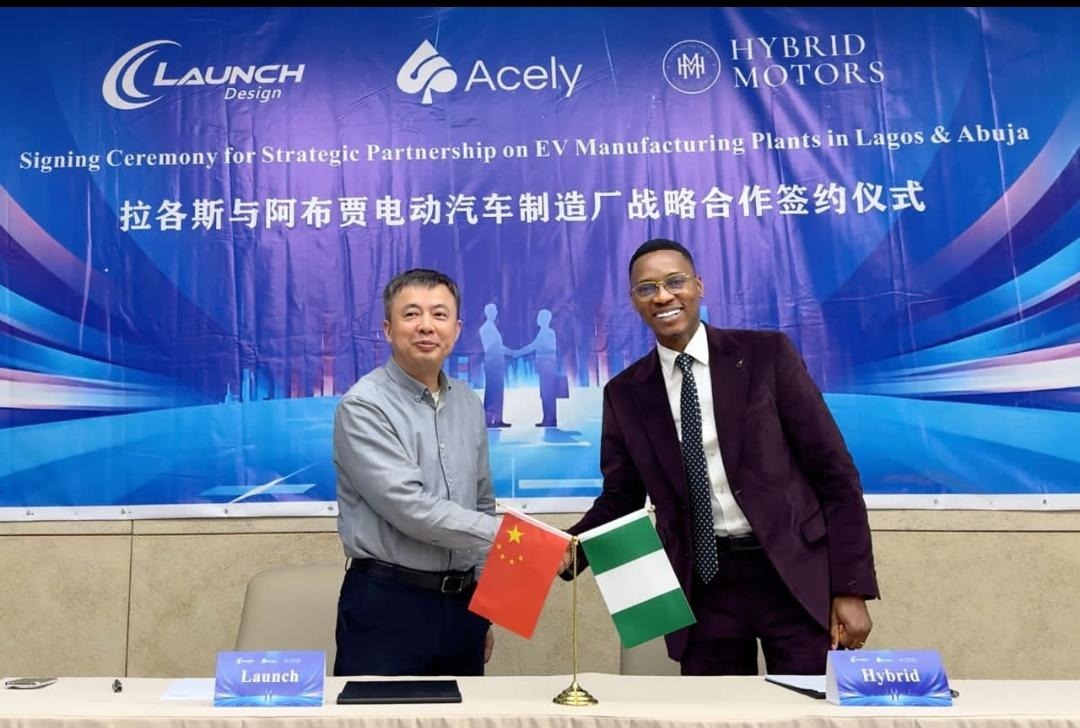
Nigeria’s push into electric vehicle manufacturing has received a major boost following a new partnership between Hybrid Motors Nigeria and Launch Design Shanghai to establish electric vehicle production plants in Lagos and Abuja.
The agreement, signed in Shanghai on May 8, 2026, is expected to accelerate local automobile production while supporting Nigeria’s transition toward cleaner and more sustainable mobility solutions.
At the centre of the partnership is “Acely,” a locally developed vehicle brand created by Hybrid Motors Nigeria specifically for Nigerian roads, terrain, and driving conditions. The companies say the project combines local market understanding with international automotive engineering expertise to create vehicles that meet global standards while remaining tailored to local realities.
Speaking during the signing ceremony, Chief Executive Officer of Hybrid Motors Nigeria, Jubril Arogundade, described the collaboration as a landmark step for the country’s automotive industry.
According to him, the partnership goes beyond vehicle production and represents a broader vision to build a sustainable automotive ecosystem within Nigeria.
“This partnership is more than a business agreement; it is a commitment to building Nigeria’s automotive future,” Arogundade said.
He added that the Acely brand demonstrates that high-quality vehicles can be designed, assembled, and produced locally while benefiting from world-class engineering support through the collaboration with Launch Design Shanghai.
On his part, Chief Executive Officer of Launch Design, Wang Xun, said the agreement offers an opportunity to contribute to the growth of Africa’s automotive manufacturing sector.
He noted that combining Launch Design’s engineering capabilities with Hybrid Motors Nigeria’s understanding of the local market creates a strong foundation for long-term success.
Under the arrangement, both companies plan to establish manufacturing facilities in Lagos and Abuja with a combined annual production capacity of 70,000 vehicles when operations reach full scale.
The Lagos plant, expected to produce up to 50,000 units annually, will be located along the Lekki-Epe corridor and serve as the primary assembly and production centre. Its location near the Lekki Deep Sea Port is expected to strengthen export opportunities to neighbouring West African countries including Ghana, Benin, Togo, and Côte d’Ivoire.
The Abuja facility, which will operate within the Free Zone Business Area of Centenary Economic City, is projected to produce 20,000 units annually. It will function as both a manufacturing and technology hub serving Northern Nigeria and nearby Sahel markets.
According to the companies, operating two facilities in different regions will help reduce logistics costs, improve operational efficiency, and create jobs across multiple parts of the country.
The Acely vehicles will focus on energy efficiency, advanced automotive technology, and local assembly while gradually incorporating electric and hybrid propulsion systems aligned with global sustainability goals and Nigeria’s clean energy ambitions.
Industry analysts believe the initiative could strengthen Nigeria’s automotive value chain by encouraging local component production, technology transfer, and skills development within the sector.
The project is also expected to reduce the country’s dependence on imported vehicles, ease pressure on foreign exchange demand, and position Nigeria as a regional manufacturing hub for automobiles.
Both companies noted that the initiative supports the Federal Government’s National Automotive Industry Development Plan (NAIDP), which aims to increase local vehicle production and attract investment into the sector.
Describing the agreement as a turning point for Nigeria’s transportation future, Arogundade said the Lagos and Abuja facilities would serve complementary markets while laying the foundation for a competitive and sustainable mobility industry in the region.
