


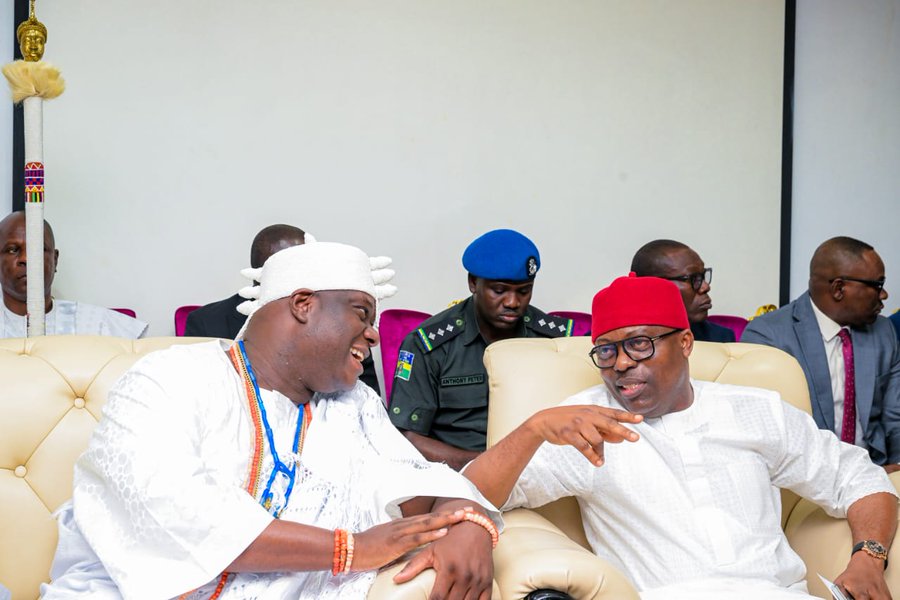
Rivers State Governor, Siminalayi Fubara, on Thursday expressed support for President Bola Tinubu’s re-election bid ahead of the 2027 presidential election, saying it would help sustain ongoing reforms and development efforts.
Fubara made the remarks while declaring open the meeting of the Southern Traditional Rulers Council in Port Harcourt, where he noted that continuity in leadership would strengthen the progress already being recorded under the current administration.
He told the gathering of monarchs from the 17 southern states that Nigeria was “in capable hands”, adding that the federal government had made visible strides in economic recovery and infrastructure delivery, including key projects such as coastal road development, despite existing challenges.
The governor argued that stability in leadership remained important for national progress, stressing that it was not in the country’s interest to “change the goalposts in the middle of the game”.
He also called for stronger cooperation among stakeholders in the region, urging southern leaders to remain united in pursuit of shared development goals.
According to him, the decision of traditional rulers to converge in Rivers State reflected the state’s peaceful environment and its readiness to host important national engagements.
Fubara further maintained that Rivers State remained calm and open to initiatives aimed at promoting unity, peace, and development across the country.
He added that strengthening southern unity was essential for broader national progress under Tinubu’s leadership.
Meanwhile, the Ooni of Ife, Oba Adeyeye Enitan Ogunwusi, who chairs the Southern Traditional Rulers Council, said the meeting was convened to deepen unity and promote peace across the region.
He described the council as a reflection of Nigeria’s cultural diversity, noting that more than 400 dialects are spoken across the southern states, which he said highlighted the strength of unity in diversity.
The Ooni explained that the Port Harcourt gathering was the fourth in the series, following earlier meetings held in Imo, Ogun, and Lagos states.
He added that the platform allowed traditional rulers to exchange ideas on shared values and collective interests, while also contributing to discussions on national security and economic stability.
According to him, the council also aimed to support government efforts in addressing the country’s pressing challenges, while emphasising that participation remained voluntary but important for regional and national development.
The meeting was attended by prominent traditional rulers from the South-South, South-East and South-West, including the co-chairman of the council, the Obi of Obinugwu, Eze Cletus Ilomuanya, and the Olubadan of Ibadan, Oba Rashidi Adewolu Ladoja.
