


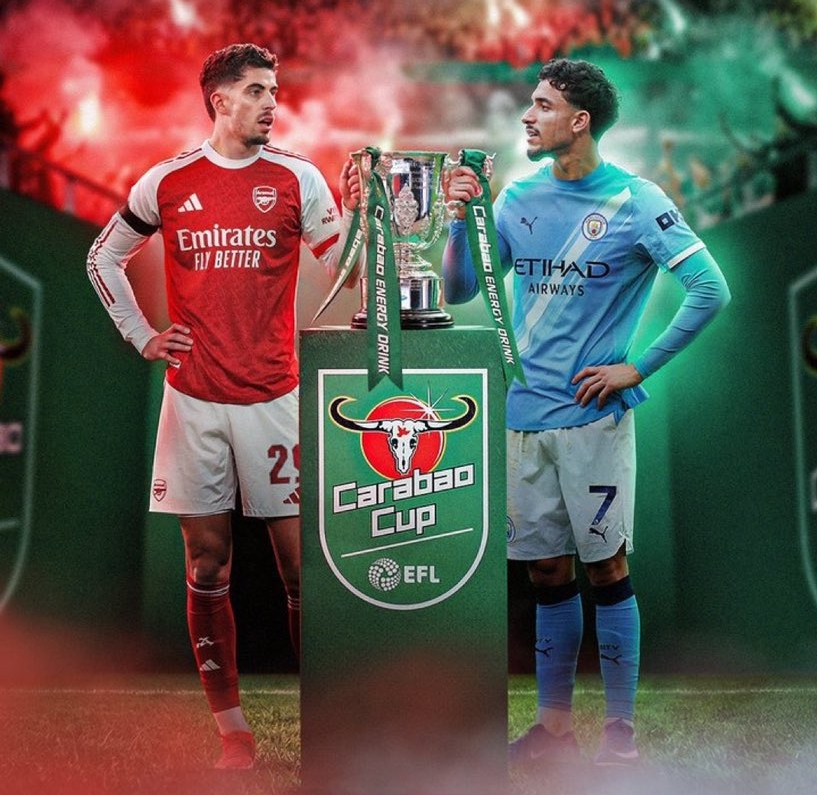
The stage is set at Wembley for a Carabao Cup final that feels less like a routine domestic showdown and more like a defining chapter in modern English football.
When Arsenal face Manchester City this Sunday, the weight of history, rivalry, and legacy will hang heavily over the contest.
This is not just about silverware. It is about a story that began eight years ago—and may now be reaching its dramatic conclusion.
Where It All Began
Back in 2018, when Pep Guardiola lifted his first major English trophy, it came at the expense of Arsène Wenger and his Arsenal side in the Carabao Cup final.
That victory symbolized more than a triumph—it marked a shift in power.
City’s dominance under Guardiola began to take shape, while Wenger’s long-standing reign at Arsenal was entering its final chapter.
After 22 years in charge, the Frenchman stepped down the following season, closing an era that had defined English football.
For many observers, that final at Wembley represented a turning point—the moment the old guard gave way to a new footballing empire.
The Student vs The Master
Fast forward to 2026, and the narrative has evolved into something even more compelling.
In the Arsenal dugout now stands Mikel Arteta—a former assistant to Guardiola at Manchester City. Having learned under one of the game’s most influential coaches, Arteta has returned to North London to rebuild Arsenal in a way that reflects both Wenger’s philosophy and Guardiola’s tactical precision.
What was once a mentor-student relationship has transformed into one of the Premier League’s most fascinating rivalries.
In 15 meetings between the two managers, Guardiola holds the edge with eight wins, compared to Arteta’s four, alongside three draws.
However, recent encounters suggest a narrowing gap, with Arsenal increasingly matching—and at times unsettling—City’s once-unstoppable machine.
Contrasting Momentum
Both teams arrive at Wembley under very different circumstances.
Manchester City’s season has been turbulent by their own high standards.
Their recent exit from the UEFA Champions League marked a third consecutive knockout-stage disappointment, raising questions about whether Guardiola’s all-conquering side is beginning to fade.
Off-field uncertainties, including the widely discussed 115 charges hanging over the club, have also added to a sense of instability surrounding the reigning giants of English football.
Arsenal, on the other hand, are surging with belief.
Their last Carabao Cup final appearance came in that 2018 defeat to City—a loss that has lingered in the club’s memory. Now, they return to Wembley with a squad matured, a system refined, and a manager determined to rewrite history.
A Final Beyond Trophies
Sunday’s clash is being framed by many as symbolic—a potential passing of the torch.
Guardiola’s Manchester City revolution reshaped English football, bringing an era of dominance built on tactical innovation and relentless success.
Yet, as this season unfolds, there is a growing sense that the cycle may be nearing its end.
At the same time, Arteta’s Arsenal represent renewal. Rooted in Wenger’s attacking philosophy but sharpened by Guardiola’s influence, they embody a new evolution of the game.
Full Circle at Wembley
From Wenger vs Guardiola… to Arteta vs Guardiola.
From the fall of one era… to the rise of another.
The Carabao Cup final at Wembley is more than a rematch—it is a moment that connects past and present, mentor and student, dominance and resurgence.
For Arsenal, it is a chance at redemption.
For Manchester City, it is an opportunity to reaffirm their legacy.
For football, it is a story of cycles—where nothing lasts forever, and every empire eventually faces its successor.
Sunday will not just produce a winner. It may define an era.
