


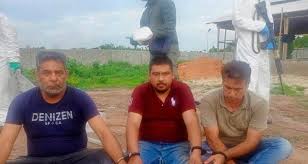
President Bola Tinubu has issued a national commendation to the National Drug Law Enforcement Agency (NDLEA) following the destruction of a major transnational drug cartel and the seizure of narcotics worth ₦480 billion.
The operation, which shut down the largest illegal methamphetamine factory ever discovered in Nigeria, led to the arrest of ten suspects, including three Mexican cartel specialists.
The details, confirmed by presidential spokesperson Bayo Onanuga on Thursday, May 21, 2026, follow a series of coordinated forest raids and urban stings by the NDLEA’s elite Special Operations Unit. Armed operatives stormed a highly sophisticated laboratory hidden deep inside the Abidagba Forest in Ogun State, catching the syndicate while they were actively processing chemicals.
According to NDLEA Chairman Buba Marwa, the laboratory was operated by a local organization in partnership with foreign technical experts. Security forces recovered 2,419.48 kilograms of crystallized methamphetamine, toxic solvents, and precursor chemicals valued at $362.9 million on the international market.
Follow-up operations in Lagos led to the arrest of the alleged kingpin, Anochili Innocent, at his home in Lekki, where investigators found the international passports of the foreign nationals.
Also see: President Tinubu Appoints Professor Segun Aina as New Jamb Registrar
The three Mexican nationals—identified as Martinez Felix Nemecto, Jesus López Valles, and Torrero Juan Carlos—were brought into the country specifically to oversee industrial-scale manufacturing.
President Tinubu warned that the sheer scale of the factory shows how international drug networks are trying to turn West Africa into a major production and transit hub for synthetic drugs bound for Europe and North America.
As of Friday morning, May 22, all ten suspects remain in federal custody as investigations expand into the network’s international banking channels.
While the presidency has called for vigilance across all communities, the focus for business and maritime analysts now shifts to Nigeria’s borders, where the entry of specialized foreign personnel and tons of industrial chemical components reveals a significant gap in regional supply-chain security.
