


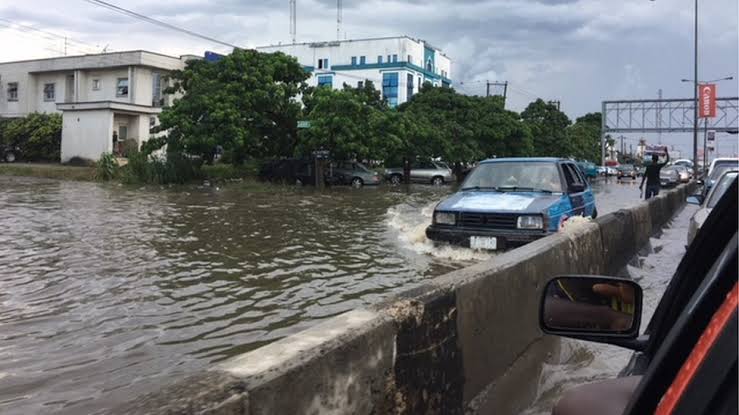
In Rivers State, flooding has become a recurring urban crisis that damages property, and raises urgent questions about planning, infrastructure, and environmental management.
Every rainy season, large parts of the city experience rising water levels that disrupt transportation, submerge homes, and force residents to navigate flooded streets. In low-lying and densely populated communities, the impact is often more severe, with families repeatedly relocating belongings and businesses suffering avoidable losses.
Environmental effects have long pointed to a combination of poor drainage systems, rapid urban expansion, and inadequate waste management as key drivers of the flooding pattern. In many areas, drainage channels are either blocked, undersized, or completely absent, making it difficult for rainwater to flow out efficiently.
Another major contributing factor is unregulated construction. As Port Harcourt continues to expand, wetlands and natural water-absorption areas are increasingly being replaced by buildings and paved surfaces. This reduces the land’s natural ability to absorb rainwater, forcing excess water into already overwhelmed drainage systems.
Climate variability also plays a role. Increasingly intense rainfall events have made flooding more frequent and unpredictable, placing additional pressure on a city infrastructure that is already struggling to cope.
Despite these challenges, solutions are both possible and well-documented. Environmental studies consistently emphasize the need for a combination of structural and policy-driven interventions.
Also see: Turaki’s PDP faction dares Wike on demolition of party secretariat
One of the most urgent steps is comprehensive drainage rehabilitation and expansion. Existing drainage systems need to be cleared, redesigned, and widened to handle heavier rainfall volumes.
Equally important is strict enforcement of regulations. This includes preventing construction on floodplains, protecting wetlands, and ensuring that new developments include proper drainage integration. Without enforcement, even well-designed infrastructure improvements risk being undermined by uncontrolled expansion.
Another critical solution lies in regular waste management and public sanitation systems. Blocked drains caused by plastic waste and debris remain one of the most visible contributors to flooding. Public awareness campaigns, combined with stronger municipal waste collection systems, can significantly reduce this problem.
In the long term, climate adaptation strategies will also be necessary. This includes better rainfall forecasting systems, early warning mechanisms, and emergency response planning to protect vulnerable communities during extreme weather events.
Flooding is no longer just an environmental issue, it is an economic and social one. It affects livelihoods, increases the cost of living, and deepens inequality between well-planned neighborhoods and underserved communities.
Addressing it will require more than temporary fixes or seasonal responses. It demands sustained investment, political will, and coordinated action between government agencies and citizens.
