


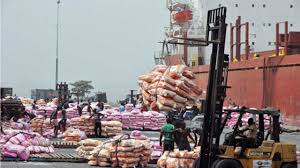
Nigeria imported three million metric tonnes of rice in 2018, which is 400,000 metric tonnes more than the quantity of the product imported in 2017, according to the 2018 United States Department of Agriculture World Markets and Trade Report.
The report also stated that Nigeria’s local rice production dropped from 2016 to 2018 compared to 2015.
The report is contrary to several claims by the Nigerian government that local rice production has increased while importation has dropped by up to 90%. The report, released in October, showed that since 2016, Nigeria had consistently milled 3,780,000 metric tonnes annually – a drop from 3,941,000 metric tonnes recorded in 2015.
It also stated that Nigeria recorded a higher consumption of rice in 2018 at 6,900,000 metric tonnes – an increase of 200,000 metric tonnes over the previous year.
The report also stated that global rice milling production for 2018 was 487,759,000 metric tonnes; a drop of 3,758,000 metric tonnes against the 491,517,000 metric tonnes recorded in 2017.
The report said, “Global rice production rose in October 2018, due to a higher crop yield in India, partially offset by a reduction in rice production in Egypt.
“This is nonetheless still lower than the prior year’s record. Global consumption by comparison, is marginally higher. Trade is largely unchanged as higher imports for the Philippines are mostly offset by lower imports for China.
” The report listed Brazil as the top producer and consumer of rice in the Western Hemisphere. A significant import market, Brazil also became a net exporter as in 2016.
Due to higher supplies in 2018, Brazil has reverted to its position as not only a net exporter but also as the top South American supplier to the global market.
“Brazil is forecast to export one million tons (milled basis) in 2018, declining to 850,000 tons in 2019 due to increased competition from Paraguay, Guyana, and Argentina.
“In the first nine months of the year, nearly half of Brazil’s exports have been paddy rice. This challenges U.S. export opportunities in Venezuela, Costa Rica, and Nicaragua.
“Brazilian milled rice is mostly shipped to Latin America, whereas broken rice is destined for West Africa,” the report added.
Formerly a net exporter, Egypt in 2018 recorded high rice imports as a consequence of strictly enforced limitations on land areas permitted for rice cultivation. Known for cultivating rice along the Nile region, Egypt set and enforced area restrictions as a result of concerns about water usage.
Its rice production in 2018/19 is said to be down by more than a third from the prior year, the lowest since 1998/99, as tight supplies have curtailed domestic consumption.
