


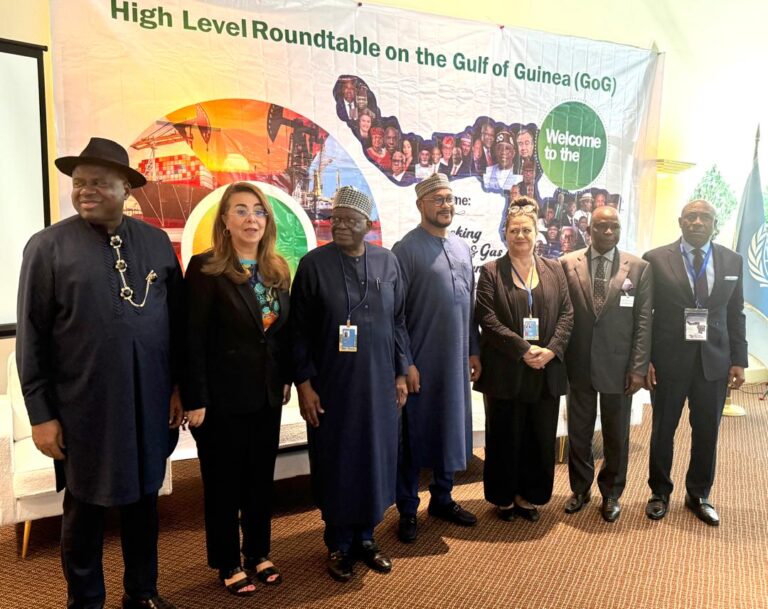
Bayelsa State governor, Douye Diri, has hailed the partnership between his administration and the United Nations Office on Drugs and Crime (UNODC), noting that the collaboration is producing measurable progress in addressing drug abuse and criminal activities within the state.
Speaking at the Nigerian Mission House in New York during a high-level dialogue on the Gulf of Guinea, held alongside the 80th United Nations General Assembly (UNGA), Diri emphasised that Bayelsa’s strategic location in the resource-rich Gulf provides both economic potential and security challenges.
The roundtable, themed “Unlocking Energy, Oil/Gas, Mineral Resources, Aviation and Maritime Opportunities in the Gulf of Guinea: A Roadmap for Peace and Security”, was organised by The New Diplomat, in partnership with the Angola-based Gulf of Guinea Commission.
Diri disclosed that the state, working with UNODC and the German government, had implemented a community-driven crime prevention initiative which, among other successes, facilitated the rescue of seven kidnapped victims in 2022.
He added that his administration is keen to strengthen such collaborations in order to secure Bayelsa’s maritime corridor.
Highlighting the economic promise of the Gulf of Guinea, the governor explained that Bayelsa, with Nigeria’s longest coastline of over 200 kilometres, is well placed for investments in tourism, energy, fisheries, ceramics, aviation, and maritime trade.
“The Gulf of Guinea anchors nearly 60 per cent of Africa’s oil production, …with proven reserves of oil and gas that are vital to global supply chains,” he said.
While outlining his government’s reforms in security, including the establishment of the Bayelsa Community Safety Corps, reorganisation of local outfits, and deployment of surveillance technologies, Diri acknowledged that piracy and maritime insecurity remain pressing concerns requiring multilateral attention.
The Executive Director of UNODC, Ambassador Ghada Waly, underlined the Gulf’s importance as an African economic hub but cautioned that it has also become a major transit point for illicit trade and financial crimes.
She cited the 2024 Nigerian Corruption Survey, which revealed that over $40 billion was siphoned from the country in the last decade through illicit flows and embezzlement.
Also see: World News Day, NUJ Urges Journalists to Uphold Professional Standards
“Corruption opens the door for criminal networks to infiltrate the supply chain and erode the rule of law,” Waly warned, urging governments and partners to intensify efforts to counter these threats.
Convener of the event, former Nigerian Ambassador to Thailand, Oma Djebah, said the dialogue was aimed at fostering long-term partnerships between governments, the private sector, and development actors.
He disclosed that the proposed Gulf of Guinea Business Council (GoGBC) would serve as a platform for job creation, infrastructure growth and regional prosperity.
