


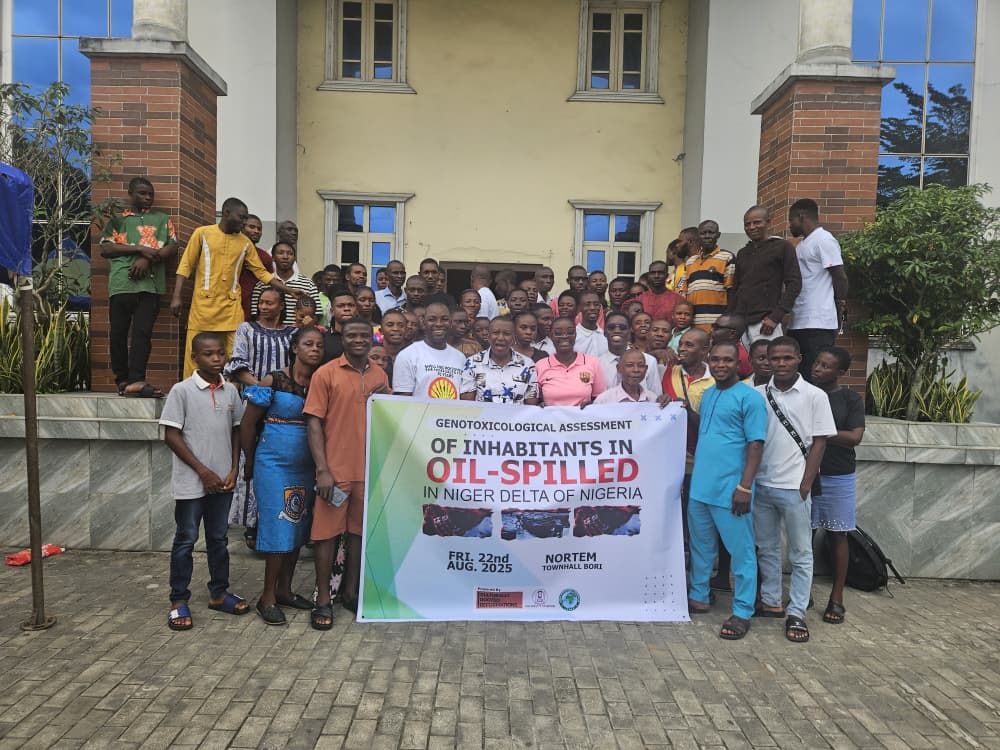
A genotoxicological assessment has commenced in Ogoni land to determine the level of genetic damage caused by decades of oil pollution to residents and other inhabitants of the Niger Delta.
The study, facilitated by the Lekeh Development Foundation and supported by Culturally Rooted Reformation (USA), is being conducted by researchers from the Department of Environmental Management and Toxicology, University of Benin.
Speaking during the assessment in Bori, Khana Local Government Area of Rivers State, on August 22, Professor Daniel Olorunfemi explained that the study focuses on the impact of pollutants on human DNA.
“Every living organism is made up of cells, and in each cell, the DNA carries the genetic material. If the integrity of the nucleus is compromised, it shows that an external factor, often pollution, has caused damage,” Olorunfemi said.
He noted that the team is using the micronucleus assay a genetic tool that detects abnormalities in cell division to identify signs of toxicity among volunteers.
“By examining saliva samples from the buccal cavity, we can assess how many normal cells remain and how many have been damaged due to pollution,” he added.
Professor Olorunfemi lamented that life has been “unfair” to inhabitants of the Niger Delta who suffer massive oil spills, contaminated farmlands, and poisoned waters, all of which enter the food chain.
Also Read: Ogoniland Stakeholders Protest HYPREP Board Shake-Up, Warn of Threat to Oil Resumption
Executive Director of Lekeh Development Foundation, Friday Nbani, said the exercise would provide critical insights into the level of genetic pollution among the Ogoni people.
“Earlier this year, our partners in the USA conducted a related study on fish from Bodo community rivers. They discovered genetic alterations in fish exposed to polluted water. The next step is to see how this affects humans who consume these fish and depend on the same environment for survival,” Nbani explained.
According to him, saliva samples collected from residents will be analyzed to determine the extent of genetic damage and establish a link between long-term oil pollution, human health, and food chain contamination in Ogoni.
“They gave us something to put in our mouth to collect saliva from the buccal cavity and see how it affects the genetic material of human.
“Of cos, we as Ogoni people have been eating the polluted fishes and the pollutant in the water that affect the genetic materials of the fishes,” Nbani said.
The results of the study are expected to be released in the coming weeks.
