


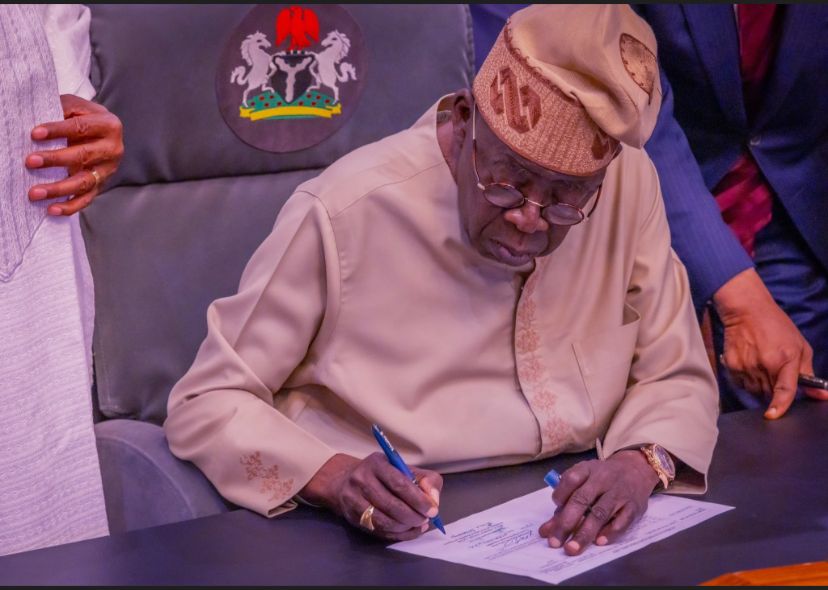
President Bola Ahmed Tinubu has signed an Executive Order aimed at strengthening Nigeria’s oil and gas revenue inflows to the Federation Account by removing what he described as unjustified and duplicative deductions permitted under the Petroleum Industry Act (PIA) of 2021.
According to a statement from the presidency issued by Special Adviser on Information and Strategy Bayo Onanuga, Tuesday, 18 February 2026, it was revealed by the order, that effective from February, government entitlements including royalty oil, tax oil, profit oil, profit gas, and related payments from Production Sharing Contracts, Profit Sharing Contracts, and Risk Service Contracts be remitted directly to the Federation Account by operators and contractors, bypassing previous retention mechanisms by the Nigerian National Petroleum Company Limited (NNPCL).
The measure is grounded in Section 44(3) of the 1999 Constitution (as amended), which vests ownership and control of mineral resources, including petroleum, in the Federal Government on behalf of the federation.
The presidency highlighted that the PIA had introduced structures enabling significant revenue losses through multiple layers of deductions.
These include NNPCL’s retention of 30% of Federation oil revenues as a management fee on profit oil and gas, in addition to retaining 20% of its profits for working capital and investments. The government argued that the separate 30% management fee is redundant given the existing profit retention.
Furthermore, NNPCL previously retained another 30% of profit oil and gas for the Frontier Exploration Fund under Sections 9(4) and (5) of the PIA, a provision criticised for potentially leading to inefficient spending on high-risk exploration amid pressing national needs in security, education, healthcare, and energy transition.
News: Tinubu Signs Electoral Act 2026 Amendment into Law
The order also addresses the Midstream and Downstream Gas Infrastructure Fund, funded partly by gas flaring penalties, noting overlap with the existing Environmental Remediation Fund under Section 103 of the PIA, which is administered by the Nigerian Upstream Petroleum Regulatory Commission (NUPRC) and supported by lessee contributions.
The presidency stated that these combined deductions divert more than two-thirds of potential revenues from the Federation Account, exceeding global industry standards and contributing to declining net oil inflows due to fragmented oversight.
President Tinubu’s directive seeks to eliminate overlapping provisions, enhance transparency, reduce leakages, and reposition NNPCL as a strictly commercial entity without influencing operating costs in ways that distort competition. It also aims to resolve concerns over NNPCL’s dual role as concessionaire and commercial operator under existing Production Sharing Contract frameworks.
The reforms, described as urgent for national budgeting, debt sustainability, economic stability, and citizen welfare, are intended to ensure federal, state, and local governments receive their full constitutional revenue shares for priority investments.
The announcement follows ongoing concerns about revenue shortfalls in the oil sector and aligns with broader fiscal efforts to maximize accruals to the Federation Account Allocation Committee (FAAC).
